How many surgical patients need reliable wound coverage like a nonwoven adhesive dressing roll after a procedure? The World Health Organization reports that 11% of patients undergoing surgery in low- and middle-income countries develop surgical site infections, while rates can reach 20% among women having cesarean sections. Although many factors affect these outcomes, dependable wound-care supplies remain an important part of postoperative care.
A nonwoven adhesive dressing roll gives healthcare facilities a flexible way to prepare wound dressings in different lengths and formats while maintaining consistent material and adhesive specifications.
Hospitals, surgical centers, outpatient clinics, distributors, and medical supply companies therefore need more than a low unit price when buying these products in large quantities. They need predictable quality, documented manufacturing controls, suitable packaging, dependable lead times, and a nonwoven adhesive dressing roll wholesale supplier that can maintain the same specifications across repeat orders.
What Is a Nonwoven Adhesive Dressing Roll?
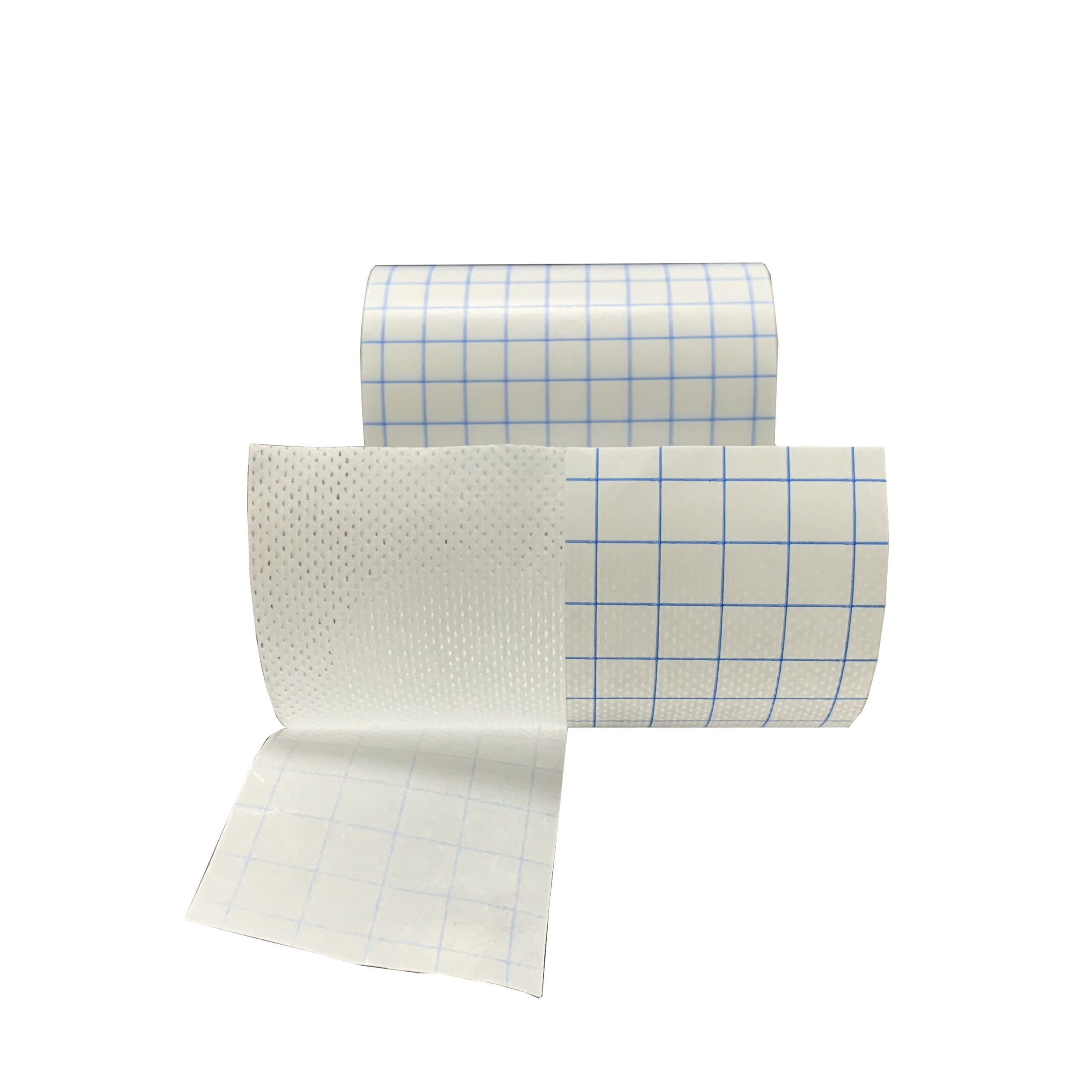
A nonwoven adhesive dressing roll is a wound-care product supplied in a continuous roll format rather than as individual pre-cut dressings. The roll normally combines a nonwoven backing, pressure-sensitive adhesive, absorbent pad or dressing area, and release liner. Depending on the product design, the absorbent area may be positioned at regular intervals so users can cut sections to the required length.
The main advantage of the roll format is flexibility. A hospital may need several dressing sizes in the same department, but maintaining every size as a separate stock-keeping unit can increase inventory complexity. A roll can support multiple applications while allowing staff to prepare a dressing according to the required wound or fixation area, provided the product is designed and labeled for that intended use.
The nonwoven adhesive dressing roll is different from ordinary adhesive tape. Medical dressing rolls are manufactured around wound-care requirements, which can include a soft backing, suitable adhesion, breathability, absorbency, easy removal, and compatibility with intended applications. The exact construction varies by manufacturer and product specification.
Basic Construction of a Nonwoven Adhesive Dressing Roll
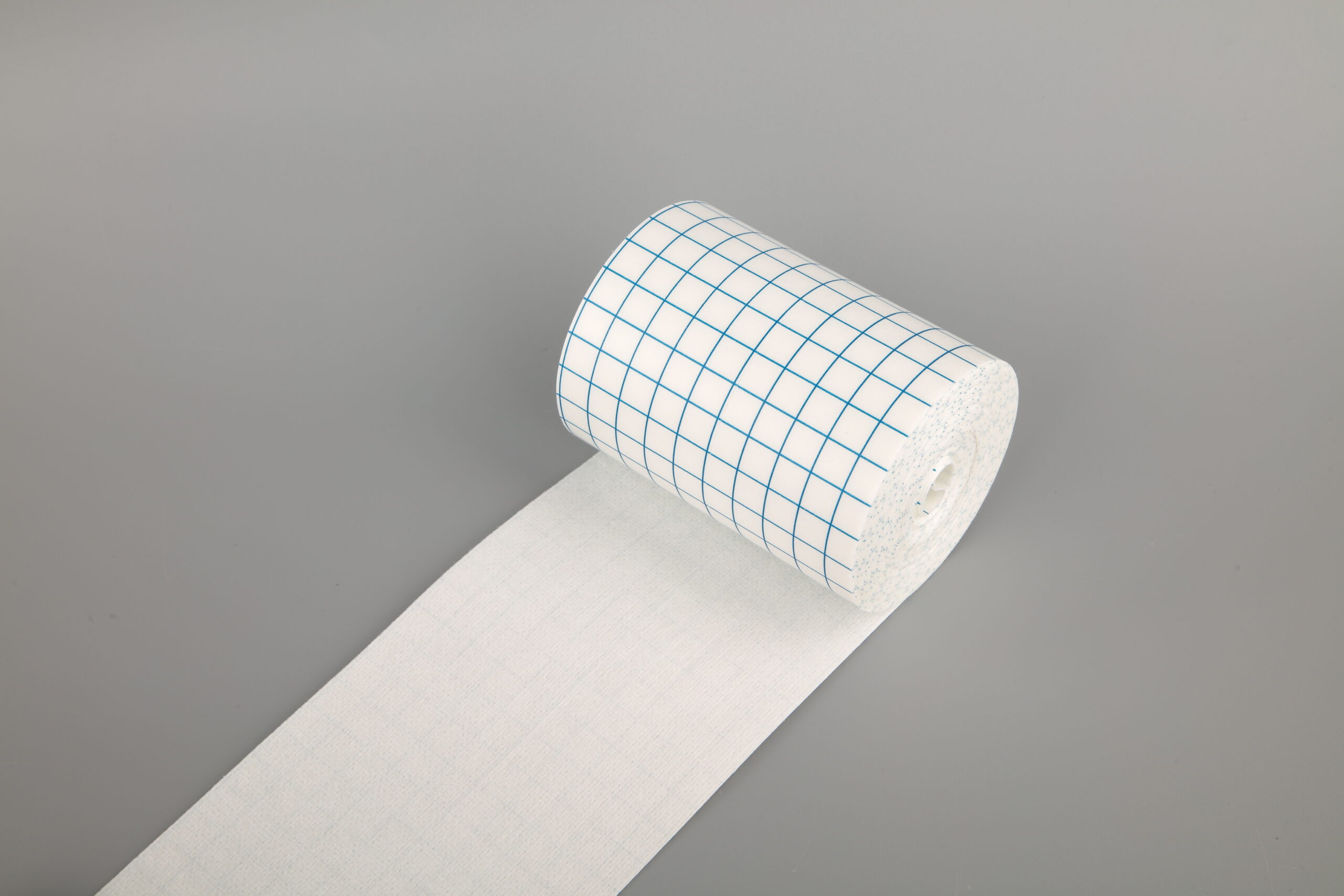
A typical product can contain four main components:
- Nonwoven backing: The backing forms the outer structure of the dressing. Nonwoven materials are often selected because they can provide softness, flexibility, and a surface suitable for adhesive coating.
- Adhesive layer: The adhesive allows the dressing to remain attached to the surrounding skin. Buyers should identify the adhesive chemistry, coating method, adhesion performance, and intended skin-contact conditions before approving a product.
- Absorbent wound-contact area: Some products include an absorbent pad designed to cover the wound area while the surrounding adhesive portion attaches to the skin. Pad material and absorbency should be specified rather than assumed.
- Release liner: The liner protects the adhesive before application. It should be removed cleanly without taking excessive adhesive with it or damaging the dressing.
Some nonwoven dressing roll wholesale suppliers also produce configurations without a separate absorbent pad when the product is intended primarily for fixation. That distinction matters because a fixation tape and an adhesive wound dressing should not automatically be treated as interchangeable products.
Why Hospitals Buy Roll Formats
A nonwoven adhesive dressing roll can simplify purchasing where a facility has frequent dressing requirements across different departments. Instead of ordering many pre-cut sizes, procurement teams may use a smaller number of roll SKUs and control cutting or application at the point of use.
The format can also help distributors serve multiple customers with different requirements. A distributor may stock a standard roll and supply it to hospitals, clinics, nursing facilities, or surgical practices that use different dressing dimensions.
Another benefit is purchasing flexibility. A facility that buys a bulk nonwoven roll for wound care can establish a recurring supply program based on monthly or quarterly consumption rather than repeatedly placing small orders.
However, a roll format does not automatically mean lower total cost. B2B buyers should compare the cost per usable dressing, material waste, packaging, labor, storage, and handling requirements.
Nonwoven Material Compared With Other Dressing Backings
Nonwoven materials are commonly used in healthcare products because they can provide a balance between flexibility, softness, strength, and manufacturability. The specific performance depends on fiber type, construction, basis weight, finishing, and manufacturing process.
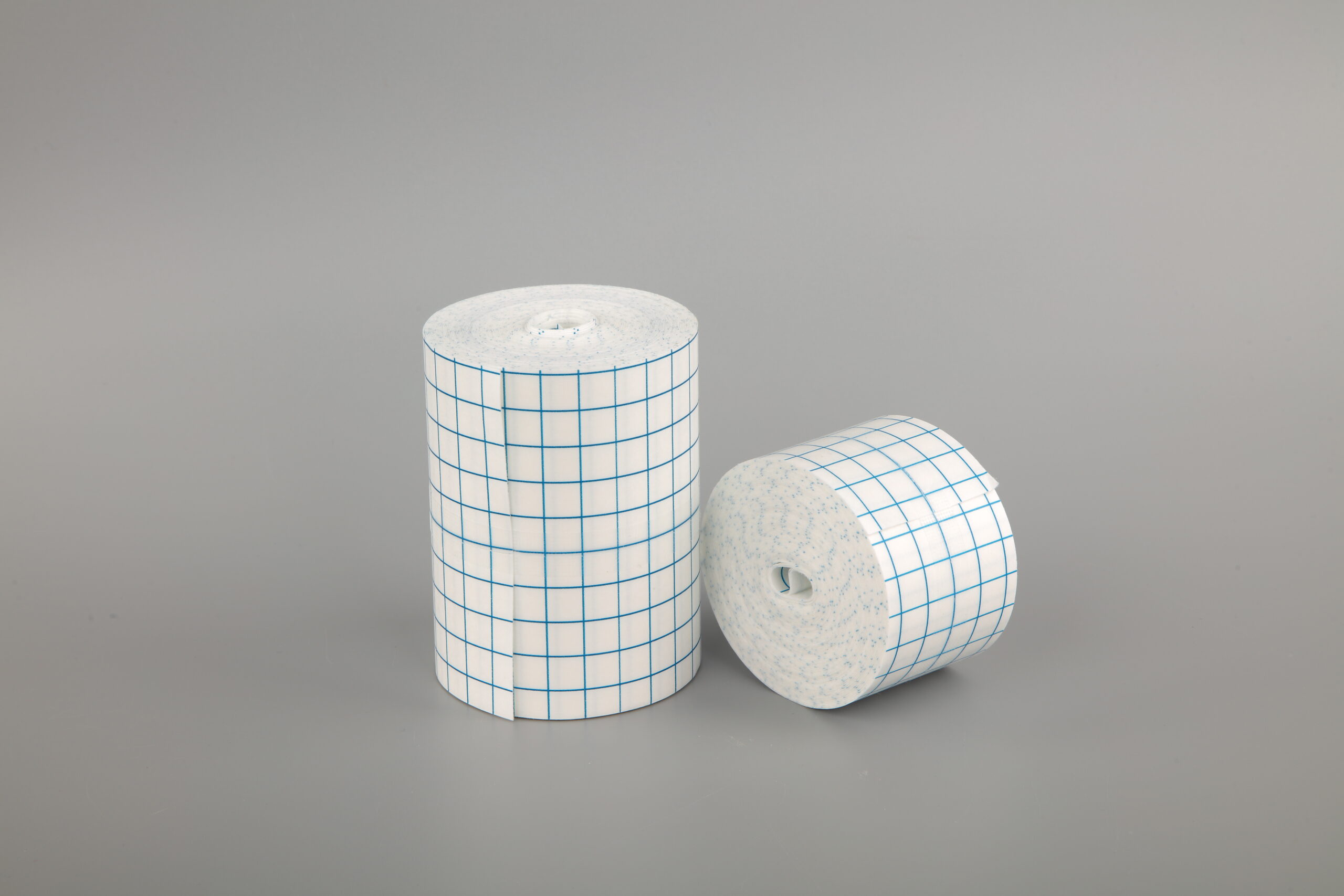
A B2B buyer should avoid evaluating the nonwoven adhesive dressing roll only by the word “nonwoven.” Two different products can both use nonwoven backing while behaving differently during application and removal.
For hospital procurement, useful specifications include material composition, weight, thickness, tensile characteristics, permeability or breathability claims where applicable, adhesive coverage, pad composition, and dimensional tolerances.
Clinical Applications Driving Bulk Demand
Demand for a nonwoven adhesive dressing roll usually comes from facilities with repeated wound-care, postoperative, or fixation requirements. Hospitals can consume large quantities because dressing products are used across multiple departments rather than in one isolated clinical area.
Postoperative Wound Coverage
Postoperative wound management is one of the most obvious applications for adhesive dressings. After a procedure, clinicians may use a dressing to cover and protect an incision according to the patient’s condition and the facility’s clinical protocol.
A nonwoven adhesive roll for surgical use bulk order can support several surgical departments when the product meets their approved specifications. This can reduce the need to purchase separate dressing products for every operating unit.
The procurement team should still confirm whether the product is appropriate for the specific intended use. A general adhesive dressing should not be presented as a specialized antimicrobial dressing unless it has the required claims, testing, and regulatory authorization.
Minor Wounds and Abrasions
General hospital departments, outpatient clinics, urgent-care facilities, schools, and occupational health units may use adhesive dressings for minor wounds and abrasions. These applications often create steady consumption rather than occasional demand. A facility may therefore prefer standardized roll formats that can be stored centrally and issued to different departments.
Surgical Centers
Ambulatory surgical centers can have particularly predictable demand because procedure schedules are often planned in advance. Procurement teams can estimate consumption based on monthly procedure volumes and average dressing use per procedure. A nonwoven adhesive dressing roll wholesale supplier should be able to maintain the same roll dimensions, adhesive behavior, packaging, and quality requirements from one production batch to another.
Catheter and Device Fixation
Some adhesive nonwoven products are used for securing medical devices, tubes, or other items. However, buyers must distinguish between a wound dressing product and a device-fixation product because the intended use, adhesive performance, and regulatory requirements may differ. That is why purchasing specifications should describe the intended application rather than relying on a generic product name.
Outpatient and Community Healthcare
Outpatient facilities often require wound-care products in smaller quantities but with high frequency. Community healthcare providers may also use dressing materials across a wide range of patients.
This can make a wound dressing roll wholesale hospital supply program attractive because one nonwoven adhesive dressing roll wholesale supplier can support several facilities under a standardized purchasing agreement.
Distributors and Medical Supply Companies
Distributors typically need more than basic product availability. They may require custom packaging, private labels, multilingual labeling, barcodes, different roll dimensions, and reliable documentation for their customers. A distributor that serves several countries may also require different versions of the same product to meet market-specific regulatory or labeling requirements.
Product Specifications for Wholesale Orders
A wholesale buyer should never approve a nonwoven adhesive dressing roll based only on a photograph and a quoted price. The product specification should define the physical construction, adhesive system, dimensions, packaging, and quality requirements.
Backing Material
Start with the exact nonwoven material. Ask the manufacturer to identify the material composition, basis weight, thickness, color, surface treatment, and relevant physical properties. If the material has a defined grade or technical specification, include that information in the purchasing document.
A consistent backing is important in this case. That is because changes in material can influence stiffness, drape, adhesive coating, tear behavior, packaging, and user experience.
Roll Width
Roll width is one of the most important commercial specifications. Common widths vary by product design and manufacturer, so the buyer should not assume that a supplier’s standard sizes will match hospital requirements.
Specify the required width, tolerance, and whether custom sizing is acceptable. For a long-term purchasing program, keeping a stable width specification can prevent unexpected changes in inventory usage.
Roll Length
The roll length affects both unit economics and inventory calculations. A longer roll may reduce packaging frequency, but it can also increase storage requirements and affect handling.
The quotation should clearly state the nominal roll length and allowable tolerance. B2B buyers should also confirm how many rolls are packed per inner box and master carton.
Absorbent Pad Dimensions
When the product includes an absorbent pad, specify its length, width, thickness, placement, and spacing. For example, a buyer may require a continuous dressing structure or regularly spaced absorbent sections. The nonwoven adhesive dressing roll wholesale supplier should provide a technical drawing showing the exact configuration. This is especially important for OEM production because an apparently minor change in pad placement can alter the usable dressing area.
Adhesive Type
The adhesive specification should receive careful attention. Buyers should ask what adhesive system is used, where it is coated, how the adhesive is protected during storage, and what performance data the manufacturer can provide.
Adhesive performance should be evaluated under the intended conditions of use. Excessive adhesion can complicate removal, while insufficient adhesion can cause premature lifting.
Procurement teams should avoid asking only whether a product is “skin friendly.” They should request the supplier’s available testing, intended-use information, and relevant supporting documentation.
Release Liner
The release liner should protect the adhesive until application and allow practical removal. A poorly designed liner can slow clinical use, especially in high-volume environments. For private-label products, the liner material and dimensions should be included in the approved specification.
Sterile and Non-Sterile Options
Not every adhesive dressing roll is sterile. B2B buyers must identify whether the product requires sterilization or not. And, if so, which validated process is used. The product specification should also address sterility assurance documentation, packaging integrity, sterilization records, and shelf life. A manufacturer should never label a product as sterile merely because it is produced in a controlled environment.
Packaging
Packaging should be specified at several levels. The product may have individual packaging, multiple units per box, and several boxes per shipping carton. The final packing configuration affects storage, freight efficiency, inventory counting, and product protection.
Hospitals should also review labeling information, lot numbers, manufacturing dates, expiration dates where applicable, storage conditions, and identification codes.
Dimensional Tolerances
A nonwoven adhesive dressing roll wholesale supplier quotation should include tolerances for critical dimensions. For example, the specification can identify acceptable limits for roll width, roll length, dressing size, pad placement, or other measurable attributes. Tolerances make incoming inspection easier because the hospital has a defined standard against which the shipment can be evaluated.
Absorbency and Performance Requirements
Where absorption is a required product characteristic, the procurement specification should identify the appropriate test method or performance target rather than using vague language. A manufacturer should be able to explain how critical product characteristics are tested and how those results are recorded.
Shelf Life and Storage
Ask for the stated shelf life, storage conditions, temperature and humidity considerations, and packaging requirements. Hospitals should consider warehouse conditions before signing a large supply agreement. A product that requires strict storage controls may have a different total cost than a comparable product with simpler storage requirements.
A Practical Wholesale Specification Sheet
Before requesting quotes, procurement teams can create a one-page technical sheet.
| Specification | Buyer Requirement |
|---|---|
| Product | Nonwoven adhesive dressing roll |
| Backing | Defined nonwoven material |
| Width | Required dimension and tolerance |
| Roll length | Required length and tolerance |
| Adhesive | Specified adhesive system |
| Pad | Required material and dimensions |
| Sterility | Sterile or non-sterile |
| Packaging | Individual/box/carton configuration |
| Shelf life | Required minimum |
| Labeling | Lot, dates, product identification |
| Regulatory market | Destination-market requirements |
| OEM | Required or not required |
| Artwork | Buyer-supplied or manufacturer-supported |
| MOQ | Required range |
| Lead time | Maximum acceptable period |
A specification like this is helpful for the nonwoven adhesive dressing roll wholesale suppliers in quoting the same product rather than quoting several different configurations.
How to Source Nonwoven Dressing Rolls from a Wholesale Manufacturer
The sourcing process should begin before a buyer contacts manufacturers. The first step is to define the expected use, approved specifications, forecast volume, delivery destination, and regulatory requirements. Without this information, price comparisons can become misleading.
Establish Annual Consumption
Review at least 12 months of purchasing and consumption history when available. Separate normal demand from unusual purchases caused by tenders, emergency stock-building, new facilities, or temporary shortages. This helps produce a more realistic baseline.
Define the Product Before Requesting Quotes
A manufacturer cannot provide a meaningful price for an undefined product. Describe the material, roll size, dressing format, adhesive requirements, sterility, packaging, and intended use. Include drawings when custom dimensions are involved.
Identify Qualified Manufacturers
If you’re looking for a nonwoven dressing roll bulk supplier, review manufacturing experience rather than relying on online catalogs. Check whether the supplier has their own production line, the processes performed internally, and stages that are outsourced. Outsourcing is not automatically a problem, but buyers need to understand where critical manufacturing steps are taking place.
Request Supplier Documentation
Ask for copies of pertinent quality certificates, product specifications, test reports, declarations, manufacturing information, and regulatory documents. The business name listed on the certificate must correspond with the name of the legal entity for the transaction performed, or there must be a proper description of that business name.
Request Samples
Samples allow the buyer to evaluate the physical product before placing a commercial order. Check the adhesive feel, the backing flexibility, the handling of the release liner, the dimensions after dressing it, the packaging and the visual consistency. The clinical or end-user team should also assess the product where appropriate in relation to its intended process.
Conduct a Nonwoven Adhesive Dressing Roll Wholesale Supplier Audit When Appropriate
For large hospital systems, a supplier audit or third-party inspection could be required. The audit may include raw-material control, production processes, quality inspection, documentation, traceability, storage, dealing with complaints and change-control procedures (if necessary) and where applicable, environmental controls.
Review Production Capacity
Price is less useful when the nonwoven adhesive dressing roll wholesale supplier cannot support the required monthly volume. Request information on:
- Production lines
- Normal capacity
- Peak capacity
- Current utilization
- Planned shutdowns
- Lead times
A nonwoven adhesive dressing roll wholesale supplier should be able to explain how it would respond to a significant increase in demand of the nonwoven adhesive dressing roll.
Confirm Batch Traceability
Suppliers should be able to inform you which production batch a product shipment comes from. Traceability is helpful in supporting complaint investigation, recall management, quality review, and internal stock control.
Compare Landed Cost
A manufacturer can offer a low factory price but impose higher packaging prices, freight costs, inspection and documentation costs, or minimum order requirements. Do not use factory unit price as a basis for comparison, including the total landed cost.
Approve a Master Specification
Once the nonwoven adhesive dressing roll is approved, place the technical specification under document control. Future orders should reference the approved specification number or product code. This is helpful in reducing the risk of receiving a product that looks similar but has different construction or performance.
How to Compare Manufacturers Before Signing a Contract
A practical evaluation matrix is helpful for the procurement teams in comparing nonwoven adhesive dressing roll wholesale suppliers objectively. Here are some questions to ask a nonwoven dressing roll bulk supplier:
- Manufacturing: Do you operate your own production facility?
- Experience: How long have you manufactured adhesive wound-care products?
- Quality: Do you maintain ISO 13485 certification?
- Regulatory: What market authorizations or registrations apply?
- Materials: Can you identify all critical raw materials?
- Testing: What tests are performed on finished products?
- Traceability: Can you trace finished goods to raw-material batches?
- Capacity: What monthly quantity can you consistently supply?
- MOQ: What is the standard MOQ?
- OEM: Can you support private-label production?
- Samples: Are pre-production and approval samples available?
- Lead time: What is the normal and peak-season lead time?
- Packaging: Can packaging be customized?
- Change control: How are buyers notified of material or process changes?
- Complaints: What is your complaint and corrective-action process?
The supplier with the lowest quoted price is not necessarily the lowest-cost nonwoven adhesive dressing roll wholesale supplier over the life of the contract.
Sourcing an Adhesive Wound Dressing Roll Manufacturer in China
China remains an important manufacturing hub for many medical consumables. B2B buyers looking for an adhesive wound dressing roll manufacturer in China will find established medical device manufacturers and trading companies. That distinction is important.
A trading company may offer useful sourcing support, but buyers should understand whether the quoted supplier is the actual manufacturer. Ask for the factory legal name, production address, quality certificates, product catalog, and documentation showing the manufacturer’s relationship to the supplied product.
A factory visit or independent inspection can help confirm production capability. Buyers can also request recent production photographs, facility videos, audit reports, or third-party inspection services where an onsite visit is not practical.
Questions to Ask a China-Based Manufacturer
Ask who manufactures the nonwoven backing, who coats the adhesive, who assembles the dressing, who sterilizes the product if applicable, and who performs the final product release.
Also ask what happens when a raw material becomes unavailable. A manufacturer that changes adhesive, nonwoven material, packaging, or pad material without customer approval can create serious supply and quality problems.
Note: For long-term purchasing, include a change-notification requirement in the quality agreement.
Certifications and Compliance
Requirements vary according to the product’s intended use, claims, and destination market so as to ensure compliance. A certificate alone does not establish that a product can legally be sold in every country.
ISO 13485
ISO 13485 is one of the most important quality-management standards in the field of medical devices. According to ISO standards, ISO 13485:2016 is a recognized standard worldwide for quality management systems used in the design and manufacture of medical devices — the requirements are aimed at consistently meeting customer and regulatory requirements.
For B2B buyers, the practical point is that ISO 13485 certification can provide evidence of a structured quality management system. However, it is essential for procurement teams to review the scope, issuing body, legal manufacturer’s name, legal manufacturing site, certificate validity, and covered activities of the certificate.
ISO 9001
ISO 9001 is a general quality management standard used across many industries. It is helpful in providing good evidence of the quality controls of the organisation, but it doesn’t replace medical-device-specific quality controls where ISO 13485 or another relevant quality system may be required.
CE Marking
Depending on the established medical device and classification rules, the needs can vary for the European market. A supplier who advertises a CE certified nonwoven dressing roll exporter should be able to supply the documents referring to the CE claim — for example, the conformity documentation and/or the evidence of involvement with a notified body if applicable.
A CE mark on a product picture does not imply compliance. The buyer should confirm the legal manufacturer, product identification, product classification, legal conformity pathway, and documents.
Declaration of Conformity
A Declaration of Conformity is an important regulatory document in many medical-device supply chains. It’s important for the procurement teams to compare the document with the actual product, manufacturer, intended market, and respective regulations. A generic certificate not specific to the nonwoven adhesive dressing roll cannot be accepted as proof of compliance.
Biocompatibility Documentation
Where the nonwoven adhesive dressing roll comes into direct or indirect contact with patients, B2B buyers should review the manufacturer’s biological evaluation approach and applicable testing. Specific tests will vary according to contact type, length of contact, materials contact, purpose for contact, and regulatory requirements. The goal is to determine whether the supplier has evaluated the product appropriately rather than simply collecting a list of test reports.
Sterilization Documentation
For sterile products, ask about the sterilization process and validation. The supplier should be able to supply suitable records of sterilization and explain how the sterilization parameters, integrity of the packs, and the release of products are controlled.
Product Technical Documentation
A reliable manufacturer of medical devices should maintain technical information covering product specifications, manufacturing controls, information about risks, testing, labeling, and regulatory documentation as applicable. B2B buyers may not receive the entire technical file, but it’s important for them to request sufficient evidence verifying the compliance of the product for its intended market.
What Hospitals Should Verify on Supplier Certificates
Before approving a nonwoven adhesive dressing roll wholesale supplier, check:
- Legal company name
- Factory location
- Certificate scope
- Product category or activities covered
- Certificate issue date
- Expiration or validity status
- Certification body
- Accreditation information where applicable
- Relationship between certificate holder and selling entity
- Product-specific regulatory documentation
- Destination-market requirements
ISO itself explains that ISO 13485 is intended to support consistent manufacture and delivery of medical devices that meet customer and regulatory requirements. The purchasing department should therefore treat certification as one part of nonwoven adhesive dressing roll wholesale supplier qualification rather than the entire qualification process.
Pricing and MOQ Structure
The cost of a nonwoven adhesive dressing roll can vary substantially between products because the physical specification is rarely identical from one nonwoven adhesive dressing roll wholesale supplier to another. The main pricing factors include backing material, adhesive system, pad configuration, dimensions, roll length, sterility, packaging, order quantity, private-label requirements, printing, inspection, and shipping.
Understanding MOQ
A nonwoven adhesive dressing roll wholesale supplier may set the MOQ based on raw-material purchasing, machine setup, packaging runs, printing requirements, or production efficiency. For a standard product, the MOQ may be relatively straightforward. For a custom OEM product, the supplier may require a higher quantity because custom packaging or printed materials cannot be economically produced in small lots.
What Affects Nonwoven Adhesive Dressing Roll MOQ Price?
The nonwoven adhesive dressing roll MOQ price should be evaluated together with the complete specification. A product with a lower price may use a different nonwoven material, a different adhesive, shorter roll length, simpler packaging, or a lower quantity per carton. Ask suppliers to quote the same specification and provide pricing at several quantities.
Request Volume Tiers
A useful quotation request can ask for prices at three to five annual volume levels. For example, a buyer might request prices for 10,000, 50,000, 100,000, and 250,000 rolls, depending on realistic consumption. This allows the procurement team to see whether the unit cost declines enough to justify higher inventory levels.
Do Not Compare Price Per Roll Alone
The more useful calculation is cost per usable dressing.
Suppose Supplier A provides a longer roll with slightly higher unit pricing while Supplier B provides a shorter roll at a lower unit price. Supplier A could still have the lower cost per finished dressing.
Calculate: Cost per usable dressing equals the total landed cost divided by the number of usable dressing units. For continuous rolls, include expected cutting waste in the calculation.
Landed Cost
A hospital importing from another country should calculate: Landed cost equals the total product price, packaging, freight, insurance (where applicable), customs charges, inspection, local delivery, and other import costs.
Note: The final purchasing decision should be based on this amount rather than the manufacturer’s ex-factory quotation.
OEM and Custom Sizing Options
OEM production can make sense when a hospital group, distributor, or medical supply company has a stable demand pattern. A custom nonwoven adhesive dressing roll can be produced with specified dimensions, packaging, labeling, and branding, subject to the manufacturer’s capabilities and regulatory requirements.
Custom Roll Width
Custom width can support a particular clinical application or distributor product range. The buyer should provide an engineering drawing or dimensional specification instead of relying on a verbal description.
Custom Roll Length
Roll length can be adjusted to suit packaging, storage, or usage patterns. However, longer rolls may not automatically improve economics if they create more handling difficulty or increase waste at the point of use.
Custom Dressing Dimensions
A hospital may require a specific absorbent pad size or spacing pattern. The nonwoven adhesive dressing roll wholesale supplier should provide a drawing for approval before mass production. The approved drawing should then become part of the quality specification.
Private Label Packaging
Distributors often request private-label cartons, boxes, individual pouches, labels, barcodes, and product inserts. Packaging artwork should be approved carefully because changes may create regulatory or inventory issues.
Multilingual Labeling
International distributors may need labels in multiple languages. Confirm which party is responsible for translation accuracy and regulatory review. The manufacturer should not add regulatory claims simply because they appear on an old customer artwork file.
OEM Tooling and Setup Costs
Some custom products may require dedicated tooling, cutting components, printing plates, or packaging materials. Before signing an OEM agreement, ask who owns any tooling, whether setup costs are refundable, and what happens to unused printed packaging if the relationship ends.
How Hospitals Calculate Annual Dressing Roll Requirements
Forecasting is one of the most important parts of medical supply procurement. A hospital that buys too little can experience stockouts and emergency purchases. A hospital that buys too much may tie up cash, occupy warehouse space, and create expiry or obsolescence risks.
Hospitals usually calculate annual requirements from historical consumption, patient volume, clinical usage patterns, roll specifications, inventory levels, and expected changes in demand. The goal is to avoid both stockouts and excessive inventory.
The WHO recommends using reliable consumption records when estimating annual medical-supply requirements. It also emphasizes accounting for lead time, order frequency, reserve stock, and minimum/maximum stock levels.
Start With Historical Consumption
The most reliable starting point is the hospital’s actual issue or usage data. For example, if a hospital used:
- January: 420 rolls
- February: 450 rolls
- March: 470 rolls
- April: 440 rolls
- May: 460 rolls
- June: 480 rolls
The six-month average monthly consumption is: (420 + 450 + 470 + 440 + 460 + 480) ÷ 6 = 453 rolls/month. The basic annual requirement would therefore be: 453 × 12 = 5,436 rolls/year.
Hospitals should use several months of reliable consumption data rather than basing the forecast on a single month’s usage.
Calculate Usage by Department
A hospital should not necessarily calculate one requirement for the entire facility. Nonwoven adhesive dressing roll can be applied in various ways in the:
- Operating rooms
- Emergency departments
- Surgical wards
- Intensive care units
- Outpatient clinics
- Wound-care departments
- Pediatric units
- General medical wards
Each department in the hospital can provide its own historical issue quantity. The procurement team can then consolidate these figures.
This strategy allows the discovery of any departments which might have an abnormally high consumption, and helps avoid an unexpected high-use surgical department from skewing the forecast for lower-use departments.
Convert Patient Activity Into Dressing Demand
For those hospitals who have the ability to forecast patient activity, they can also use clinical data to estimate demand. For instance, if there are expected procedures and the average consumption of dressings per procedure is, say 40, then the projected requirement is: Expected procedures × average dressing-roll consumption per procedure = 400 dressings.
Suppose the surgical department will have 8,000 surgeries every year and its past experience indicates an average of 0.65 rolls per surgery: 8,000 surgeries × 0.65 per surgery = 5,200 rolls.
The hospital can then add an adequate buffer for stocking. This approach is especially helpful if the hospital anticipates that the number of patients will vary markedly from the previous year.
Account for Roll Length and Width
This is essential if a comparison is made from one supplier to another. A “roll” is not a defined amount. Different width and length commercial nonwoven adhesive dressing rolls are available. For example, one manufacturer lists 5 cm × 10 m, 10 cm × 10 m, 15 cm × 10 m, and 20 cm × 10 m configurations, while another lists products from 2.5 cm × 10 m through 20 cm × 10 m.
When evaluating different roll configurations, hospitals should base consumption calculations not only on the number of meters but also normalize to the number of rolls. For example: 5,000 rolls × 10 meters = 50,000 meters. If a nonwoven adhesive dressing roll wholesale supplier offers 5-meter rolls instead, the equivalent requirement becomes: 50,000 ÷ 5 = 10,000 rolls. This ensures that procurement teams are not comparing offers purely on price per roll when the quantity of dressing material differs.
Add Safety Stock
Hospitals rarely want their annual purchase quantity to equal their exact forecasted consumption. Unexpected surges in patient populations, delays in supply deliveries, emergency needs, or supplier issues can all lead to shortages. WHO and reputable procurement guidance recommends that reserve stock be kept, and minimum stock calculated based on consumption for supplier lead time plus reserve stock.
A simplified calculation: Annual procurement requirement = Forecast annual consumption + Safety stock − Usable inventory on hand. For example:
- Forecast consumption: 5,436 rolls
- Safety stock: 600 rolls
- Usable inventory: 300 rolls
5,436 + 600 − 300 = 5,736 rolls. Thus, the hospital would order around 5,736 rolls (depending on hospital purchasing schedule and supplier MOQ).
Consider Supplier Lead Time
The nonwoven adhesive dressing roll reorder period is significantly influenced by lead time. If a hospital consumes 450 rolls per month and the nonwoven adhesive dressing roll wholesale supplier lead time is 2 months: 450 ÷ 30 × 60 = approximately 900 rolls.
The hospital should have sufficient inventory for expected usage until another shipment arrives, plus a reserve, depending on the hospital’s inventory policy. WHO also explains that increased time between ordering and receipt, and infrequent ordering, tend to result in increased ordering size and stock levels.
Use PAR Levels for Routine Replenishment
Many healthcare establishments use Periodic Automatic Replenishment (PAR) levels to manage supplies at storage locations. Research on hospital inventory management describes PAR/up-to-level systems as a common approach for replenishing healthcare supplies.
A simplified PAR calculation is: PAR level = Expected usage during replenishment period + Safety stock. For instance, if a ward uses 100 rolls per month, receives deliveries every two months, and maintains a 50-roll safety buffer: 100 × 2 + 50 = 250 rolls. Therefore, the ward’s replenishment level would be approximately 250 rolls.
Adjust the Forecast for Growth
Past consumption is not necessarily indicative of future requirements. Hospitals should consider:
- New operating rooms
- Increased surgical volume
- New outpatient services
- Expansion of wound-care services
- New wards
- Changes in clinical protocols
- Seasonal patient increases
- New contracts or referral programs
Suppose the hospital’s demand has been 5,436 rolls per year and it predicts this will grow by 8%: 5,436 × 1.08 = 5,871 rolls. Before adding safety stock and accounting for inventory on hand, the hospital would consume about 5,871 rolls per year.
Build the Annual Requirement Formula
A practical procurement formula is: Annual requirement = Historical annual consumption × Expected growth factor + Safety stock − Usable stock on hand. For a hospital using 5,436 rolls annually, expecting 8% growth, maintaining 600 rolls of safety stock, and holding 300 usable rolls: 5,436 × 1.08 + 600 − 300 = 6,171 rolls. The procurement team can then budget for approximately 6,171 rolls over the coming year and divide that quantity across planned purchase cycles.
Convert the Requirement Into Purchase Orders
Hospitals don’t necessarily buy their entire annual requirement in a single shipment. If the annual requirement is 6,171 rolls and orders are placed every quarter (4 times a year): 6,171 rolls ÷ 4 = approximately 1,543 rolls per order. However, the final order quantity should also consider the supplier’s MOQ, carton structure, lead time, storage ability, supply date, and negotiated volume cost.
For example, if a manufacturer packs 80 rolls per carton, the hospital may need to round the theoretical order quantity to a commercially practical carton quantity. Different carton configurations from manufacturers means purchasers should work with the carton size supplied by the manufacturer, not a default carton size.
The most important thing is that the annual nonwoven adhesive dressing roll requirements should be calculated from actual consumption and not simply by multiplying an arbitrary monthly estimate by 12. Hospitals should also normalize the calculation by roll length and width so that a 5-meter roll and a 10-meter roll equate to different amounts of dressing material.
Wholesale Procurement Checklist
Before approving a nonwoven adhesive dressing roll wholesale supplier, review the following areas:
| Procurement Area | Buyer Checklist |
|---|---|
| Product definition | Approved technical specification available |
| Dimensions | Width, length, pad size, and tolerances confirmed |
| Materials | Backing, adhesive, pad, and liner identified |
| Intended use | Clearly defined |
| Sterility | Sterile/non-sterile status confirmed |
| Packaging | Inner and master packaging approved |
| Labeling | Required information confirmed |
| Quality | Supplier quality system verified |
| Certification | Relevant certificates checked |
| Regulatory | Destination-market requirements confirmed |
| Samples | Samples evaluated and approved |
| Testing | Required test reports reviewed |
| Traceability | Batch/lot identification confirmed |
| MOQ | Minimum quantity acceptable |
| Pricing | Volume tiers received |
| Capacity | Supplier can meet forecast demand |
| Lead time | Production and shipping timelines acceptable |
| OEM | Custom requirements confirmed |
| Change control | Supplier notification process established |
| Complaints | Corrective-action procedure reviewed |
| Logistics | Shipping terms and documents confirmed |
A procurement team should also keep all approved supplier documentation in one controlled record. This makes future audits and supplier reviews easier for those who need to buy nonwoven dressing roll in bulk.
Common Mistakes When Buying Nonwoven Dressing Roll in Bulk
Selecting the Lowest Unit Price
The lowest quoted unit price can be attractive for B2B buyers, particularly when their budgets are tight. However, a lower price can result in shorter roll lengths, different materials, weaker packaging, or different product specifications. Compare equivalent products before making the decision.
Buying Before Testing Samples
A product may look acceptable in a catalog but perform differently in actual use. Sample approval should happen before a significant production commitment.
Treating All Nonwoven Dressings as Equivalent
“Nonwoven” describes a material construction, not a complete performance specification. Adhesive, thickness, absorbency, backing strength, liner design, sterility, and dimensions can differ considerably.
Ignoring Tolerances
A nonwoven adhesive dressing roll wholesale supplier may produce a roll that is nominally 10 cm wide but varies outside the buyer’s acceptable range. Critical dimensions should have defined tolerances.
Ordering Without a Demand Forecast
Buying based on a single month’s consumption can lead to either a shortage or excess inventory. Use historical data, procedure volume, current stock, lead time, and safety-stock policy.
Failing to Confirm Factory Identity
A company selling the product may not operate the manufacturing facility. Buyers should know who manufactures the product and which company is responsible for quality and regulatory documentation.
Accepting Unverified Compliance Claims
Statements such as “CE approved” or “ISO certified” should be supported with current documentation. The buyer should verify the certificate scope and the actual legal entity involved.
Ignoring Change Control
A manufacturer may change a raw material, adhesive, packaging supplier, or production method. A written change-notification process helps prevent unexpected changes to an approved product.
How to Build a Long-Term Supplier Agreement
Once a supplier has passed technical and commercial evaluation, the hospital or distributor should establish a clear purchasing framework. The agreement can define product specifications, prices, volume tiers, lead times, delivery terms, inspection requirements, documentation, complaint handling, change control, and payment terms.
Fixed Specifications
Attach the approved product drawing and technical specification to the agreement. This reduces ambiguity during future purchase orders.
Forecast Sharing
A hospital can provide a rolling forecast rather than committing to every forecast quantity. For example, the buyer may share a 12-month forecast and issue firm purchase orders for the next two or three months. This gives the manufacturer visibility while retaining flexibility for the buyer.
Safety Stock Programs
For large facilities, suppliers may support scheduled production or inventory programs. A supplier can manufacture against an agreed forecast and ship according to a delivery schedule. This model can reduce lead-time risk without forcing the hospital to receive its entire annual volume at once.
Price Review Rules
Long-term contracts should clarify how prices may change. Relevant factors can include major raw-material increases, packaging changes, freight changes, currency movements, or agreed volume adjustments. Price revisions should require documentation rather than an unexplained increase.
Quality Control During Incoming Inspection
Purchasing does not end when the shipment arrives. Hospitals should establish an incoming inspection process appropriate to the product’s risk and procurement policy.
Inspect:
- Carton condition
- Packaging integrity
- Product identification
- Batch or lot information
- Roll width
- Roll length where practical
- Pad position
- Adhesive coverage
- Label accuracy
- Visible defects
- Quantity received
Sampling plans can be used rather than inspecting every unit when the organization has an established quality system. If a shipment fails inspection, the buyer should record the problem and notify the supplier using the agreed complaint process.
Maintaining Consistency Across Repeat Orders
Consistency is one of the biggest benefits of working with a qualified manufacturer. A hospital may approve a nonwoven adhesive dressing roll after evaluating samples, then expect every later shipment to match the approved construction. The manufacturer should therefore maintain controls over critical raw materials and production parameters.
A change in nonwoven backing, adhesive, pad material, liner, or packaging should be reviewed according to the agreed change-control procedure. This is particularly important for private-label products because customers may assume that the same product specification remains unchanged for years.
Questions to Ask Before the First Large Purchase
Before placing a major order, procurement teams should have clear answers to several questions.
- What exactly are we buying? The technical specification should define the product completely enough that different suppliers would quote substantially equivalent products.
- Who actually manufactures it? Know the legal manufacturer, factory location, and responsible supplier entity.
- What documentation supports the product? Review the relevant certificates, declarations, test reports, specifications, and regulatory documents.
- Can the manufacturer supply the projected volume? Check production capacity and lead times.
- What happens if demand increases? Agree on how additional orders will be handled.
- What happens if the manufacturer changes materials? Establish written change-control requirements.
- What happens when there is a quality complaint? Set response times, investigation procedures, corrective-action requirements, and replacement terms.
- What is the real landed cost? Include all expected costs, not only factory price.
When to Choose Standard Products and When to Choose OEM
Generally, standard products work well for buyers who want timely purchasing, rapid development cycles, moderate order quantities, or a proven configuration. OEM products can be more attractive if a B2B buyer has high recurring volume and needs custom dimensions, private labeling, packaging control, or a differentiated product line.
A hospital purchasing department should not automatically choose OEM production simply because it can. For custom products, additional artwork, documentation, approval, minimum order, and inventory requirements also apply. The most suitable alternative is the one that best fits the actual buying need.
What Makes a Reliable Nonwoven Dressing Roll Bulk Supplier?
A dependable supplier needs to offer consistent, high-quality service. The manufacturer should have documented production controls, reliable supply of raw materials, adequate quality management, realistic capacity, traceability, transparent communication, and a clear response mechanism in the event of problems.
While price is important, it needs to be part of a supplier scorecard. A supplier who saves $0.01 per roll but creates repeated shipment delays can increase the hospital’s total cost through emergency purchases and administrative work. A slightly higher-priced supplier may provide better overall value when product specification, documentation, lead time, and quality performance are more reliable.
Working With BKAMED, a Certified Manufacturer
BKAMED helps hospitals, surgical centers, distributors, and medical companies order nonwoven adhesive dressing roll products in bulk. When evaluating a medical dressing supplier, certification should be considered alongside product specifications, manufacturing controls, documentation, production capacity, and regulatory needs.
BKAMED’s medical supply manufacturing process aims to facilitate regular product quality and reliable bulk supply acquisition. Before entering full-scale commercial production, B2B buyers have the option of checking the specifications, quality records, packaging specification, and customization options of the products. This assists the procurement team in determining if the nonwoven adhesive dressing roll has the application and purchasing benefit they are looking for.
BKAMED can also assist in discussions regarding product size, packaging, OEM/private-label applications, and bulk ordering plans — as needed for distributors and healthcare providers with unique needs.
Conclusion
When purchasing a nonwoven adhesive dressing roll in bulk, there is far more to consider than collecting quotes from suppliers. Consistent specifications, reliable quality, adequate documentation, production capacity, and delivery are requirements that hospitals and surgical centers need from a manufacturer.
Before placing an order, buyers should evaluate materials, adhesive performance, dimensions, packaging, certifications, MOQ, lead times, and total landed cost. As order volume grows, it’s more important for organizations to qualify suppliers when purchasing nonwoven dressing roll in bulk quantities. Distributors sourcing from an adhesive wound dressing roll manufacturer in China should also verify manufacturing capabilities, OEM options, private-label support, and regulatory documentation.
With correct demand forecasting, hospitals can maintain sufficient stock without overstocking. Finally, the best supplier of nonwoven adhesive dressing roll isn’t necessarily the cheapest on the market. It is a manufacturer who can consistently deliver the right product, quality, quantity, documentation, and service required for long-term healthcare procurement.
Source Nonwoven Adhesive Dressing Rolls for Your Healthcare Supply Needs
Selecting the correct nonwoven adhesive dressing roll supplier can help simplify bulk supplies, reduce procurement risk, and limit cost. For hospitals, surgical centers, distributors, and healthcare organizations seeking reliable wound-care products for healthcare supply programs, BKAMED is the partner they can trust. Whether it involves product specifications, bulk quantities, packaging, or OEM requirements, buyers can have discussions with a manufacturer experienced in medical supply production.
BKAMED can assist you in reviewing the appropriate roll configurations for your needs, whether you are buying a standard nonwoven adhesive dressing roll or a tailored one for your market. Share your required dimensions, estimated order volume, packaging preferences, and target market to discuss available options, MOQ, pricing, and production lead times. Contact us today to discuss your next bulk dressing roll order and build a reliable supply program around your actual healthcare procurement needs.
