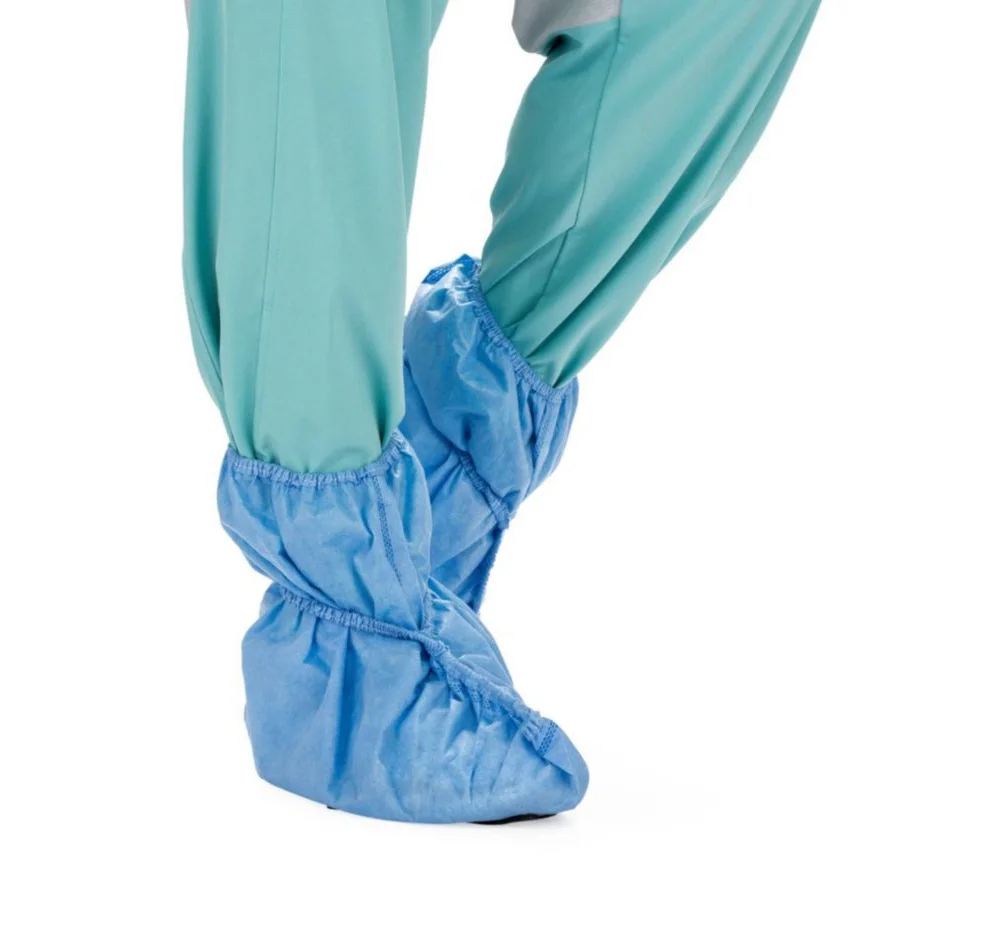
What does a pair of disposable shoe covers have to do with a $33 billion annual problem? More than you think. Hospital-acquired infections are the most expensive yet still the most preventable problem in healthcare, and shoe soles, which freely roam between infected wards, ICUs, and theatres, are recognised as a source of infection. Despite shoe covers being a front-line piece of personal protective equipment (PPE), they are generally underspecified and over-priced because most hospitals have never considered sourcing directly from a shoe covers manufacturer.
This is where our guide comes in. For supply chain managers, infection control procurement officers, and regional medical distributors, sourcing shoe covers directly from a disposable medical shoe covers manufacturer is a no-brainer with a cascading effect – reduced cost, guaranteed quality, and no disruption of supply as a result of a multi-tiered distribution network. Here’s everything you need to know to make it happen.
The Role of Shoe Covers in Infection Control and the Impact of Procurement Choices
Healthcare-associated infections (HAIs) are among the most stubborn and expensive issues facing the healthcare industry. Medical research published in the National Library of Medicine, estimates that 5% of all hospital patients will acquire a healthcare-associated infection (HAI). This results in a total of 722,000 infections, or 75,000 deaths, every year – at a cost of between $28 billion and $33 billion each year in the United States alone. These are real people. For every one of those numbers, there is an extended hospital stay, a negative impact on patient health, and a tangible cost to the hospital.
Yet often overlooked in the discussion is something right under our noses: the floor that everyone walks on in the hospital. Shoe covers, one of the most common consumables in any surgical environment, are involved in the spread of pathogens. And the effectiveness of these shoe covers, how they are specified, purchased, and used, affects infection control.
The Shoe Sole Problem
Infection control protocols tend to address the most visible high-touch objects: bed rails, IV tubing, doorknobs, and instruments. Less frequently considered is the floor, and what is on it.
A 2014 report published by Open Forum Infectious Diseases confirmed what many infection control experts have long suspected: hospital floors are commonly contaminated with methicillin-resistant Staphylococcus aureus (MRSA), vancomycin-resistant Enterococcus (VRE), and Clostridium difficile, and shoe soles serve as “contaminated transportation devices” that serve as a means of transferring pathogens throughout hospital wards.
A study at a long-term care institution showed that at least 47% of the time, contamination of hospital floors with MRSA in the rooms of colonized patients was transported to other rooms by shoes. What this means is shoe covers are not a cosmetic part of hygiene. When designed and used correctly, they act as a barrier at the source of most contamination.
And this is where the chain-of-infection argument is relevant for hospital procurement. A recent study of disposable shoe covers in a Sydney teaching hospital found 40 polypropylene shoe covers, exposed to the floor of a day surgery unit, became contaminated with large numbers of bacteria, and those bacteria, some of which were pathogens, could be transferred to operating room bedsheets. The result prompted the authors to recommend that infection control protocols include guidance about how and when to remove shoe covers after contact with the floor.
The message for procurement professionals is this: the physical protection a shoe cover offers can only be as good as the material used, the specification it adheres to, and the reliability of supply.
What the Numbers Say: The Financial Weight of HAIs
Decisions about infection control are not just medical decisions, but also financial decisions. They both need to be understood by hospital administrators and supply chain professionals.
Surgical site infections (SSIs) alone make up 20% of all HAIs and impact an estimated 2% to 5% of patients who undergo surgery as inpatients, and up to 25% of major surgical procedures, and cost between $3.5 billion and $10 billion annually in the United States. The average SSI adds almost 10 days to a patient’s hospital stay.
One prospective cohort study showed patients with HAIs remained in the hospital an average of 8.3 days longer than other patients, and had higher direct costs. When applied to a large surgical unit, the cost of an increased HAI rate is high.
It’s not hard to see from these numbers that the case for investing in the right specified, readily available shoe covers is a compelling one. The cost of a well-specified, disposable shoe cover is a fraction of a cent, compared with the cost of a single infection. Procurement teams often end up specifying products that don’t meet the necessary requirements, or sourcing products from an unreliable supplier, due to a lack of access to these cost figures – and excessive focus on the cost of products at the time of procurement.
Regulatory Standards: What WHO, CDC, and AORN Require
Facilities don’t work in isolation in infection control. Procurement decisions are made against the standards of three major organisations.
Here’s a brief list of each’s recommendations regarding shoe covers:
| Regulatory body | Guidance on Shoe Covers |
|---|---|
| WHO | Recommends disposable shoe covers in settings where there is a risk of bodily fluids leaking |
| CDC | Advocate for floor cleaning in hospitals; acknowledges that floors can be a source of infection |
| AORN (2024 Guidelines) | Requires fluid-resistant shoe covers or boots be worn when gross contamination (with blood or other bodily fluids) is anticipated; shoe covers worn as PPE must be removed immediately following use, and hand hygiene must be performed |
The 2024 AORN Guidelines for Perioperative Practice clearly state that fluid-resistant shoe covers or boots should be worn when gross contamination is reasonably anticipated, and shoe covers worn as PPE should be removed immediately and followed by hand hygiene. Ensun
This is important information for hospital procurement and infection control staff. This guidance does not allow the use of shoe covers to be optional in high-risk scenarios. It is mandatory. This means that the hospital’s supply of shoe covers must be fluid-resistant, must be in adequate quantity to allow for appropriate donning and doffing practices, and must be governed by an established policy on PPE.
Gaps in compliance almost always begin at the source: procurement.
The Procurement-Quality Connection: Compliance Starts with Sourcing
This is where infection control and supply chain management intersect, and where many facilities face risks of which they may not be aware.
For example, procuring shoe covers incorrectly can lead to:
- Wrong material specification: A shoe cover made from a low GSM (grams per square meter) non-woven that is not fluid resistant does not comply with AORN’s guideline for a case where contamination is anticipated. This is a shoe cover, but it does not meet the clinical criteria required by the guideline.
- Wrong sizing: Universal covers that are too big or too loose make the cover hard to put on and more likely to be removed too soon or worn improperly – lowering the compliance rate of the whole surgical team.
- Supply stockouts: Shortages, particularly during the flu season, result in the use of lower-quality products or no shoe covers at all. Neither situation provides optimal infection control practices, which may be difficult to prove in an audit.
- Unverified sourcing: Unverified or non-certified shoe covers may not be manufactured to the material and performance claims made on the label. Without ISO certification and third-party product verification by the manufacturer, there is no way to assure the product’s performance in practice.
The link between sourcing and infection control isn’t always clear until there is a problem. But the solution to avoiding it is simple: source bulk disposable shoe covers for hospitals directly from manufacturers that can provide certification for their production processes, specification of their materials, and supply chain capacity.
Why Is There A Difference Between The Cost Of Hospital Goods Through A Distributor And Direct From The Manufacturer?
Hospital procurement personnel are often aware that distributor pricing is higher than a manufacturer’s price. But few have quantified how much more, and how much more that translates into when purchasing a year’s supply of shoe covers for a surgical department.
How the Conventional Supply Chain Works and How the Cost is Added
The traditional way of sourcing shoe covers for a hospital involves the product usually changing hands a few times before it gets to the hospital. And each passing brings a markup.
This typically means:
Manufacturer → Regional Importer → National Distributor → Group Purchasing Organisation (GPO) → Individual Hospital / Facility
The party in the chain will add 15% to 40% to the cost of the product to cover their costs, inventory, transportation, and margin. When the shoe covers finally arrive in the hospital’s warehouse, the cost of the shoe covers can be 35% to more than 100% higher than the factory price (depending on the number of intermediaries).
For example, a pair of non-woven shoe covers (for an operating room) costing $0.08 – $0.12 at the factory can be sold in a hospital at $0.18 – $0.25 or more at the end of a distribution chain. Now that may not sound like much. But it adds up to a lot for the volumes a medium-to-large hospital uses.
Where the Savings Are
Let’s take a hospital that consumes 300,000 pairs of shoe covers annually, which is not uncommon for a hospital with multiple operating theatres and a high throughput of daily procedures. With a per-unit price difference of as little as $0.07 between the price received from the distributor and the price received from the manufacturer, this hospital is paying an additional $21,000 per year for these items.
For a hospital conglomerate or regional medical distributor, which may place an order for 500,000+ units per year, the difference is even greater. That’s a 30% price difference that adds up to a significant line item on the procurement budget.
The cost differences grow with volume as shown below:
| Annual Volume | Distributor price (per pair) | Direct Manufacturer Price (per pair) | Annual Saving |
|---|---|---|---|
| 100,000 pairs | $0.22 | $0.14 | ~$8,000 |
| 300,000 pairs | $0.22 | $0.14 | ~$24,000 |
| 500,000 pairs | $0.22 | $0.14 | ~$40,000 |
| 1,000,000 pairs | $0.22 | $0.14 | ~$80,000 |
Note that these figures are speculative of standard non-woven shoe covers. Actual prices vary by specification, material, and order structure
The Hidden Costs That Never Appear on the Distributor’s Quote
Not only unit price comes into play. There are many costs built into the supply chain model used by many distributors that are never made explicit and thus never accounted for by the procurement department.
- Handling and replenishment costs In addition to the price-per-unit, some distributors will charge additional fees for replenishment services due to split shipments or emergencies, which might be included in the service contract, not in an individual quote.
- Minimum purchase amounts Some distributors enforce certain minimum purchase amounts for each transaction, which makes it difficult for the facility to purchase the exact amount of goods that were intended.
- Delayed restocking Due to being supplied by many manufacturers and carrying various product lines, it is possible that the exact shoe cover SKU you are after may not have been in stock at all, leading to much longer replenishing cycles through distributors – 4–8 weeks, as opposed to working directly with the producer.
- Fewer Customization Opportunities The distributors provide what they have in their stock. In case of a facility requiring a certain GSM, a certain elasticity level, resistance against liquid substances or customized packaging, that will be hard for the distributor. But the manufacturer will be able to help with this.
- Lack of Visibility into Quality Facilities that receive shoe covers via a distributor cannot easily reach out to the manufacturer, ask for production information, obtain test reports and check compliance. Such visibility is possible only when dealing with a direct manufacturer.
What Manufacturer-Direct Pricing Actually Includes
Working with a disposable medical shoe covers manufacturer directly involves more than just receiving a product at a lower price. It also includes a set of value additions that distributors do not offer
This kind of agreement typically includes the following:
- FOB/CIF pricing. Pricing that includes either shipping costs to the originating port (FOB) or all the way to the destination port (CIF), depending on terms of the contract
- Sample availability. Either free or subsidized samples of product can be provided prior to ordering bulk quantities of product so that the facility can see and test the actual product being ordered
- Account manager. A single contact point who knows the specifics of facility’s needs and ordering
- Quality documentation. Upon request, the facility receives test reports, certificate of compliance and other ISO compliance information
- Flexible specification. The facility may specify the material weight of the footwear, sole construction or elastic requirements to meet their medical needs
- Pricing discounts based on volume. As the order volume increases, the price decreases creating natural incentives for long-term relationships.
In this respect, a procurement team working to procure PPE footwear for healthcare facilities would do well to consider how commercially transparent a supplier is. It should be noted that a medical shoe covers wholesale supplier cannot provide this level of commercial transparency.
Why Do You Need a Distributor?
It would be deceptive to assume that sourcing directly from the manufacturer is the perfect strategy for any healthcare establishment. There are indeed cases when it makes more sense to continue dealing with a distributor.
- Very small healthcare establishments that require relatively few units of shoe covers annually. The expense related to the coordination of the international order may actually exceed the cost reduction associated with a better price per unit
- Large healthcare establishments that need consolidated invoices for a huge variety of medical supplies within many categories.
- Healthcare establishments that do not have enough time or resources to deal with shipping, customs clearance, and quality control. In this case, the distributor assumes all these responsibilities
Moreover, there are establishments that opt for both strategies simultaneously. They buy high-demand medical products, such as hospital shoe covers, directly from the manufacturer while still relying on distributors for less common ones.
MOQ, Pricing Structure, and Tips on Negotiation with a Shoe Covers Manufacturer
When a hospital or distributor begins looking into the possibilities of direct sourcing from manufacturers, one of the earliest concerns raised will be MOQ or minimum order quantity.
Those working in procurement who have always relied on distributors will probably see this as an obstacle. In truth, however, MOQ is far more flexible, and knowledge about MOQ and pricing structure can enable procurement professionals to achieve competitive prices for bulk shoe covers used by hospitals.
What is MOQ?
MOQ is an acronym for minimum order quantity. It’s the minimum quantity a manufacturer will produce or ship per order, and there is a simple reason why.
See, when a production line for shoe covers is set up, there’s time involved in preparation of raw materials, quality control, setting up of packaging, etc. An order of 50 pairs would mean the cost of running the line would be far too high. MOQ is really the point at which the production costs make commercial sense for the manufacturer to run a cost-effective line and for the buyer to receive the cost-based price rather than paying the higher price charged on small batches.
The key point here is that MOQ is not an insurmountable obstacle. It is a starting point for a negotiation, and in high-volume commodity markets such as medical consumables, MOQs can be more flexible than buyers might think.
Common MOQ for Disposable Shoe Covers
MOQ’s for shoe covers are typically broken into three categories, based on order type:
| Order Type | Typical Quantity | What It’s Used For |
|---|---|---|
| Sample Order | 1-5 cartons (100-500 pairs) | Testing before making a commercial order |
| Standard MOQ | 10-20 cartons (1,000-2,000 pairs) | Regular single purchase orders |
| Contract Volume | 50+ cartons per order | Replenishment schedules and discounts for quarterly or annual orders |
Most manufacturers will be willing to supply an order of samples where the cost is at or slightly above. This is standard practice and a manufacturer that will not supply samples until a first order should be viewed with suspicion. The sample period is a time for procurement to sample the product before making a larger commitment.
Estimate Your Facility’s Annual Consumption
One of the most common procurement errors is negotiating without knowing the true consumption of the facility. A manufacturer is more responsive (and will offer lower prices) when a buyer can establish credibility in their volume upfront.
This is a simple method for calculating annual shoe cover consumption:
Daily usage = Number of operating theatres in use × Average number of procedures per room per day × Number of shoe covers per procedure
Yearly use = Daily use x Operating days per year
For instance, a hospital with 8 operating theatres performing an average of 6 procedures per room per day and using 2 pairs of shoe covers per procedure would use approximately 96 pairs per day. That’s about 28,800 pairs of shoe covers per year used in the OR alone, assuming 300 days a year in operation. Add in ward/ ICU/ visitor use, and the number rapidly increases.
Knowing this number and preferably broken down by department, demonstrates to the manufacturer that the hospital is well-organised and takes its purchasing seriously. This is important for pricing.
How Pricing Tiers Work
A manufacturer’s shoe cover price is not a standard rate. It’s volume-based and there can be a big gap from one tier to the next. Here is the general structure:
- Tier 1 – Sample pricing. Generally at or slightly above the cost of production. This is to get the product into the hands of the buyer for testing, not to make profit. Do not price commercials based on samples.
- Tier 2 – Standard single-order price. This is the price charged for orders that meet the standard MOQ but are less than contract volumes. This price is based on typical commercial margins and is the default price for most first-time customers.
- Tier 3 – Large volume contract pricing. Offered when a buyer signs on to a specific annual volume, usually broken down into quarterly orders with specified MOQs per shipment. These are the unit prices at their lowest, and where the medical consumables MOQ discussion applies most for large hospital chains and regional distributors.
For procurement teams responsible for purchasing PPEs to supply to health care facilities at scale, the commercial goal of negotiating annual supply agreements with Tier 3 pricing is almost always the right one. It may only be a few cents per unit price, but that adds up to a lot over 300,000-500,000 pairs per year.
Negotiation Tactics That Actually Work
Negotiating with a manufacturer or supplier is more effective when you’re well-prepared. Here are the top strategies that work for hospital procurement officers:
- Bundling SKUs with one vendor. If the hospital is buying non-woven gowns, exam gloves, or other disposable personal protective equipment (PPE) , the total volume of these products, when added to the bulk disposable shoe covers for hospitals, will allow the hospital to negotiate lower prices all around. Manufacturers like buyers who make their lives simple.
- Lock volumes, lock prices. Contracting for 12-month annual volume requirements – even if the product is shipped quarterly – provides the manufacturer with production certainty. Get a locked unit price for the contract term in return, allowing procurement to hedge against rising costs for raw materials.
- Negotiate payment terms early Typical international medical supply payment terms include 30% deposit with balance on Bill of Lading, or 30-day net for accounts with good credit history. Obtain favourable terms at the start of the relationship – 30-day or 60-day net – for better cash flow and reduced payment administration.
- Always ask for samples before your first order. Always request samples before you place your first order. A good manufacturer will have no issue providing them. Use the sample period to confirm the material, construction, and documentation of the product before investing in a large order.
What to Look for When Assessing Samples
When a shoe cover sample is received, it should be assessed systematically and objectively. The following areas should be evaluated:
- Texture and weight of material. Is the GSM of the product in line with the quoted GSM value? Is there any inconsistency of texture and fabric density?
- Tightness of elastic cuffs — the elastic band should hold tightly around the legs but should neither cut into nor roll down the leg
- Grip of the sole. Place the shoe cover on an artificial surface that simulates a wet condition and evaluate the performance of the product
- Ability to repel liquids. Place some liquid on the surface and watch how it responds; the liquid should form beads and roll off without penetration
- Quality of seams and edges. The seams of the product should be checked as to whether the sewing or bonding is tight along the seams
- Packaging uniformity. Is each pair folded consistently and packaged neatly? Packaging standards demonstrate manufacturing standards
In addition to the physical sample, you will want to ask for the following paperwork: a product test report that establishes material properties and performance grades, an ISO certification from the manufacturer, and a certificate of compliance. If any of these documents prove elusive or take a long time to obtain, then view that as a procurement risk signal.
A Practical Observation about Medical Supplies MOQs for Small Facilities
For smaller hospitals or a stand-alone surgical center, it can be difficult to meet the minimum order quantity requirements. However, there are two strategies you can follow:
First, look at manufacturers that cater to low minimum order quantities. Many manufacturers do, especially with new customers.
The second solution involves forming a purchasing cooperative with neighboring facilities to meet the MOQ threshold together.
The good news is that you won’t likely stop there. Most manufacturers understand that buyers who begin small but experience reliable quality will become their biggest clients in time.
What to Look for in a Medical Shoe Cover: Materials, Specs, and Performance Standards
An organization that chooses the wrong material to meet an OR application does more harm than just squander their budget – it creates a compliance issue that has serious implications for patient care. Specifying a shoe cover correctly depends solely on the application for which it will be used, anticipated levels of fluid contact, and infection control policies in place.
Materials Underneath the Fabric
Shoe cover materials define nearly all of its performance attributes. Four materials make up medical shoe covers and have specific applications in healthcare.
1. Non-Woven Polypropylene (PP)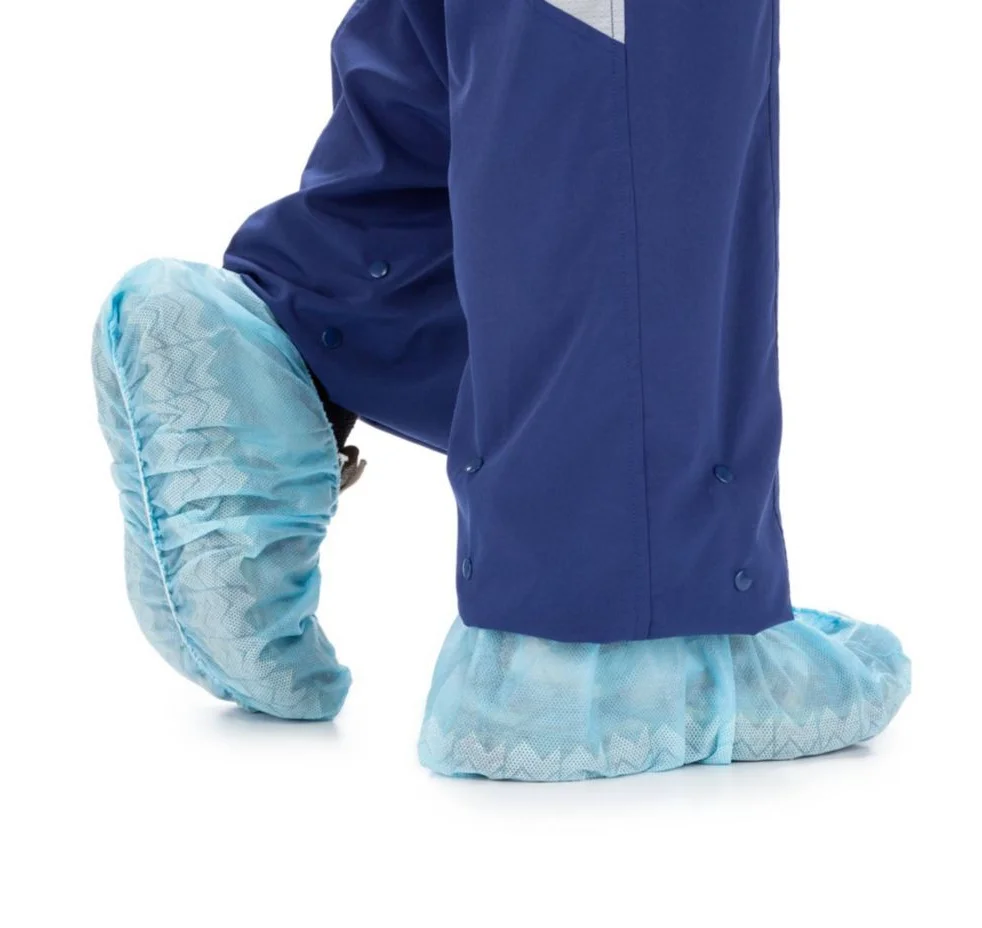
Made of bonded polypropylene fibre, this is the most common type of material used in shoe coverings within hospitals. It is both lightweight and breathable, and therefore highly cost-effective to manufacture. For this reason, it is commonly used for standard wards, visitors’ lounges, and standard operating rooms in which little or no liquid exposure occurs.
2. SMS (Spunbond-Meltblown-Spunbond)
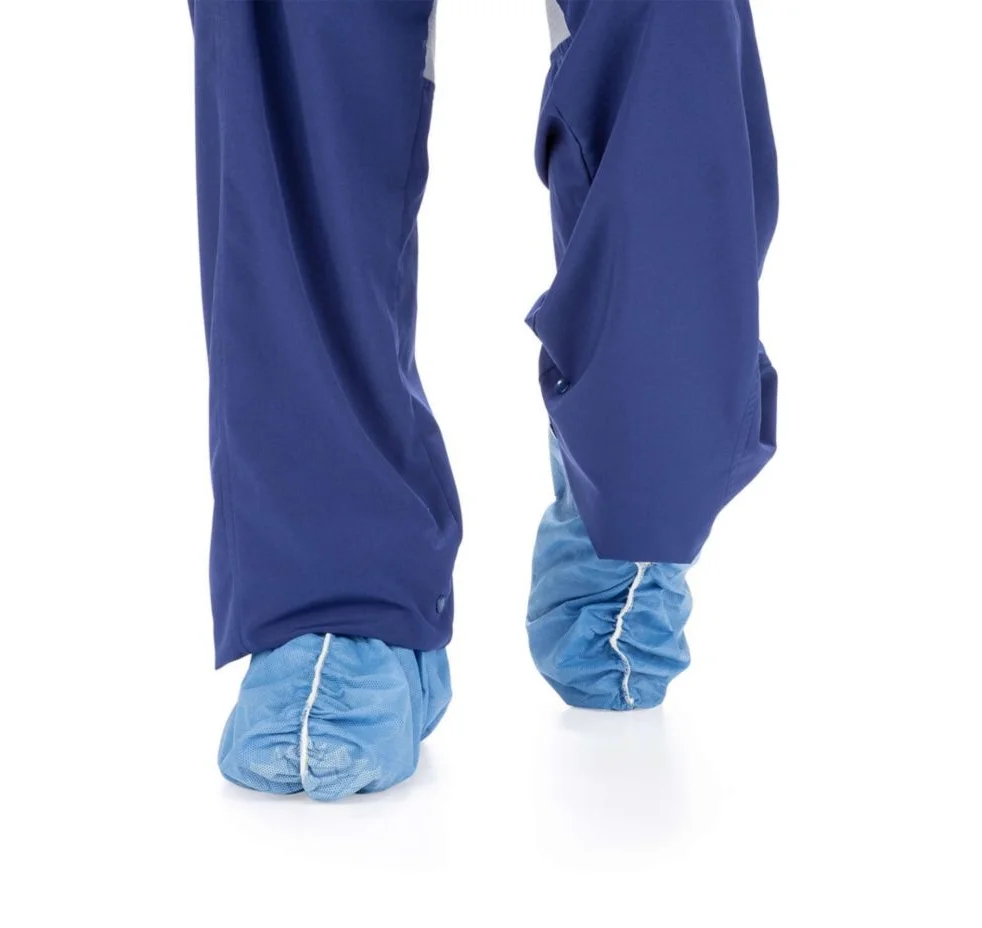
SMS is a composite of three layers of fabric: two outer layers of spunbond for strength, and one middle layer of meltblown, which serves as a fluid barrier as well as a particulate barrier. The reason why non-woven shoe covers made out of SMS are specifically recommended for use in operating rooms is the presence of that additional fluid barrier layer, which provides significant extra protection against liquids.
3. Polyethylene (PE) Film
Polyethylene shoe covers consist of a single layer of plastic film material, thus providing complete waterproofing. They are recommended for use in any high-liquid procedure, such as trauma surgeries, obstetric theatres, and gastroenterology. However, the drawback is reduced breathability, so this material is not ideal for everyday use.
4. Coated Non-Woven Composites.
These involve combining a non-woven core material with a PE or polyurethane layer on the outside surface, thereby providing a compromise between increased fluid resistance compared to just PP or SMS materials, but still maintaining some comfort over an entirely PE structure. This type is often chosen for use in ICUs and extended surgery times.
GSM: The Metric That Reveals What Level of Protection a Shoe Cover Offers
GSM means grams per square metre, and it is the most important number that you should inquire about when considering purchasing shoe covers. The higher the GSM, the stronger, denser, and more effective the material will be.
Here is a guideline for recommended GSM ranges based on the hospital environment:
| Hospital Environment | Recommended GSM Range | Key Requirement |
|---|---|---|
| Ward / Visitors | 15-25 GSM | Breathable, cost-effective |
| Standard Operating Room | 30-45 GSM | Durable, fluid-resistant |
| Intensive Care Unit / Isolation ward | 35-50 GSM | Barrier effectiveness, fit |
| Surgery requiring a high level of fluid | 50+ GSM or PE coated | Waterproof |
| Cleanrooms | 45-60 GSM | Low lint, dust-free |
When you approach a potential supplier, always request the GSM of that exact product, not the type of material itself. Two non-woven PP shoe covers will differ greatly in terms of performance if one is 20 GSM while the other is 40 GSM.
Fluid Resistant vs. Waterproof: An Important Difference
It is one of the most frequently misinterpreted requirements, and either way, it will lead to serious issues with the product purchased.
Being fluid resistant implies that the material is repellent against water at the surface; no absorption, only temporary contact with the liquid, as in splashes or spills. Non-woven SMS shoe covers designed for OR are fluid-resistant. This makes them suitable for a great number of OR environments where incidental fluid contact is expected.
A waterproof property ensures that fluid penetration is prevented regardless of pressure, pertinent for procedures where the members of the surgery team stand or work in large quantities of fluids. The waterproof property is present in PE-coated shoe covers and full PE film constructions. According to the AORN guideline, the use of fluid-resistant or waterproof shoe covers or boots is required in procedures where gross contamination is foreseeable.
For the procurement department, this means facilities should have both, used appropriately. Water-resistant shoe covers for the surgical team for routine surgeries; waterproof shoe covers for complex, high-contamination surgeries.
Grip Soles: Essential for Safety
Anti-Skid is a Must for OR Floors. A wet floor in an operating theatre can form during a procedure, and the loss of traction for a surgeon or scrub nurse during a procedure is a safety incident – not just a nuisance.
When choosing anti-skid medical shoe covers for operating theatre floors, consider soles with:
- PVC dot pattern. Small raised dots were added to the surface of the sole. Performs well for moderate slip on dry floors.
- Diamond (criss-cross) pattern. A more aggressive pattern that is effective on wet floors and with high foot pressures
- Coverage area. The anti-skid sole should be applied to the whole plantar surface, including the heel
- Adhesion strength. The coating should not wear or fail during a procedure; in this case, the pattern will peel off or flatten out, negating the anti-skid effect
When testing samples, always try the anti-skid sole on a wet surface – not just by looking at it. The effectiveness of the slip-resistant coating versus a decorative coating is obvious when walking on it.
Cuff Elastic Types: Fit is More than Skin Deep
The cuff is the part of the shoe cover that holds it in place, and it’s more than a cosmetic consideration. A shoe cover that falls down or bunches up at the ankle is one that is pushed up, rolled down, or, in the worst case, taken off too soon. All of which defeats the purpose.
The types of elastic cuffs are:
- Single elastic – one band encircling the cuff. Widely used in low-cost standard shoe covers; acceptable for low-risk settings.
- Double elastic – two bands at the cuff opening; offers a superior fit and seal, adaptable to a range of leg sizes. The standard for OR shoe covers.
- Knitted elastic – knitted band, providing more stretchability and better conformability. Commonly used for longer surgeries when the shoe cover needs to retain its fit.
Double elastic is recommended for most OR and ICU uses. The latter can be used for general ward and visitor shoe covers, where the risk of infection is lower.
Sizing: Universal or Sized
Typically, disposable shoe covers are a universal fit to suit a range of shoe sizes. This is not a problem in visitor rooms and general wards. But for surgeons and nurses working many hours in the OR, it’s not.
One-size-fits-all shoe covers that are too big on smaller shoes have extra material at the toe that bunches up and gets caught underfoot, posing a trip hazard. On larger shoes, they can be too tight and may even split at the seam.
Sized varieties, which are generally available in S/M and L/XL sizes or as incremental sizes, overcome these problems. They may help increase compliance among staff to wear shoe covers because they are more comfortable and convenient. In terms of procurement, sized options add a bit to inventory management complexity, but reduce wastage from covers being thrown out because they don’t fit well.
Product Spec Comparison: Selecting the Right Shoe Cover
| Specification | Standard Non-woven (PP) | Fluid Resistant (SMS) | Waterproof (PE-Coated) |
|---|---|---|---|
| Material | Polypropylene non-woven | Spunbound meltblown Spunbond | PE film or PE-coated non-woven |
| GSM range | 15-25 GSM | 30-45 GSM | 50+ GSM or coated |
| Fluid resistance | Minimal | Moderate - High | Full waterproof |
| Sole grip | Basic or none | Anti-skid dot/criss-cross | Anti-skid dot/criss-cross |
| Elastic type | Single | Double | Double |
| Breathability | High | Moderate | Low |
| Typical use case | General ward, visitors | Standard OR, Perioperative, ICU | High-fluid surgery, trauma, and obstetric |
| BKAMED reference | PP shoe cover range | SMS OR, shoe cover range | Waterproof PE shoe cover range |
This table is a good guide for spec’ing shoe covers for use in various clinical settings. For facilities with a large procurement footprint (across multiple departments), it’s worth developing a specification matrix with a product type allocated to each department (rather than just one product type for the whole institution).
Specifying shoe covers at procurement time avoids arguments about quality, wastage of mis-matched products, and most importantly, ensures that the shoe covers used in the OR are fit for the clinical purpose they are required to perform.
How to Vet a Manufacturer: Certifications, QA Processes, and Compliance Red Flags
Selecting a shoe cover supplier is not just a business decision; it is a clinical risk mitigation decision. A manufacturer that can’t provide evidence of certified credentials, a quality control process, and clear standards of production is a risk, no matter how low the price quote appears.
This section provides procurement professionals with a guide on how to vet manufacturers before entering a supply contract. The aim here is to go beyond the promises and ask questions that will determine if the manufacturer can be relied upon.
The Certifications That Matter
When considering an ISO-certified medical shoe cover manufacturer, the first step is to determine which certifications apply to the product you are sourcing and what they ensure.
The three most important certifications for hospital procurement are:
-
ISO 13485
This is the ultimate standard for medical consumable procurement. ISO 13485 confirms the manufacturer has a quality management system for medical device manufacture, including control of raw materials and traceability, document control, and vigilance (post-market surveillance).
An ISO 13485-certified shoe cover manufacturer has been independently audited (and signed off) to work to those standards. It’s the most critical certification to check before placing initial orders.
-
CE Marking
CE-marked medical disposables are tested to European Union regulations for health, safety, and environmental impact. CE marking is mandatory for European hospital networks and any other distributor supplying into the EU market.
The CE marking should be checked to ensure that the product is marked under the correct CE Directive or Regulation, as this may impact the product standards applied.
-
FDA Registration
Manufacturers of medical consumables that are exported to the US market must hold an FDA registration. This is a facility registration, rather than product clearance, but it is required for import.
For purchasing managers sourcing on behalf of US hospitals, FDA registration should be confirmed on the FDA’s public database before entering into a contract.
How to Check Certifications
A website logo doesn’t mean anything. The only way to ensure that a manufacturer is certified is to request and verify the certificate.
Here is the verification process:
- Ask to see the original certificate, not a copy, not a scanned copy embedded in a booklet. Obtain the current, valid certificate document with the name of the issuing body, certificate number, scope, and date of issue.
- Look up the certificate number on the issuing body’s list. ISO 13485 certificates for accredited certification bodies can be checked with the International Accreditation Forum (IAF) or the national accreditation body. CE marks can be verified in the EU’s NANDO database of notified bodies.
- Check the scope. A certification for “non-woven fabrics” is not equivalent to one for “disposable medical protective wear”. Be certain the scope of the certification includes the product category of the shoe cover being purchased.
- Check the date. Certificates need to be renewed. An expired certificate is not a simple clerical error; the manufacturer’s operations are no longer audited.
What a Credible QA Process Looks Like Inside the Factory
Certificates will assure the procurement team that the quality assurance process has been inspected. But knowing how a quality assurance process works provides insight into production practices.
There are three stages to a shoe cover QA process for a compliant manufacturer:
Stage 1 – Incoming Inspection Materials
Raw materials, including non-woven fabric rolls, elastic, PE film, and sole coating materials, should be tested upon receipt against specified criteria. This involves checking GSM, composition, and appearance for defects. Any material failing this inspection should be rejected and returned.
Stage 2 – In-Process Inspection
Sampling should be performed at regular intervals during production to verify tolerances (shoe cover size spec), tension of stretch materials (cuff performance), packaging printing (package label quality), and bond or seam strength. This ensures production drift is detected and corrected early.
Stage 3 – Finished Product Testing
Before a batch is shipped, finished shoe covers should be tested to meet the product’s performance specifications (fluid-resistant rating, tensile strength of the shoe cover material, slip-resistant rating of the sole, and packaging integrity). If a manufacturer can provide batch testing reports with each order, then they are doing exactly what hospital procurement staff should expect.
Red Flags That Should Stop a Procurement Process
Not all manufacturers that look good on paper have the goods behind them. These are the red flags to watch out for:
- Being unable to provide original documentation, slow in response, or being vague when asked about it
- Lack of QA staff. Quality checking is ad-hoc or “visual inspection only.”
- Refuses to send product samples. A confident manufacturer would do so readily
- Price much lower than the market. Unit cost 40-60% lower than others is usually a result of a specification cut
- No permanent factory address or audit capability. Trading companies will often identify themselves as a manufacturer; always check that the product is produced at a specific site that can be audited.
- Slow or erratic communication. The speed of communication (and quality of responses) during the quoting process is a good indicator of how problems will be solved once the order is placed
10 Questions to Ask Before Signing a Supply Agreement
Every procurement team should work through these questions when considering a shoe cover manufacturer.
- Is it possible to see the ISO 13485 and CE marking certificate, including the scope and date of issue?
- What are the in-house QA procedures, and when during production are tests conducted?
- What is the annual production capacity for disposable shoe covers and the lead time (from order confirmation to shipment)?
- What is the minimum order quantity (MOQ), and are there options to order a sample for the first order, then proceed with a full order?
- What are the material specifications available – GSM, material, sole design, and elastic?
- Can the product be packed in a special way, private labelled, or OEM produced, and what are the lead time and MOQ consequences?
- What paperwork is included in a shipment – batch test report, certificate of conformity, packing list?
- How will the quality dispute be resolved if the product is not to specification on receipt?
- Can you provide references from the current hospital or medical distributors who have purchased and resold the product to evaluate the supply and product variability?
- Can an audit of the production facility be arranged (virtual or physical inspection), and have any external audits (BSCI, Sedex, etc.) been performed?
If a manufacturer can clearly and quickly answer these questions, with supporting documentation, then they are behaving in an operationally transparent way that warrants a supplier relationship. Unclear, delayed, or adverse responses to any of these questions should be a red flag.
BKAMED’s Quality Assurance Medical PPE
BKA Med is a professional manufacturer of medical consumables (including disposable shoe covers), and our quality assurance and certification standards meet hospital procurement standards. BKA Med’s quality assurance medical PPE standards apply to all three stages of production indicated above, with certification available to qualified buyers upon request.
Once procurement teams have completed the evaluation phase, the next consideration is supplier selection: OEM and private label options are covered in this section, including how to design a custom packaging program for hospital networks and distributors.
OEM and Private Label Options: Custom Packaging Programme for Hospital Networks and Distributors
When it comes to shoe covers, hospital networks and regional distributors sometimes go beyond questions of product specifications and price. For many of these organisations, the question goes a bit beyond product specification and pricing. Many are wondering whether they can purchase these products with their own branding, their own packaging, and using their own specification, to suit their individual needs. And the answer is yes – with OEM and private label products.
This section explores how they work, what can be tailored, and how to get the ball rolling with manufacturers.
What’s the difference between OEM and ODM?
You may hear these terms used in the procurement of medical consumables, and they are often used interchangeably, where they shouldn’t be. They are related but distinct.
OEM (Original Equipment Manufacturer) is when the buyer gets a product from the manufacturer and sells it under their brand name. The product design, specification, material, packaging, etc., are the standard product design. The buyer puts their company logo, plant name, and packaging language on the package.
Original Design Manufacturer (ODM) is one step further. It’s where the manufacturer creates or alters the product to the buyer’s liking. This could be a specific GSM not listed in the catalogue, sole pattern, elastic placement, or a combination of items not listed as products. With a private label disposable shoe cover OEM arrangement, buyers typically begin with an OEM relationship and evolve to ODM as their business grows and their relationship with the supplier deepens.
Why Hospital Chains and Distributors Offer Private Label Shoe Covers
There are a number of reasons why large medical networks and regional distributors prefer to run a private-label disposable shoe cover program, rather than stock and sell the manufacturer’s product with their brand.
-
Margin Control.
For distributors, it’s about margin control. Retail selling a private label product eliminates the manufacturer’s brand equity from the pricing equation – the distributor can set the retail selling price without being constrained by a prominent manufacturer’s suggested retail price.
-
Brand Consistency.
Brand control is important for PPE distributors to hospital networks. Having a single, consistent brand of shoe covers available across all facilities (and with packaging that is consistent across sites) makes it easier to train staff, track compliance, and manage inventory.
-
Facility-specific labelling requirements
Localised labelling of medical products is becoming more common in larger organisations, especially those with operations in different countries. Packaging for private label shoe covers can be printed in multiple languages, with country-specific regulatory labels, and with colour-coded labels for different departments, which would not be available in a catalogue product.
-
Specification Exclusivity
Some OEM products can be sold with exclusivity of product specification, where the manufacturer delivers the product to only one distributor in a given market. This can be invaluable for distributors establishing a unique product portfolio.
What Can Be Customised Under Private Label Programmes
The extent of customisation options under a private label disposable shoe covers OEM program is wider than expected by new customers. These are some of the customisations that are normally possible:
- Number of pairs per inner pack, either 50 pairs, 100 pairs, or any custom quantity, depending on the customer’s needs
- Master carton specifications, including the number of inner packs per master carton, the dimensions and weight of the master carton, and relevant information for storing and handling
- Packaging language. Packaging text in English, French, Arabic, Spanish, or any other language of choice, depending on the target market
- Facility’s or distributor’s logo and brand name on inner pack and master carton
- Color coding of packaging based on size (S/M versus L/XL) or type (standard versus waterproof) of shoe covers for use in facilities stocking several SKUs
- Regulatory markings. CE marking or FDA reference in the label, as applicable
All these require artwork approval prior to manufacture, a common procedure in private label programs, which can be done by supplying an artwork file to us.
Lead Times for Private Label Shoes Cover Order
Custom packaging lead times should be considered while doing the ordering, especially when OEM ordering for the first time
Catalogue shoe cover products can usually ship out within 4-6 weeks from order placement. In addition to the standard lead time considerations, there are additional processes in OEM order fulfillment:
- Creating the artwork and submitting it to the buyer
- Approving the manufacturer’s proof copy
- Printing plate creation (for new label designs)
- Production runs involving custom packaging
- Quality check and packing
Based on the above, it may take an additional 2-4 weeks to complete an order from OEM compared to the standard lead time. Once you have the print plates ready for future orders, the lead time is back to normal.
What would be the recommendation for the team doing its first time ordering shoe covers under a private label or OEM program? The recommendation would be to start the artwork process before even signing the contract. Lack of artwork approval is normally the cause of delays in lead times.
Conducting a Remote Factory Audit for OEM Buyers
Not every purchasing department can afford to travel to the manufacturing plant prior to making an OEM order. Remote auditing has proven to be an acceptable substitute practice since 2020. It should not be an issue for a trustworthy infection control consumable product manufacturer to conduct such a process remotely.
The following are the requirements of a proper remote audit:
- Live video factory tour, including production floor, quality control lab, storage space, and packaging department
- Independent audit reports, including BSCI (Business Social Compliance Initiative) or Sedex (Supplier Ethical Data Exchange)
- Pictures of production machines, quality controls on products in progress, final products’ quality controls, and the packaging room
- Testimonials by at least two or three OEM clients about quality of work performed by the manufacturing plant
A company unwilling to provide information regarding these issues should be avoided.
How to Start an OEM Request with BKAMed
In order to obtain a quote that is both relevant and timely, the following information must be considered prior to sending out an OEM request:
- Target product specifications (type of material, GSM, type of sole, type of elastic, size)
- Certification required (ISO 13485, CE, FDA, others)
- Annual quantity estimate and order frequency
- Packaging specifications (number of units inside the inner pack, languages, logos, colours)
- Target destination country and Incoterms required
The more information that is available at the beginning of the discussion, the more precise the quote will be.
Shipment, Lead Time, and Incoterms
The process of sourcing medical shoe covers directly from manufacturers is almost always going to include some form of international shipment. For procurement professionals who are more accustomed to sourcing products domestically, issues like freight costs, lead time, and documentation might come as foreign territory.
While it doesn’t have to be overly complex, there is information that needs to be learned prior to placing your first order. This section deals with all those logistical details that need to be sorted out before you commit to a direct source for medical shoe covers.
Incoterms: The Three That Matter Most for Medical Consumables
Incoterms are standard terms of trade that define the obligations related to freight, insurance, customs clearing, and risk during international shipments. There are eleven different Incoterms, but when sourcing shoe covers, only three need to be considered.
| Incoterms | What It Means | Whose Freight Responsibility Lies With |
|---|---|---|
| EXW (Ex Works) | Goods are ready at the factory. All freight, insurance, export clearance, and further handling become the buyer’s responsibility at this point | Buyer arranges all freight |
| FOB (Free On Board) | The shipper is responsible for loading the goods on board the ship at the origin port and ensuring export clearance. The buyer will be responsible for all ocean freight, insurance, and import clearance at this point | Buyer arranges all freight |
| CIF (Cost, Insurance, Freight) | The manufacturer handles and pays all costs of getting the freight to its destination port. The responsibility of import clearance and further delivery is the buyer’s responsibility | Manufacturer to destination port |
Of the three Incoterms, FOB or CIF would seem more reasonable for procurement teams and distributors who are making their first direct procurement from the manufacturer. Under EXW, the responsibility of freight falls entirely on the buyer from the very beginning, requiring prior freight forwarding services that may not yet be in place for first-time buyers.
EXW offers some margin of cost savings to an experienced procurement team with its own freight forwarders due to direct control of the freight costs.
Understanding Lead Times: Managing Expectations
Perhaps the most frequent sticking point on direct manufacturer sourcing is unrealistic lead times. Distributors typically stock locally, which means you might feel like you’re ordering from the local store. With a direct manufacturer, there is a different lead time.
Here’s a typical lead time for disposable shoe covers:
- Catalogue items – 4-6 weeks after order confirmation to the port of origin
- Private label – 6-10 weeks (including artwork approval and print preparation)
- Demand surges (Q4, post-outbreak, global PPE demand) – add 2-4 weeks to any of the above
The lesson from COVID-19’s impact on the shoe cover supply chain was this: facilities that sourced directly from manufacturers with prioritised allocation arrangements were able to continue supply. Facilities relying fully on distributors during periods of peak demand were last in line.
The best way to avoid this situation is to account for lead times in procurement planning – and hold buffer stock.
Documentation Required for International Shipments
Certain documentation is required for international shipments of medical PPE. These should be standard practice from a reputable manufacturer.
The requisite documentation for disposable shoe cover shipments is:
- Certificate of Origin. Certifies the place of manufacture; required for customs and tariff classifications
- Product Test Reports – batch performance test results (GSM confirmation, fluid resistance, tensile strength); critical for clinical procurement audit trails
- MSDS (Material Safety Data Sheet) – required for some material types and shipping lanes; confirms product composition and shipping guidelines
- Commercial Invoice – value per item sent, needed for customs and duties
- Packing List – carton count, pair count per carton, gross and net weight; needed for receiving in the warehouse
For hospitals and facilities sourcing PPE for medical facilities in a number of countries, the full documentation set per shipment streamlines compliance audits and customs clearing processes.
BKAMed includes the standard documentation set with each international shipment, and can provide additional compliance documents, such as copies of certificates of conformity and ISO certification documents, on request.
Why BKA Med Is The Leading Manufacturer of Disposable Medical Shoe Covers for Hospitals

BKA Med is a China-based professional manufacturer of medical consumables, which supplies to hospitals, surgical centres, and medical distributors in several international markets.
Shoe covers are just one of the categories of products that the company produces, including non-woven products, gauze, cotton, bandages, wound care, surgical tape, medical plaster, catheters, and a wide range of other first aid and infection control consumables as well.
The diversity of manufacturing is important. It means BKA Med is not a product-focused company with a single line of production; it is a manufacturing facility with the capacity, quality, and international supply chain capability to be a trusted medical consumable partner for facilities and distributors that require more than a one-off sale.
Certifications and Compliance
BKA Med is certified in quality management and regulatory compliance in line with hospital procurement policies and procedures, including adherence to ISO standards for medical consumables and CE marking for supply into Europe.
Buyers can request copies of certification documents, including the scope of certification, the certifying body, and the dates of validity (the same process as Section 5 in this guide).
For purchasing teams working in regulated markets, BKAMed’s certification documents support the traceability of hospital infection control and procurement governance initiatives.
The Shoe Cover Product Range
BKA Med’s shoe cover range is built to meet the entire range of demands in the hospital and surgical environment operation, not just a single shoe cover.
Here’s what’s on offer:
| Product Type | Material | Key Feature | Typical Use |
|---|---|---|---|
| Standard Disposable Shoe Cover | PP Non Woven | Breathable, lightweight | General ward, visitor areas |
| Surgical-grade non-woven shoe cover | SMS Non-woven | Fluid-resistant barrier layer | Standard OR, perioperative |
| Waterproof shoe cover | PE coated / PE film | Full waterproof protection | High-risk fluid surgery, trauma, and obstetric |
| Anti-skid OR shoe cover | PP or SMS with PVC sole | Grips on wet floors | Operating theatre environments |
| Heavy-duty shoe cover | High GSM non-woven blend | Improved protection and strength | ICU, Isolation rooms, cleanrooms |
All products are offered in standard sizes, but can be customized for size, elasticity, and inner pack count. For hospitals with multiple departments that require a variety of shoe cover sizes, BKA Med can provide the entire range of sizes under a single supply contract – making procurement much easier.
BKAMED’s Manufacturing Capability and Supply Reliability
BKA Med is a factory-direct supplier, not a middleman. This is important for procurement teams requiring consistent quality with subsequent orders. When the same factory is making every batch to the same written specification, batch-to-batch variability can be controlled in a documented process rather than relying on chance.
BKA Med’s manufacturing operations have been configured to handle high-volume order intake from either hospital volume orderers or distributor volume orderers. The company can handle large orders from those organisations that order in their tens of thousands on a yearly basis without sacrificing lead times.
BKA Med caters to overseas buyers in Europe, the Middle East, Africa, and Asia-Pacific through their efficient shipping processes that take care of shipping documentation on their part. As for those purchasers who may be new to direct purchasing from a manufacturer, the customer account team at BKA Med will help navigate the logistical challenges that come with it.
BKA Med’s Private Label Capability for Distributors
In accordance with Section 6, BKA Med provides full OEM and private label capability for hospitals as well as regional distributors. Custom packaging, labeling languages, packaging configurations, as well as custom brand artwork are all possible when working with BKA Med. When creating a custom line of medical disposables, BKA Med serves as the manufacturing partner for your brand.
How to Get Started
Getting started with BKA Med is quite simple. The first step should be a sample request, which enables procurement departments to analyze the sample itself on the basis of the requirements at their facility before making any decision about ordering.
The typical sequence of steps from sample approval to first purchase is as follows:
- Making a sample request via BKAMED, indicating the product type and specification required
- Delivery of samples along with all the documents needed (test report, CoC)
- Confirmation of specifications; making a request for a commercial offer with indication of volume and packaging required
- Agreement upon supply conditions, Incoterms, and payment method
- Making your first order, receiving full documentation along with the consignment
The quotation period is normally 2–3 working days for catalogued products, and 5–7 working days for custom/OEM products.
FAQs
What is the minimum order quantity for disposable medical shoe covers from BKA Med?
The company provides samples of 1 to 5 cartons. MOQ for commercial orders ranges from 10 to 20 cartons, or around 1,000-2,000 pairs, depending upon the type and specification. MOQ on the first order tends to be flexible when the customer is able to provide an estimate of the annual volume.
Is it possible to order shoe covers in custom/private-labeled packaging?
Yes, the company provides a complete private label program for OEM. This can be done according to individual needs, such as inner packing count, master box pack, labelling language, brand name/logo, and colour coding according to size or product type. Orders with custom packaging tend to take additional time, around 2-4 weeks, longer than the standard lead time. In case of repeat orders with identical packaging, the lead time comes down to near standard lead time.
How can a hospital ascertain that a shoe cover manufacturer is ISO certified?
Ask the supplier for the original ISO 13485 certificate containing the certificate number, issued by the body, its scope, and expiry date. Check out this certificate number from the issuing body’s website or from the IAF database. Ensure that the certificate scope includes the relevant category of medical consumables to be procured. Any ISO-certified manufacturer will happily give you this certificate as a mark of their compliance and legitimacy.
Which type of material is best for shoe covers for hospitals?
For standard operations where only occasional contact with fluids may occur, non-woven shoe covers made up of SMS (spunbond-meltblown-spunbond) are the most preferred products. Meltblown material offers some level of fluid resistance while keeping it breathable at the same time. For high-level procedures like trauma surgeries, OB theatres, and GI surgeries, waterproof shoe covers made of coated or full PE films should be employed. Most hospitals keep supplies of both these shoe covers and apply them according to the procedure.
How long does it take to get a bulk order of shoe covers?
Typical lead time for standard catalog items is 4-6 weeks after receipt of the purchase order to delivery at the port of origin. Lead time for custom or private label orders is 6-10 weeks to allow for artwork approval and print setup; repeat orders on an existing item are close to standard lead time. In peak season, allowing another 2-4 weeks to this schedule is advisable. The best way to ensure supply during peak season is to have sufficient inventory in the form of a 60-90 days’ buffer stock at the facility level.
Does BKA Med ship internationally? What shipping terms can be used?
Yes, BKA Med ships its products to all international buyers based in Europe, the Middle East, Africa, and the Asia Pacific regions. BKA Med has experience shipping goods into these regions through freight forwarders and understands the documentation needs specific to each region. Available shipping terms are FOB and CIF; EXW may be considered in cases where customers prefer their own freight forwarding agent. Every order is shipped with full documentation: certificates of origin, commercial invoice, packing list, and quality control test reports.
Sourcing Shoe Covers Direct: The Bottom Line for Hospitals and Distributors
The benefits associated with procuring your own shoes directly from the disposable medical shoe covers manufacturer are based on four main factors: decreased cost per unit, improved product specification, quality assurance, and supply reliability. We’ve looked at all of these factors in-depth and provided insight into distributors’ markups, certificates to check, and even international shipment.
Procurement specialists who are prepared to order should do three things. First, order a product sample from BKAMed; secondly, review the product’s characteristics; and thirdly, request a commercial offer.
An order made from an ISO certified medical shoe cover manufacturer means you’ll be receiving a high-quality product with guaranteed supply and competitive prices.
Start the conversation at bkamed.com.
