
A medical tape order might appear straightforward on paper: select the width, confirm the number of rolls required, and order them. However, when thousands of rolls are involved, differences in adhesive performance, backing material, packaging, compliance, and delivery reliability can make a significant difference to your operation.
That’s why it’s important to look beyond the lowest quotation when sourcing Zinc Oxide Bandage Tape. Hospital procurement teams value reliable fixation performance and consistent quality. Sports medicine distributors look for rigidity, tensile strength, and other physical characteristics. Importers and wholesalers are looking for competitive pricing, documentation, and guaranteed replenishment.
This guide explains the key characteristics B2B buyers should consider before buying Zinc Oxide Bandage Tape wholesale in bulk, including product specifications, supplier qualification, compliance, MOQ, pricing, and opportunities for OEM and long-term supply planning.
What Is Zinc Oxide Bandage Tape?
Zinc Oxide Bandage Tape is a medical-grade rigid or semi-rigid adhesive tape used for dressings, for supporting an injured area, and for firm fixation. It is usually made with a woven textile fabric such as cotton, rayon, or a similar weave, and is bonded with a medical-grade adhesive formulation that has historically contained zinc oxide. This combination results in a tape with excellent adhesion and firmness for reliable support.
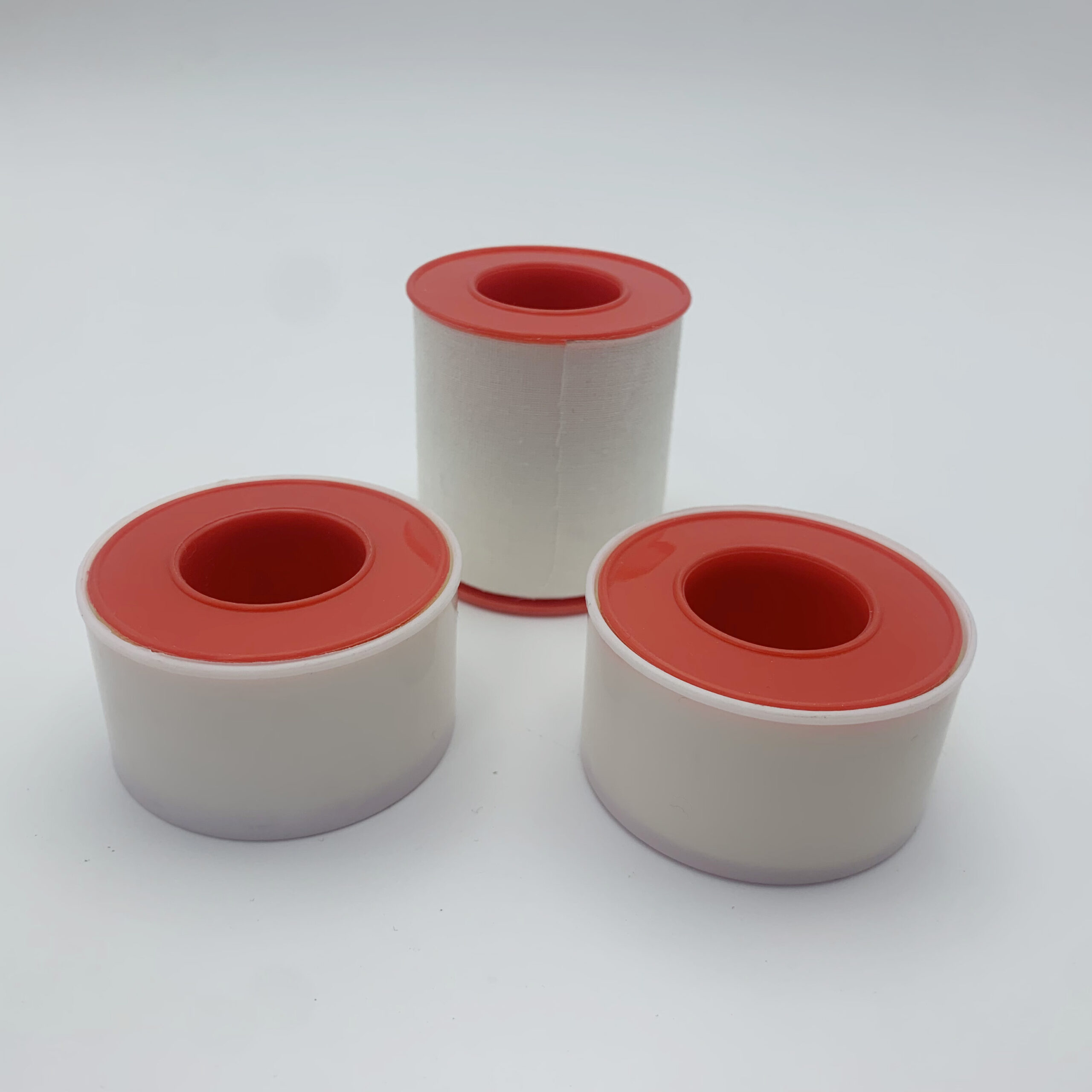
For B2B buyers, it is important to understand how the tape is constructed, as each component can impact performance and cost. A typical construction can be divided into three layers:
- Backing cloth: The woven fabric gives the tape its strength, rigidity, breathability, and tear resistance. Cotton is a commonly used material, though other textiles such as rayon may be specified depending on the manufacturer and intended use.
- Adhesive coating: The adhesive provides the necessary tackiness to secure the tape to skin, dressings, or other medical materials. Buyers should pay close attention to adhesion, residue, skin tolerance, and performance under moist or perspiration conditions.
- Roll and packaging: The coated material is wound into rolls and may be individually wrapped, packed in protective casings, or supplied in bulk cartons for various applications.
A key feature of Zinc Oxide Bandage Tape is its low extensibility. Unlike elastic or kinesiology tapes, which are designed to move and stretch with the body, this tape is intended to remain stable. Where firm fixation or mechanical support is needed, zinc oxide tape is therefore typically the product of choice.
It can be used in a variety of ways, including wound fixation, medical device securement, sports strapping, and joint stabilization. For example, UNFPA specifies zinc oxide adhesive tape for wound dressing and general securement of tubing and devices, with requirements including strong adhesion, breathability, non-stretch construction, hand-tearability, and water resistance.
These characteristics make Zinc Oxide Bandage Tape a regular medical consumable for hospitals and distributors, not just another adhesive product. The appropriate specification is ultimately determined by the intended market — whether clinical wound care, first aid, sports medicine, or general distribution.
Zinc Oxide Bandage Tape vs. Zinc Oxide Tape: What B2B Buyers Need to Know
When ordering medical tape from overseas, you’ll encounter several names for similar products: Zinc Oxide Bandage Tape, zinc oxide tape, zinc oxide plaster tape, and zinc oxide strapping tape. While these terms are often used interchangeably in supplier catalogs, procurement teams shouldn’t take anything for granted — because not every product with the same name will share the same specifications.
The primary difference lies in intended use and positioning. Zinc Oxide Bandage Tape describes a rigid adhesive tape designed for clinical settings — the attachment of dressings, securing bandages, and routine wound care. Zinc oxide tape is a broader commercial term that can include rigid strapping products used in sports medicine, physiotherapy, and athletic support.
When comparing zinc oxide bandage tape wholesale suppliers, a quotation for “zinc oxide tape” may therefore refer to a different product than a quotation for Zinc Oxide Bandage Tape. The two can vary in fabric weight, adhesive construction, rigidity, tensile strength, dimensions, packaging, and even the regulatory claims being made.
Why the Product Name Alone Is Not Enough
Suppose two factories bid to supply you with 5 cm wide zinc oxide tape. The offers may look similar on paper. However, one manufacturer may produce a lighter woven backing primarily suited to dressing fixation, while the other may produce a denser, more rigid backing designed for athletic strapping.
The adhesive used may also vary. One product might be designed for comfortable skin contact and extended fixation, while the other focuses on strong adhesion during sports use. These differences can affect performance and also the documentation required for your destination market.
This is especially important for distributors. A product promoted as a hospital wound-care product should be supported by the appropriate documentation and labeling. Equally, a supplier providing zinc oxide bandage tape to sports medicine wholesale buyers should be able to discuss rigidity, tensile strength, adhesion, and primary use in sports medicine applications.
Zinc Oxide Bandage Tape vs. General Zinc Oxide / Strapping Tape
| Attribute | Zinc Oxide Bandage Tape | General Zinc Oxide / Strapping Tape |
|---|---|---|
| Typical backing | Woven cotton or cotton-blend fabric suited for firm fixation | Woven textile, often used for rigid athletic support |
| Rigidity | Rigid or semi-rigid as specified | Rigid and non-stretch, or rigid with some stretch (hybrid) |
| Primary use | Fixation of dressings, bandages, and wound care | Joint stabilization, athletic strapping, and injury prevention |
| Typical buyers | Hospitals, clinics, medical distributors, pharma | Sports medicine suppliers, physiotherapists, sports teams |
| Performance priorities | Adhesion, fixation, skin tolerance, and tearability | Rigidity, tensile strength, adhesion, and secure joint support |
| Regulatory considerations | Must meet the intended medical use and destination-market requirements | Documentation should match the medical or sports-related claims being made |
| Common widths | Narrow to medium — widths suited to dressing and medical fixation | Narrow, medium, and wider for various body parts |
Use the table above as a purchasing reference, not as a technical specification applicable to every product. Backing weight, adhesive formulation, tensile strength, and dimensions differ from manufacturer to manufacturer.
Why This Difference Affects Your Supplier Quotations
One of the most frequent procurement pitfalls is comparing zinc oxide bandage tape wholesale supplier quotes on a price-per-roll basis alone. A lower-priced quotation may not represent the best value if one supplier offers a lighter product while another offers a heavier, stiffer construction.
The same problem occurs with packaging. A sports distributor might want products sorted into retail-ready boxes or multipacks, whereas a hospital may need individually wrapped rolls with detailed product labelling and traceability. These requirements affect the final unit price and must therefore be defined before suppliers submit quotations.
There may also be regulatory implications. The intended use, product claims, labelling, or destination market can all affect how the product is regulated. Buyers should not assume that a certificate or regulatory document for one zinc oxide tape product automatically applies to all products sold under a similar name.
What to Write in Your RFQ
Do not send an RFQ asking only for “zinc oxide tape.” Instead, give the manufacturer enough information to identify exactly what you need. For example:
- Product: Zinc Oxide Bandage Tape
- Intended use: Hospital dressing and bandage fixation
- Backing: Woven cotton
- Construction: Non-stretch / rigid
- Width: 5 cm
- Length: [required length]
- Packaging: Individually wrapped
- Quantity: [required quantity]
- Destination: [country/market]
- Required documents: Applicable quality and regulatory documents
When ordering sports medicine tape, specify that the product is intended strictly for rigid athletic taping and provide any relevant performance criteria relating to tensile strength, rigidity, adhesion, or width.
This level of detail allows for meaningful comparison of zinc oxide bandage tape wholesale supplier quotations, since all manufacturers are quoting against the same specification rather than their own interpretation of “zinc oxide tape.”
The best approach is to treat the product name as a starting point rather than a specification. Request a technical data sheet, a sample, packaging information, intended-use documentation, and applicable certifications before making any bulk purchase commitment.
Why Zinc Oxide Bandage Tape Is a High-Volume B2B Category
On the surface, Zinc Oxide Bandage Tape may not appear to be a particularly large medical consumable when compared with wound dressings, gauze, or surgical equipment. But in practice it belongs to a far bigger and growing medical tapes and wound-care supply chain, making it an attractive recurring SKU for clinics, resellers, importers, and sports medicine suppliers capable of maintaining a steady supply.
The Market Is Large — and Still Growing
According to Grand View Research, the global medical tapes and bandages market was valued at USD 7.8 billion in 2023 and is expected to expand at a 3.4% CAGR from 2024 to 2030, reaching USD 9.9 billion by the end of 2030. The largest application segment was surgical wounds, and hospitals contributed over 28% of end-use revenue in 2023.
According to a separate analysis by Grand View Research, the global medical adhesive tapes market was valued at USD 9.3 billion in 2023 and is projected to grow at a 6.14% CAGR through 2030, with surgical use, wound dressing, and securement cited as key demand areas.
These figures are not specific to Zinc Oxide Bandage Tape alone. They illustrate the scale of the broader category to which zinc oxide tapes belong. For B2B buyers, the opportunity is not just about selling zinc oxide tape — it’s about participating reliably in a large, recurring-consumables market.
What Keeps Bulk Demand Moving?
There are several structural reasons for continued demand:
- Aging populations: Older individuals typically require more healthcare, including the treatment and management of wounds, injuries, and chronic conditions. Grand View Research specifically identifies the growing geriatric population and its associated health needs as a key factor driving demand for medical tapes and bandages.
- Surgical activity and wound care: Medical adhesive tapes are used routinely to hold dressings, tubing, and IV lines in place across clinical procedures. Rising surgical activity tends to sustain ongoing demand for medical tape products.
- Sports and physical activity: Beyond the hospital, rigid zinc oxide tapes continue to play a role in sports medicine, physiotherapy, athletic coaching, and injury support, creating an additional commercial channel.
- Outpatient and home care: A growing trend toward healthcare services delivered outside hospital settings generates further demand for functional and easy-to-use fixation products. The expansion of home healthcare services is also contributing to growth in the medical adhesive market overall.
Why It Becomes a Repeat-Order SKU
The most significant commercial benefit is the frequency of consumption. A hospital does not buy adhesive tape once and use it indefinitely. Tape is consumed as dressings are changed, procedures are carried out, departmental stocks are replenished, and emergency supplies are replaced.
The same applies to distributors. Once a customer has approved a specific Zinc Oxide Bandage Tape, it can be added to a product catalog or placed on a hospital supply contract, and subsequent orders become significantly more straightforward than the initial qualification order.
This creates several opportunities: recurring hospital replenishment based on historical consumption; pharmacy, clinic, sports supplier, and medical retailer stock rotation; contract or framework purchasing where approved products are reordered throughout a contract period; and private-label programs in which a distributor develops its own specification and brand.
In this category, consistency with a zinc oxide bandage tape wholesale supplier can therefore be as important as the initial price.
Why China Matters to B2B Sourcing
When searching for a zinc oxide bandage tape exporter or a zinc oxide athletic tape manufacturer in China, China is a key source to consider given its role in the production and supply of medical consumables. However, manufactured-in-China status is not a qualification in itself.
Buyers should review the manufacturer’s production capacity, quality system, export experience, documentation, sample quality, MOQ, and ability to maintain the same specification across repeat orders. Working directly with a qualified manufacturer can also prove advantageous for larger distributors, offering improved customization options, private-labelling possibilities, and more stable long-term pricing.
The challenge is not simply finding the cheapest Zinc Oxide Bandage Tape available in China — it is finding a manufacturer that can deliver the same specifications, quality, documentation, and supply reliability every time an order is placed.
Applications Driving High-Volume Bulk Demand
Multiple healthcare channels demand Zinc Oxide Bandage Tape. Hospitals use it for routine dressing fixation; sports medicine practitioners rely on rigid tape for joint support and injury management; distributors, pharmacies, humanitarian organizations, and government agencies represent further purchasing channels. This diversity is a strategic asset for manufacturers and wholesalers, as demand does not rely on any single customer segment.
1. Hospitals and Clinical Settings
Hospitals are among the most consistent users of medical adhesive tape, applying it across standard clinical tasks as well as specialty procedures.
Zinc Oxide Bandage Tape can be used to hold wound dressings in place and to assist in securing gauze or other wound-care materials in surgical and postoperative wards. Dressing changes are a routine activity, and replenishment is typically needed more frequently than with longer-lasting medical supplies.
Other clinical applications include IV, catheter, and cannula securement where tape forms part of a fixation system for medical tubing and devices; general ward use where nurses apply fixation tape during routine wound care and dressing changes; emergency departments where first-aid and trauma teams maintain ready stocks of fixation materials; and burn and wound-care units where frequent dressing changes generate considerable demand for fixation products.
For hospital procurement, volume is just one factor. Consistent adhesion, clean hand-tear performance, packaging, traceability, and appropriate documentation all determine whether a specific tape is approved for routine institutional use.
2. Sports Medicine and Physiotherapy
Sports medicine represents a significant demand channel. Rigid zinc oxide tape is well established in athletic strapping and mechanical joint support.
Sports medicine distributors supply physiotherapy clinics, professional teams, gymnasiums, athletic departments, and individual healthcare providers. These customers use rigid tape for ankle, wrist, finger, and other joint applications that require firm strapping.
Typical purchasing environments include physiotherapy clinics maintaining regular stocks for patient treatment; athletic training rooms where tape is used in practice, competition, and injury management; professional and amateur sports teams purchasing tape as part of medical kit; and team medical kits stocked with a range of widths and roll sizes for different applications.
For this segment, rigidity, tensile strength, adhesion, and tearability are more central purchasing criteria than institutional packaging format. A sports medicine wholesale zinc oxide bandage tape program should therefore start with specific performance requirements, not a generic medical bandage description.
3. Distributors and Pharmacy Channels
Medical distributors represent another significant recurring-demand channel, purchasing for resale across multiple downstream markets.
A distributor may sell Zinc Oxide Bandage Tape as part of a broader wound-care or first-aid product line including gauze, bandages, dressings, and other medical supplies. Once established, restocking becomes a regular part of inventory procedures. Pharmacy and distribution channels can include first-aid kit assembly, retail pharmacy stock, occupational health and workplace first-aid supplies, clinic and nursing-home supplies, and fulfilment of government and institutional tenders.
This creates an opportunity for importers to purchase in bulk from a rigid zinc oxide bandage tape wholesale supplier and sell into multiple customer segments rather than relying on a single group.
4. Humanitarian and Government Procurement
Humanitarian organizations and government agencies can generate large-volume requirements through medical supply procurement for field operations, emergency preparedness, and public health programs.
NGOs may include adhesive tape in emergency wound-care or first-aid kits, while disaster-response programs maintain stockpiles that require periodic replenishment. Government procurement can also cover centralized buying for hospitals, clinics, emergency services, and national medical-supply programs.
These orders can carry requirements that go beyond typical commercial purchasing — defined specifications, documentation, packaging instructions, delivery schedules, and tender compliance. Organizations using international procurement processes often develop detailed technical specifications before inviting suppliers to bid.
One Product, Four Demand Channels
The same basic Zinc Oxide Bandage Tape product can serve four distinct B2B channels — hospitals, sports medicine, distribution, and humanitarian/government — each with different purchasing priorities. For distributors, this is not a niche SKU; it can be integrated into a much larger medical-consumables portfolio with multiple potential revenue streams.
What matters is not treating all four markets as identical. A hospital buyer may prioritize clinical documentation and consistent fixation. A sports distributor may focus on rigidity and athletic performance. A humanitarian procurement may emphasize specification compliance and on-time delivery. A pharmacy distributor may place greater weight on packaging, price, and retail presentation.
Understanding these differences before ordering in bulk allows buyers to make the right choices regarding specification, packaging format, and supply strategy for each market.
Key Specifications to Define Before Ordering
Before sending a single RFQ, you need a specification sheet — not a general description. Ask ten different suppliers to quote “Zinc Oxide Bandage Tape” without one, and you will receive ten different products at ten different prices, most of which will not be genuinely comparable.
You don’t need to be a materials engineer to get this right. You simply need to identify the variables that meaningfully affect performance and price, and document them before inviting bids. Vague RFQs are among the most common reasons buyers end up comparing offers that don’t correspond to the product they actually need.
Every Zinc Oxide Bandage Tape specification sheet should cover the following:
- Backing material and fabric weight. Most Zinc Oxide Bandage Tape is manufactured using a woven cotton or cotton-blend fabric, though some producers use rayon-blend backings. Cotton tends to be more rigid and tear-resistant — important for buyers sourcing a bulk rigid zinc oxide bandage tape for sports strapping or joint-support applications. Rayon-blend backings can be more skin-friendly, which matters in hospital dressing fixation where patient comfort is important over multi-day use. Specify the gsm of the fabric, not just “cotton” or “rayon.”
- Adhesive type and performance. Ask about initial tack, peel adhesion, holding power over time, residue upon removal, and performance under moisture or perspiration. A Zinc Oxide Bandage Tape that loses tack in a humid ward or during an athlete’s training session is not performing its function, regardless of how it reads on a datasheet.
- Roll width and length, with tolerance. Specify the exact width or widths required — typical widths range from approximately 1.25 cm to 10 cm — along with the required roll length and acceptable tolerance. A 10% roll-length shortfall across a container-load order is a significant financial loss and a method some lower-quality suppliers use to reduce costs.
- Edge finish and hand-tear performance. Clean, straight edges with no fraying are an indicator of disciplined manufacturing. Good hand-tear performance — producing a straight, clean tear in both directions without scissors — is essential in fast-paced clinical and sideline environments where staff may not have a free hand to reach for shears.
- Perforated vs. non-perforated. Perforated Zinc Oxide Bandage Tape can be more breathable and comfortable for extended wear, while non-perforated tape may provide a more uniform adhesive bond. Determine which type your end use requires before requesting pricing, as the two are not interchangeable when comparing quotations.
- Packaging format. Requirements vary: some buyers need individually wrapped rolls or retail-ready boxes, while others prefer bulk cartons. Hospitals generally favor bulk institutional cartons that are easy to store and distribute internally. Resellers supplying pharmacies or sports shops often require retail-ready presentation. This must be clarified in advance as it affects both price and MOQ.
- Labelling requirements. Depending on your destination market, labelling may need to include lot number, manufacturing and expiry dates, country of origin, barcode, and the correct language or languages. Approve label artwork before mass production begins — corrections during production are expensive and time-consuming.
- Shelf life and storage conditions. Confirm the validated shelf life, minimum remaining shelf life at time of shipment, and recommended storage conditions. This is particularly important for hospitals or NGOs that need to carry a substantial shelf-life buffer before products reach their end users.
Turning This Into a Working RFQ
Put all of the above in plain language in your inquiry before contacting a single manufacturer: your required backing material and fabric weight, adhesive performance requirements, exact roll width and length with acceptable tolerance, whether you want perforated or non-perforated tape, edge finish and hand-tear expectations, preferred packaging format, labelling requirements for your destination market, minimum required shelf life at shipment, and any certifications needed on file such as CE/ISO documentation for zinc oxide bandage tape bulk orders.
Send that same list to every supplier you are considering. Once all are quoted against the same criteria, there is no guesswork about why one quote is 20% cheaper than another, and no unwelcome discoveries after the container arrives that “cheaper” meant a thinner backing and a lower-grade adhesive.
How to Find and Qualify a Zinc Oxide Bandage Tape Wholesale Supplier
With a specification sheet in place, the next challenge is finding a zinc oxide bandage tape wholesale supplier that can consistently deliver to it. This is where many B2B buyers run into difficulty — not because good manufacturers are scarce, but because it is hard to distinguish a true factory from a trading company selling someone else’s production.
Manufacturer vs. Trading Company: Know Who You’re Actually Talking To
Many companies sell Zinc Oxide Bandage Tape. Far fewer actually produce it. A trading company acquires goods from multiple factories and sells them under its own name — which isn’t inherently dishonest, but it does place a layer between you and the manufacturing plant, along with a markup.
A true zinc oxide bandage tape exporter with its own production line should be ready to provide a factory audit or video tour, answer detailed technical questions about the adhesive formulation and backing construction, and discuss its own quality-control process in specific terms rather than with generic industry claims. If a “supplier” is non-specific when you ask where the tape is actually made, that tells you something important.
What to Check Before You Request a Quote
A few factors distinguish zinc oxide bandage tape wholesale suppliers worth working with from those likely to cause problems later:
- Years of experience in medical consumables manufacturing. A background in this field — not just textiles or packaging — tends to be associated with more consistent quality control and knowledge of medical labelling and documentation requirements.
- Export track record. A zinc oxide bandage tape wholesale supplier who regularly ships products internationally will already understand the commercial invoice, packing list, certificate of origin, and customs paperwork your market requires. One without export experience will be learning on your order.
- Quality management systems. Ask about incoming raw-material inspection, in-process quality monitoring, and finished-roll verification before packaging. A zinc oxide bandage tape wholesale supplier who can describe their controls in specific, detailed terms is a very different proposition from one who simply says “We have strict QC.”
- Sample responsiveness. The speed and thoroughness of a supplier’s response to a sample request is a reliable indicator of how they will handle an actual order. Slow, partial, or incomplete sample delivery rarely improves once payment has been made.
- Communication quality. Clear, prompt, and technically accurate answers during the inquiry stage predict how smoothly production and shipping will go later.
Red Flags Worth Walking Away From
The following warning signs should give you pause before ordering Zinc Oxide Bandage Tape in bulk:
- Vagueness or ambiguity about certifications, particularly when asked which specific product a certificate applies to.
- Difficulty or reluctance to provide production samples.
- Quotes that vary significantly from inquiry to inquiry for no apparent reason.
- A factory address that cannot be verified, or a registered address that does not match the stated production location.
Any one of these may have an innocent explanation. What matters is when they appear as a pattern — because that pattern tends to reappear at the worst possible time, when you need a zinc oxide bandage tape wholesale supplier for repeat orders.
Start Smaller Than You Think You Need To
Even when all the boxes are ticked on paper, a zinc oxide bandage tape wholesale supplier should earn a long-term contract rather than simply receive one. A trial order before committing to volume gives you the opportunity to see what actual delivery consistency, packaging quality, and shipping performance look like before you scale. Compare the results against your specification sheet. If the product delivers, move forward. If it doesn’t, you’ve limited your exposure to a single shipment rather than a full container you now need to manage.
Compliance and Import Regulations
Zinc Oxide Bandage Tape comes into direct and extended contact with skin — frequently damaged skin. That fact alone is sufficient for regulators around the world to treat it as a medical device rather than a standard textile product, which means compliance cannot be an afterthought once your container is at sea.
An incorrect regulatory picture is not just a fine. It can result in a shipment held at customs, a rejected hospital tender, or a distributor removing your product from their catalog.
United States: FDA Classification
In the U.S., Zinc Oxide Bandage Tape is regulated under 21 CFR 880.5240, “Medical adhesive tape and adhesive bandage,” with product code KGX. This is a Class I product — the lowest-risk FDA category, alongside items such as tongue depressors and bandages.
Class I status generally means standard Zinc Oxide Bandage Tape is exempt from premarket notification (510(k)) requirements. That’s helpful for buyers — no lengthy FDA clearance process for a standard product. However, exempt from 510(k) does not mean exempt from FDA oversight.
Manufacturers and U.S. importers are still responsible for complying with FDA general controls, including establishment registration and device listing, and manufacturers are expected to operate within the Quality System Regulation (21 CFR Part 820) framework. If a zinc oxide bandage tape wholesale supplier responds to FDA-related questions with “It’s exempt, it doesn’t matter,” challenge that position.
European Union and UK: CE Marking and UKCA
For shipments to the EU, Zinc Oxide Bandage Tape must be CE marked in accordance with the EU Medical Device Regulation (MDR). The supplier’s Declaration of Conformity must include the product name and model or SKU, the applicable device classification, the legal name and address of the manufacturer, and the standards against which the product has been assessed. A generic declaration that references an entire catalog without identifying your specific product is a documentation problem, not a formality.
Post-Brexit rules for the UK mean CE marking alone may not be sufficient for goods placed on the Great Britain market, and UKCA marking requirements apply in many scenarios. If you are importing into the UK, verify which marking scheme applies to your specific shipment and timeline — requirements have changed multiple times since 2021, so last year’s answer may no longer be correct.
ISO 13485: The Quality System Behind the Certificates
Both the FDA and CE/UKCA frameworks reference ISO 13485, the international quality management standard for medical device manufacturers. A supplier with CE/ISO zinc oxide bulk certification indicates that its production, inspection, and documentation processes have been independently audited against this standard.
An important caveat: ISO 13485 certificates are generally limited in scope to a specific product line or facility. Not all SKUs in a manufacturer’s catalog are necessarily covered. Ask directly whether the certificate scope includes Zinc Oxide Bandage Tape by name, and if uncertain, cross-check the certificate number against the public database of the issuing certification body.
Customs Classification: Get the HS Code Confirmed, Not Assumed
A surprising number of bulk orders encounter problems at customs classification. Zinc Oxide Bandage Tape may be classified under Chapter 30 (pharmaceutical dressings, such as HS 3005.10 for adhesive dressings put up for retail sale) or under HS Chapter 56 or 59, depending on the specific product form and applicable code requirements.
This is not a minor technicality — it determines your duty rate. The safest approach is to obtain a Binding Ruling determination from your customs broker for your specific product and destination market, rather than assuming the classification used by your zinc oxide bandage tape wholesale supplier or a competitor. Two shipments with the same packing list contents can legitimately be assigned to different codes depending on how the product is presented and whether sterility is claimed.
Import Documentation Checklist
Before your Zinc Oxide Bandage Tape shipment leaves the factory, confirm you will receive the following:
- Commercial invoice — the official sales document including price, quantity, and buyer and seller information, used by customs to calculate duties.
- Packing list — details the contents and packing of the shipment, used by customs and freight handlers to confirm what is being imported.
- Certificate of origin — certifies the country where the goods were produced, sometimes required to apply the correct tariff rate or trade agreement benefit.
- CE Declaration of Conformity and/or FDA-relevant documentation — the manufacturer’s official declaration that the product conforms to applicable regulatory requirements in the destination market.
- Product test reports — laboratory data establishing that the tape meets the performance standards referenced in the product description, such as adhesion or tensile strength.
- Sterilization validation documents — evidence of sterilization process validation, required if the product is marketed as sterile.
Country-Specific Registration Nuances
In addition to FDA and EU/UK requirements, most markets in the Middle East, Southeast Asia, and Latin America require local registration or import licences for Class I devices, even those subject to minimal scrutiny elsewhere. Requirements are country-specific and subject to periodic change. Verify current requirements with a local regulatory contact rather than relying on what worked on a previous shipment to a different market.
A Practical Rule Worth Repeating
All compliance documents must reference the specific product and model being imported. One of the most common causes of delay in Zinc Oxide Bandage Tape shipments at customs is mismatched paperwork — a certificate that references a different SKU, a slightly different product name, or an outdated specification. A five-minute document check before shipping can save weeks of customs clearance difficulty.
Pricing and MOQ Structure
With a clear understanding of what you need, the natural questions follow: how much does it cost, and how much do you need to buy to reach a competitive price? The price for Zinc Oxide Bandage Tape is not a single fixed figure that can be compared directly against another supplier’s price — it is the sum of several variables that shift depending on what you are specifying.
What Actually Drives the Per-Roll Price?
Backing material is the most significant factor — heavier cottons cost more than lighter ones. Adhesive coating weight also plays a role: a thicker, higher-tack layer requires more raw material and will generally cost more than a low-weight coating designed for simple attachment.
Roll width and length costs scale in a fairly predictable way. Packaging complexity is another matter — individually wrapped rolls with branded printing sit at the higher end of the unit-cost range compared to bulk-carton packaging.
Certification overhead is also a factor. A zinc oxide bandage tape wholesale supplier maintaining ISO 13485 and CE documentation carries costs that a non-certified factory does not. And as with most manufactured products, higher order quantities lower the per-roll cost by distributing fixed production costs across more units.
Standard SKU MOQ vs. Private-Label MOQ
A stock, off-the-shelf Zinc Oxide Bandage Tape SKU is typically available at a lower MOQ, since the manufacturer produces it regularly and has packaging materials on hand.
When custom printing, custom carton designs, or private-label packaging are introduced, the MOQ increases — the factory must commit to new packaging materials and artwork setup, which only makes commercial sense at higher volumes.
If you’re asking about zinc oxide bandage tape MOQ pricing and receiving an unusually high figure, customization requirements are the most likely explanation.
Typical Market Ranges to Sanity-Check Quotes Against
The table below reflects general market ranges and should not be treated as a fixed quotation. Use it as a reference point to identify outlier quotes — not as a price to lock in without your own RFQ process.
| Format | Typical Width | Typical MOQ | General Price Range Signal |
|---|---|---|---|
| Standard stock SKU | 2.5–5 cm | Accepts smaller quantities and lower MOQ | Lower end of market range |
| Standard stock SKU | 7.5–10 cm | Moderate MOQ | Middle range, scales with width |
| Special / customized packaging | Any width | Higher MOQ due to packaging setup costs | Higher than stock SKU, reflects artwork and packaging costs |
| Adhesive / backing changes (OEM with custom spec) | Any width | Highest MOQ | Highest, reflects formulation and development costs |
Factory Price vs. Landed Cost
This is where many buyers get tripped up. A worked example: Supplier A offers a lower per-roll factory price, but ships in less-protective bulk packaging that raises freight charges and inspection costs. Supplier B offers a higher factory price but provides dense carton packing, adequate carton protection, and a proven track record, resulting in lower pre-shipment inspection requirements.
When total landed cost is calculated — including packaging, inspection, freight, duties, customs clearance, and warehousing — Supplier B may prove less expensive than Supplier A. Comparing factory prices alone without performing this full calculation is one of the most common over-payment scenarios in bulk procurement.
How to Structure Your RFQ So Quotes Are Actually Comparable
Send all suppliers the same specification, the same Incoterm (FOB, CIF, or whichever you are using), and the same packaging requirement. Without this, you are not comparing prices — you are comparing three different products presented as the same line item, and the lowest number on the page will not necessarily be the best price once the shipment reaches your dock.
OEM and Private Label Zinc Oxide Bandage Tape
Once you’ve completed initial orders and are ready to build a portfolio, the next step is selling Zinc Oxide Bandage Tape under your own brand name rather than the manufacturer’s — the OEM or private-label route.
What OEM and Private Label Actually Mean Here
In this category, the two terms describe slightly different scopes of work. Private label typically involves branding the manufacturer’s existing, proven Zinc Oxide Bandage Tape formulation with your own logo, packaging, and labelling. The tape itself doesn’t change — only the presentation does.
OEM can go further, involving custom development of the product itself — a specific width range, adhesive formulation, or backing weight — tailored to your exact requirements rather than selected from the manufacturer’s standard range. This distinction matters significantly for both cost and lead time.
What You Can Customize
A qualified zinc oxide bandage tape exporter offering OEM services can generally provide custom logos on tape, boxes, and wrappers; printed roll cores with your brand; personalized packaging and box designs; master carton artwork for shipping and warehouse identification; barcode and product coding setup; multilingual labelling for different destination markets; and custom widths and roll lengths based on your customer requirements.
Why Distributors Build Private-Label Lines
It’s not just about appearance. Private-label Zinc Oxide Bandage Tape gives distributors real control over their margin — they are no longer competing solely on price against other resellers of the same generic product. It also builds brand recognition with hospitals, clinics, and sports medicine customers who come to recognize and specifically request your packaging.
For distributors already supplying gauze, dressings, and other wound-care SKUs, a private-label tape line completes the catalog, making you a more rounded supplier than a single-product vendor and improving your position in tender bids and long-term contracts.
What to Lock Down Before Development Starts
Get the following agreed in writing before any private-label run is produced:
- Artwork approval. Review and approve final box, carton, and wrapper designs before mass production begins. Mid-run changes are time-consuming and costly for both the buyer and the manufacturer.
- MOQ per SKU and per color. Private-label MOQs are typically set per design variant rather than per total order volume. If ordering three widths at one MOQ, ask whether this represents three separate MOQs or whether a combined MOQ arrangement is possible.
- Lead-time impact. Customization adds time for artwork proofing, packaging tooling, and first-run quality checks. Build this into your reorder planning to avoid being caught out by a design-change delay.
The Natural Next Step
If you’ve read this far, you’re probably thinking beyond being a one-time buyer of Zinc Oxide Bandage Tape — you’re considering building a Zinc Oxide Bandage Tape line and introducing your brand to hospitals, sports medicine clinics, and distributor catalogs.
As a manufacturer rather than a trading company, BKAMED supports OEM and private-label Zinc Oxide Bandage Tape programs ranging from custom packaging and branding to complete specification development, all backed by the quality systems and export experience described throughout this guide.
To find out more about what a private-label program might look like for your business, contact us and we will discuss the details with you.
Procurement for Sports Medicine Distributors vs. Hospital Buyers
Hospitals and sports medicine distributors can purchase the same Zinc Oxide Bandage Tape, but the procurement process leading to that purchase can be entirely different. A hospital typically purchases tape within a controlled clinical supply chain that prioritizes consistency, documentation, compliance, and uninterrupted availability. A sports medicine distributor is more likely to assess the product on performance, customer demand, packaging, resale value, and supply flexibility.
Understanding this distinction matters for manufacturers. A zinc oxide bandage tape wholesale supplier who understands what each buyer type values can develop a more meaningful quotation, make better recommendations, and design a supply arrangement suited to long-term repeat business rather than a one-time sale.
| Procurement Factor | Hospital Buyers | Sports Medicine Distributors |
|---|---|---|
| Purchasing process | Tender, framework contract, approved supplier list, PO, or scheduled reorder | Purchase order, distributor agreement, direct reorder, or inventory-based purchase |
| Order cadence | Monthly, quarterly, contract-based, or consumption-driven | More variable, dependent on inventory, seasons, team demand, and customer requirements |
| Primary specification priority | Skin compatibility, dressing fixation, adhesion, and consistent clinical performance | Rigidity, tensile strength, adhesion, tearability, and joint-support performance |
| Packaging preference | Bulk institutional cartons | Retail-ready, clinic-ready, or team-kit packaging |
| Documentation priority | Complete compliance dossier, certifications, technical files, and test reports | Product specifications, performance data, samples, and essential compliance records |
| Typical decision-maker | Procurement officer, supply-chain manager, or hospital purchasing committee | Distributor buyer, clinic owner, team physiotherapist, or sports medicine manager |
| Main commercial concern | Price, compliance, consistency, and supply reliability | Performance, price, packaging, resale margin, and customer acceptance |
Hospital Buyers: Consistency and Compliance Come First
For hospitals, procurement of Zinc Oxide Bandage Tape is typically embedded within a broader medical supply system. The buyer must have confidence that the product will conform to its approved specification on every reorder. Strong suppliers therefore need to offer more than an attractive opening bid.
Hospital purchasing may operate through formal tenders, framework agreements, approved vendor processes, or recurring purchase orders. Subsequent orders are generally subject to the same product specification, packaging configuration, quality standards, and commercial terms agreed at the time of initial qualification.
Hospital buyers typically prioritize clinical performance (adhesion, dressing fixation, handling, and suitability for intended medical applications); specification consistency across all batches; documentation including quality certifications, technical specifications, test reports, and applicable regulatory declarations; supply continuity because shortages can affect multiple wards and departments simultaneously; and total cost accounting for unit price, freight, carton configuration, delivery terms, and long-term price stability.
Institutional cartons are generally preferred in hospital settings — straightforward to store and distribute through a controlled inventory system rather than consumer-oriented retail packaging.
Predictability is ultimately what gets it right for a hospital buyer. The manufacturer is expected to continue supplying the approved product, maintain documentation and quality standards, and replenish on schedule without sudden changes in specification or packaging.
Sports Medicine Distributors: Performance and Flexibility Drive the Purchase
Sports medicine distributors operate in a more performance-driven environment. They may serve physiotherapy centres, sports academies, professional teams, rehabilitation centres, athletic trainers, and specialty retailers. While compliance remains important, purchasing decisions are often heavily influenced by how the tape performs during physical activity.
Rigidity, tensile strength, adhesion, tearability, and ease of application are key criteria for joint-support and athletic strapping use. A distributor may request samples and have physiotherapists or sports professionals evaluate the tape before committing to a large order.
They may ask whether the tape provides adequate support during movement; whether the adhesive remains in place during training or competition; whether practitioners can tear and apply it efficiently; whether it performs consistently across repeated applications; whether packaging suits clinics, teams, or retailers; and whether the wholesale price allows a reasonable distributor margin.
Packaging can carry significant commercial weight. In addition to large institutional cartons, a distributor may want smaller inner packs, retail-ready packaging, branding options, or OEM/private-label arrangements. These formats make it easier to supply smaller customers while building a recognizable product line.
Order patterns may also be less predictable than hospital purchasing. Sporting seasons, tournaments, school programs, and major competitions can cause demand spikes. A manufacturer able to provide consistent quality and accommodate fluctuating order volumes is therefore an asset.
Price Sensitivity vs. Performance Sensitivity
Price matters to both buyer groups, but the calculation differs. Hospital purchasing departments managing significant recurring spend need to account for unit price and total landed cost — but the lowest quotation is not always optimal if poor consistency generates complaints, replacements, or supply failures.
Sports medicine distributors must consider how performance affects downstream sales. A tape that fails during athletic use leads to customer complaints and lost accounts. Paying a modest premium for reliable performance can therefore be more commercially sound than optimizing for the lowest unit price.
The value proposition for manufacturers should reflect this distinction: hospital buyers need consistent specification, compliance documentation, reliable supply, and competitive landed cost; sports medicine distributors need proven performance, ease of use, flexible packaging, competitive wholesale pricing, and dependable replenishment.
Choosing the Right Procurement Strategy
These two buyer types do not necessarily need completely different products. If the Zinc Oxide Bandage Tape specification suits the application, the same tape can serve both markets. What changes is how the product is evaluated, packaged, documented, priced, and replenished.
Manufacturers should therefore ask specific questions before submitting a quotation: What is the intended use? What volume is anticipated? How will the tape be packaged and distributed? Is the buyer purchasing for resale or internal use? What documentation is needed? How frequently will orders be placed? These questions shift the engagement from a one-off bulk transaction to a more reliable supply strategy.
For larger buyers in particular, once occasional ordering transitions to recurring procurement, the focus shifts from identifying a suitable tape to standardizing the approved product and building a reliable ordering cycle. This is where inventory planning, repeat specifications, demand forecasting, and scheduled purchasing are essential to maintaining uninterrupted supply.
Managing Ongoing Bulk Supply: Forecasting, Standardization, and Risk
When a hospital system or sports medicine distributor moves from sporadic purchases to recurring bulk procurement, the goal is no longer managing individual transactions — it is ensuring the right tape is available when needed, without oversupply, too many SKUs, or unnecessary supply-chain disruptions.
One of the most effective ways to achieve better control is standardization. A hospital system can simplify procurement across multiple wards or facilities significantly by agreeing on a small number of tape types for defined applications, rather than allowing each department to purchase different products. A distributor can apply the same logic at the customer level, concentrating procurement on core SKUs.
This approach can offer several benefits: a reduced number of SKUs to monitor and restock; more straightforward staff training and consistent product usage; improved volume per approved specification; easier batch-to-batch quality comparison; and a lower risk of ordering an inappropriate substitute product.
Demand forecasting should be based on actual consumption data, not estimates. For a recurring consumable like surgical or sports tape, historical purchasing records are the appropriate starting point. Procurement teams can review departmental and customer-level usage, monthly consumption, average order quantities, and inventory turnover rates.
Forecasting should also account for anticipated changes that may increase demand. Hospitals expecting higher patient volumes or expanded clinical programs may need additional product. Sports distributors may see seasonal demand increases during training periods, competitions, school sports seasons, and injury-prone times of year. A basic forecasting model built on historical consumption and expected growth or seasonal variation can help procurement teams anticipate future requirements rather than react to them.
Buffer stock provides an additional layer of protection. Rather than operating with only enough inventory to cover average demand, carrying a reasonable safety stock — sized according to supplier lead time, demand variability, and the operational consequences of a stockout — can reduce supply risk. The appropriate buffer level will depend on the organization’s risk tolerance and available storage capacity.
Dual-sourcing can provide further security for critical or high-volume supply chains. A hospital system or large distributor may maintain an approved secondary supplier who can be called upon if the primary factory experiences production issues, raw-material shortages, shipping delays, or other disruptions. Dual-sourcing increases administrative overhead but reduces dependency on a single supply chain.
The purchasing structure should also match the buyer’s profile. For a hospital system with consistent consumption and a desire for agreed pricing, specifications, and delivery conditions over an extended period, a framework or blanket purchase agreement is appropriate. Similar arrangements can be used by distributors with stable demand to secure supply while releasing stock through scheduled purchase orders. For smaller distributors or buyers with highly variable demand, ad hoc reordering may be more practical. Once consumption becomes predictable, however, shifting to planned deliveries can improve inventory management, support supplier production scheduling, and help control costs.
Common Sourcing Mistakes to Avoid
A mistake in bulk procurement can be costly precisely because it is multiplied across thousands of rolls or cartons. Reviewing the product, supplier, documentation, logistics, and commercial terms before ordering in bulk is time well spent.
1. Comparing Quotes on Unit Price Alone
A lower price per roll does not necessarily mean a lower total procurement cost. Before determining which quotation is more competitive, confirm that equivalent specifications are being compared — dimensions, backing material, adhesive properties, packaging quantity, and intended application all need to match.
2. Skipping Sample Testing
A product can look suitable on paper and perform differently in practice. Request samples and test them against your specification before committing to a full production run, especially when switching suppliers or introducing a new specification.
3. Accepting Generic Certificates
A supplier may present an official-looking certificate without making it clear what product it covers or whether it remains valid. Confirm that certificates and supporting documents reference the correct manufacturer, product, model, scope, and applicable certification requirements for your destination market.
4. Underestimating Landed Cost
The factory price is only one component of what the buyer actually pays. Freight, insurance, customs duties, port fees, local transportation, and other destination costs can differ considerably and should be calculated before comparing quotations.
5. Ordering Without a Written Specification
Verbal agreements invite misunderstandings. Attach a specification to the purchase order covering all important characteristics — dimensions, backing material, adhesive, packaging, labelling, sterilization where applicable, and acceptable quality requirements.
6. Choosing a Trading Company Without Identifying the Manufacturer
A trading company can offer legitimate value-added sourcing services, but buyers should know who is actually making the product. Knowing the factory behind the order makes it much easier to assess production capacity, quality systems, certifications, OEM capability, and batch-to-batch consistency.
Conclusion
Successful Zinc Oxide Bandage Tape procurement involves considerably more than identifying a zinc oxide bandage tape wholesale supplier with an attractive quotation. Institutional buyers — hospitals, sports medicine distributors, and others — need a sourcing strategy that aligns product specifications with real-world use, purchasing volumes, documentation requirements, logistics, and replenishment planning. Bulk purchasing becomes more predictable and cost-effective when appropriate SKUs are standardized, recurring demand is forecasted from actual consumption data, sensible safety stocks are maintained, and supply disruptions are planned for.
The strongest supplier relationships are built on consistency. Evaluate samples before large orders, verify documentation, compare equivalent specifications, calculate landed costs, and establish written requirements before production begins. These controls transform bulk procurement from a series of potentially risky purchases into a repeatable, manageable supply process.
Partner with BKAMED for Zinc Oxide Bandage Tape Wholesale Supply
BKAMED provides reliable wholesale sourcing and OEM/ODM manufacturing services for distributors, hospitals, and medical-supply companies.
As a manufacturer rather than a trading company, BKAMED brings together export experience, quality production, manufacturing flexibility, and product customization, supported by a broad range of wound-care products covering non-woven products, gauze, bandages, and other medical supplies. This simplifies sourcing for distributors looking for a consolidated zinc oxide bandage tape wholesale supplier capable of supporting multiple catalog lines without concerns about product availability.
Ready to discuss your requirements? Request a quote, the product catalog, or reach out to BKAMED for bulk pricing, private packaging, OEM specifications, and long-term supply options.
