When hospitals are running out of medical tape, the issue of the empty carton is seldom the only concern. A simple procurement problem can become a real headache in the supply chain if there are delayed procedures, interrupted wound care, and emergency purchases. This is why it’s not just a matter of comparing prices from different suppliers when purchasing Nonwoven Medical Tape and Paper Surgical Tape.
For hospitals, distributors, GPOs, and private-label manufacturers, the only questions are simple: What tape specification suits the intended application? Can a nonwoven medical tape bulk supplier supplier provide consistent quality when wholesaling? Are the necessary certifications and documents available? And will the price quoted be competitive after freight, duties, and other landed costs?
This B2B sourcing roadmap for Nonwoven Medical Tape and Paper Surgical Tape explains how to get started. Whether you’re looking for product specifications, supplier verification, MOQ, pricing, compliance, or OEM opportunities, we will give you a rundown of what you need to consider before ordering your next bulk order.
Nonwoven Medical Tape vs. Paper Surgical Tape: What’s the Real Difference?
Selecting between Nonwoven Medical Tape and paper surgical tape to use for hospitals and medical distributors is not just about the price of the rolled tape. Backing structure, adhesion, breathability, wet resistance, conformability, and skin compatibility are just a few of the areas where the two products can differ significantly.
That difference has a significant impact when buying thousands of rolls for various departments. An adhesive tape suitable for regular dressing may not be the most appropriate for IV securement, fragile skin, or highly mobile areas.
The first step for the right B2B sourcing decision is to know what each tape is intended to accomplish.
What Is Nonwoven Medical Tape?
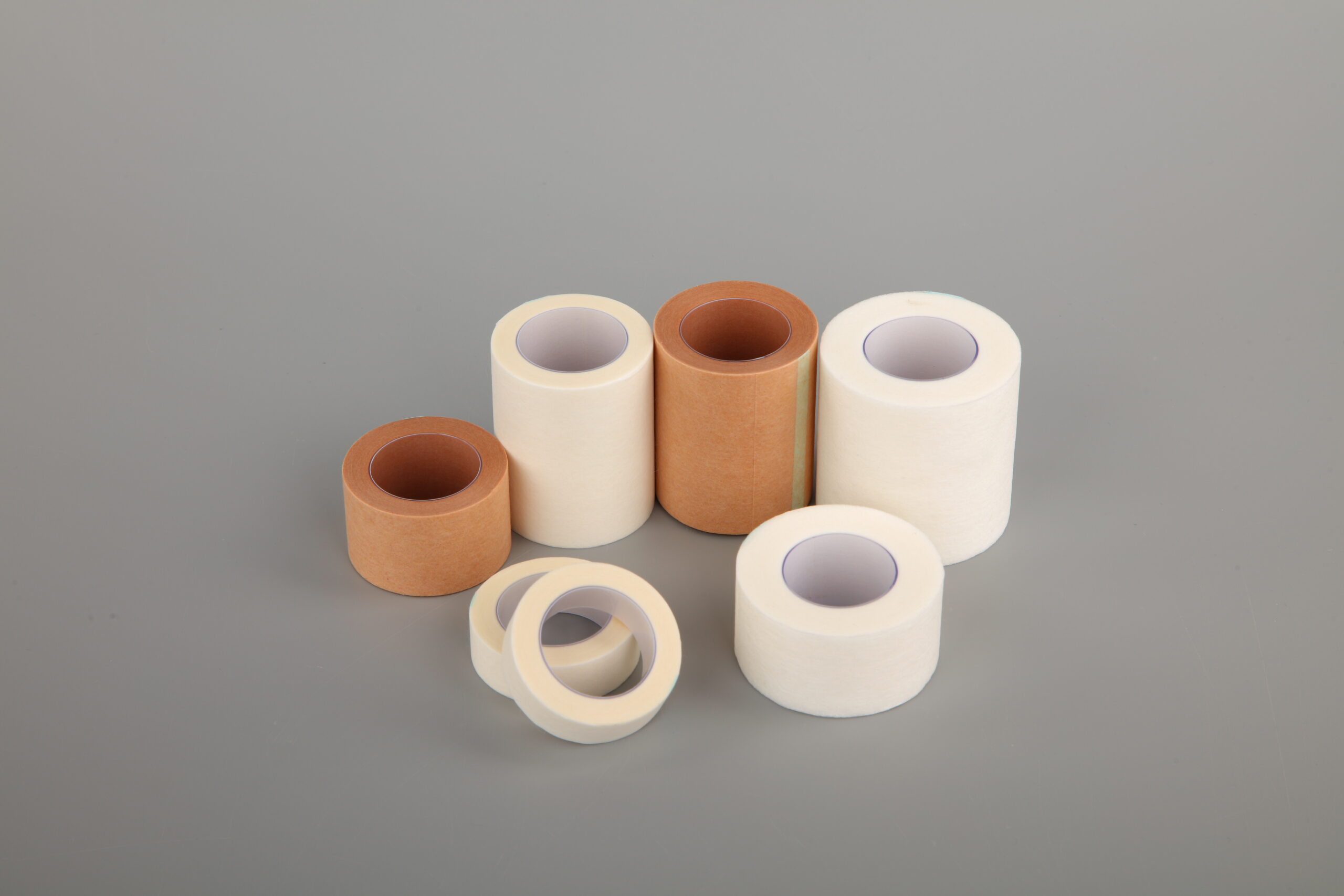
Nonwoven medical tape is made from a nonwoven textile backing that is made from fibers that are mechanically, thermally, chemically, or multi-process bonded together. Common materials are polypropylene (PP), polyethylene (PE), rayon, and blended fibres.
As a result, the backing is light in weight, breathable, soft, and conformable. Depending on its construction and adhesive system, it can offer tighter adhesion than paper tape, which is light in weight.
What Is Paper Surgical Tape?
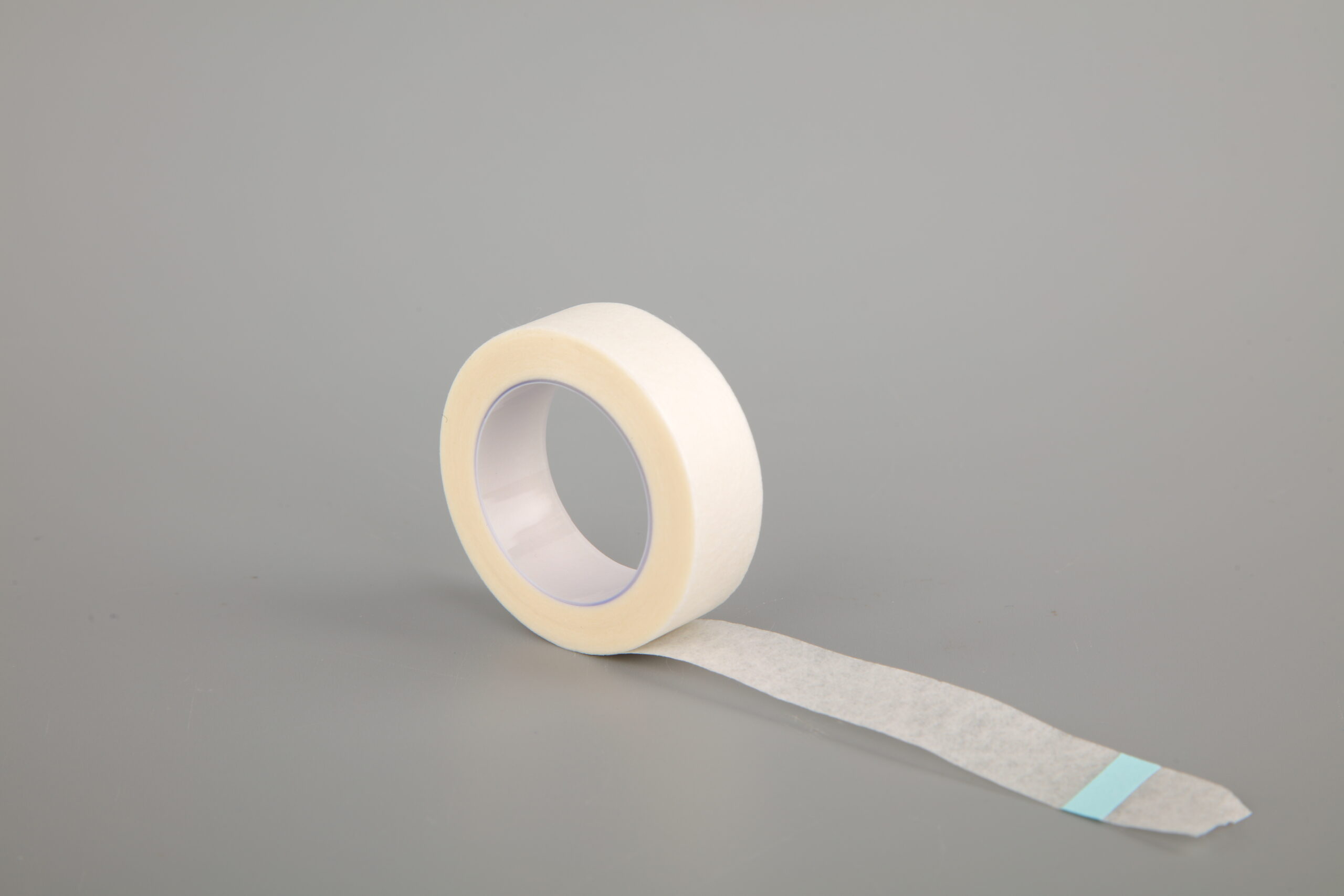
Paper surgical tape uses a paper or paper-like backing made primarily for lightweight, breathable, and gentle fixation. Its structure allows it to conform to the skin while remaining easy to tear and remove.
It is frequently selected for skin sensitivity or fragile skin, frequent dressing changes, wound-adjacent applications, and situations where there is no need for strong adherence.
Nonwoven vs. Paper Surgical Tape: B2B Comparison
Nonwoven medical tape bulk supplier quotations are less complex for procurement teams when they are able to compare the products based on the same criteria.
| Specification | Nonwoven Medical Tape | Paper Surgical Tape |
|---|---|---|
| Backing material | Polypropylene, polyethylene, rayon or mixed nonwoven fibers | Paper or crepe paper or paper-like backing |
| Breathability | High and relates to GSM and pore structure | The porosity of the backing accounts for the generally high value. |
| Adhesion strength | Medium to strong (as per the adhesive) | Low to moderate, typically at an optimum level for gentle fixation |
| Conformability/stretch | Conformability is good; some grades have a limited amount of stretch. | Compliant (low structural strength) |
| Wet/fluid resistance | Good to excellent, subject to construction. | Generally lower; if specially treated, it may be higher. |
| Skin sensitivity fit | Designed for general day-to-day usage in the clinic. | Ideal for delicate or sensitive skin. |
| Typical wear duration | Ideal for applications where secure fixing is required | Usually chosen for regular changing of the tape |
| Cost per unit | Moderate — varies depending on the specification | Useful for general purposes where it is economical. |
| Best clinical use | IV line, Tubing, Dressings, post-operative fixation | Skin sensitivity, fixation, care at home. |
These characteristics are industry comparisons in general. Actual performance will depend on the manufacturer’s backing, adhesive formulation, manufacturing process, and quality control programs.
When Nonwoven Medical Tape Wins
In most cases, nonwoven tape is the superior choice in applications demanding a higher level of fixation, flexibility, and resistance to handling. Hospitals may use it for:
- Securement of IV line and tubing.
- Holding the catheter/cannula in place.
- Heavier wound dressings
- Post-operative dressings
- Orthopedic dressings
- Areas exposed to regular movements.
- General medical fixation
One reason why nonwoven tape can provide better mechanical performance is its backing structure.
Unlike woven fabrics, where the yarns are interlaced in a fixed pattern, nonwoven materials consist of fibers bonded into a web. The manufacturing process can be engineered to achieve the right balance between softness, tensile strength, tear resistance, and conformability.
For procurement teams, this means GSM alone should not determine whether or not one nonwoven tape is better than the other.
B2B buyers should also request:
- Tensile strength
- Tear resistance
- Peel adhesion
- Backing composition
- GSM
- Moisture resistance
- Skin-contact performance
The chemistry of the adhesives is also important. Many manufacturers use acrylic adhesives, particularly when they are looking for a balance between reliable adhesion, aging stability, and compatibility with the skin.
This is why a nonwoven medical tape bulk supplier should be able to provide a technical data sheet instead of quoting price per roll only.
When Paper Surgical Tape Wins
Generally, paper tape is the better option when gentle fixation and easy removal are more important than maximum holding power.
This is particularly helpful in:
- Elderly patients with fragile skin
- Pediatric applications
- Repeated dressing changes
- Wound-adjacent fixation
- Lightweight dressings
- Home healthcare
- Long-term care facilities
- Low-tension applications
Therefore, it’s important for the procurement team to avoid evaluating paper surgical tape by how strongly it sticks.
In many clinical environments, excessive adhesion is undesirable. If the tape is removed repeatedly, the priority might be maintaining sufficient fixation while reducing discomfort and unnecessary stress on the skin.
This distinction is particularly important for B2B buyers looking for a paper surgical tape wholesale hospital supply partner. The goal is not finding the strongest tape available, but finding a tape whose performance matches its clinical application.
Microporous Surgical Tape: The Misconception Buyers Should Understand
When searching for surgical tapes for B2B sourcing, microporous surgical tape can be misleading since “microporous” refers to a property, which may not necessarily apply to the backing material.
A microporous material is one that has very small openings, or pores, allowing for air and water vapor to flow through the material. This can contribute to breathability and minimize an occlusive covering sensation.
Paper-based and nonwoven tapes can be manufactured with breathable or microporous characteristics.
Therefore, B2B buyers should not assume that:
Microporous = paper tape
Or:
Microporous = nonwoven tape
Rather, request from anonwoven medical tape bulk supplier supplier exactly how the microporous structure is produced and the supporting technical data (where available).
This distinction is particularly helpful in comparing quotations from a micropore tape manufacturer China vs any other manufacturer overseas. Different nonwoven medical tape bulk suppliers can advertise “microporous surgical tape” while offering products with substantially different GSM, pore structures, adhesives, and performance specifications.
What About Rayon, Cloth, Silk, and PE Medical Tape?
Nonwoven and paper tapes are only two categories within the broader medical tape market.
Other common backing materials are:
- Rayon tape: preferred for its softness, conformability, and soft texture.
- Cloth tape: used when mechanical support and durability are needed.
- Silk tape: traditionally, it’s associated with strong adhesion and smooth handling characteristics.
- PE tape: may have a smooth, flexible backing; construction would also offer good moisture protection.
These classifications should not be considered independently for hospitals or distributors. The selection of the right product will depend on the intended clinical purpose, adhesion required, sensitivity of patient skin, environmental conditions, and purchasing specification.
This is also why it’s important to check a nonwoven medical tape bulk supplier’s product catalogue alongside the technical documentation.
What Should B2B Buyers Actually Choose?
There is no universal winner between nonwoven and paper surgical tape. Rather, the purchase process should be in line with the intended use.
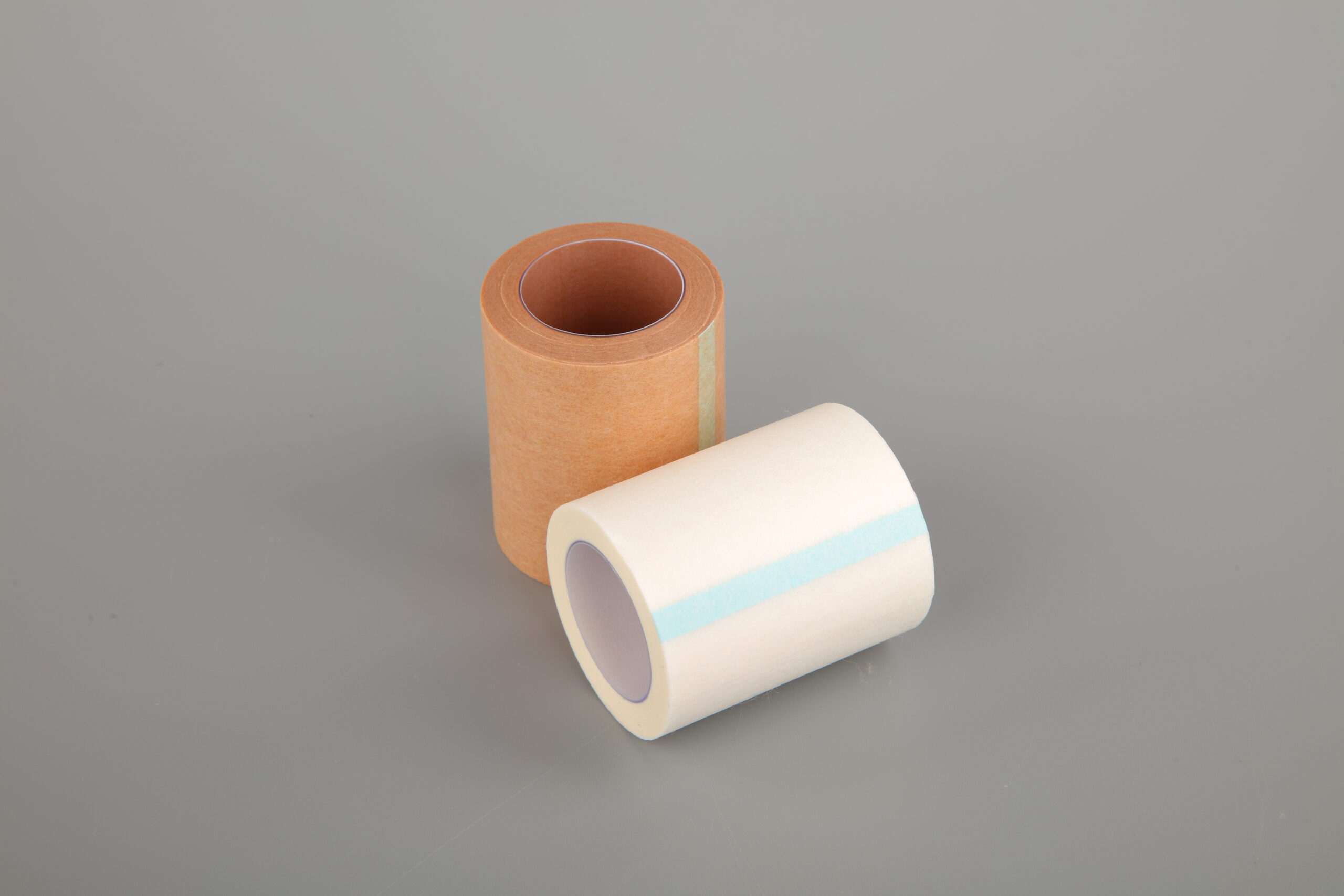
Choose nonwoven tape when the priority is:
- Stronger fixation
- Better handling resistance
- Securing tubing or medical devices
- Supporting heavier dressings
- Applications involving movement
Choose paper surgical tape when the priority is:
- Gentle fixation
- Frequent dressing changes
- Fragile or sensitive skin
- Lightweight dressings
- Home and long-term care applications
For larger hospital systems, the most practical strategy is standardizing both the products for different clinical applications instead of forcing one tape to serve every department.
Comparing Nonwoven Medical Tape & Paper Surgical Tape for bulk purchasing? It’s important to review a manufacturer’s complete technical specifications before deciding. For B2B buyers evaluating BKAMED’s options, review the relevant nonwoven tape and paper tape product pages for available specifications, configurations, and packaging options.
Clinical Applications and Consumption Drivers
Nonwoven Medical Tape & Paper Surgical Tape are common consumables in hospitals, clinics, hospital suppliers, and home health care networks. Demand is driven by the total number of patients, dressing changes, securing medical devices, and routine clinical procedures performed daily.
For B2B buyers, understanding where tape is consumed is helpful in determining which specifications to stock, how much inventory to hold, and when to place another order.
Core Clinical Applications by Care Setting
Surgical tape has various demands from different departments. Therefore, it’s important for hospital procurement teams to consider the application when selecting SKUs rather than purchasing a single tape for all departments.
Acute and Surgical Care
Operating rooms and surgical wards use tape in:
- Securing post-operative dressings
- Fixing drains, tubes, and other devices
- Holding temporary dressings in place
- Supporting wound-care procedures
- Securing materials during surgical preparation
In some cases where stronger fixation and better handling resistance are necessary, nonwoven tape may be used.
Medical-Surgical and General Wards
General wards can generate a high recurring tape consumption, because it is used throughout the patient’s stay.
Common applications include:
- IV and catheter securement
- Wound dressing retention
- Splint and bandage fixation
- Securing tubing and lightweight medical devices
- Routine dressing changes
For distributors, this makes general wards an important demand center when calculating the annual requirements.
Emergency and Trauma Care
Emergency departments usually need tape that can be applied quickly and remains secure during patient movement.
Nonwoven tape options can be helpful, particularly in areas where higher tear resistance and reliable fixation are required. However, hospitals can also stock paper tape for less demanding applications and patients requiring gentler fixation.
Home Healthcare and Long-Term Care
Generally, home-care providers prioritize comfort, easy removal, and consistent performance during repeat dressing changes.
Paper surgical tape can be suitable, particularly in:
- Lightweight dressings
- Fragile skin
- Long-term wound management
- Routine home-care procedures
Pediatric and Neonatal Care
There is a need to pay attention to the sensitivity of the skin in pediatric and neonatal environments. Therefore, soft, gentle, and hypoallergenic adhesive systems and products that are designed to be removed in a controlled manner should be a priority for procurement teams.
The actual specification depends on the clinical department and the validated performance data of the manufacturer.
Diagnostics and Monitoring
Tape can also be used for mounting sensors, electrodes, catheters, and other monitoring applications. In this case, rather than maximum tensile strength, conformability and reliable adhesion are more important.
What Drives Bulk Medical Tape Consumption?
The number of tape rolls present in the hospital’s storeroom seldom determines the hospital’s need for tapes. There are several operational factors that can significantly increase or decrease the annual consumption rate.
Patient Volume and Bed Occupancy
Generally, the higher the number of patients in a facility, the higher the volume of required dressing changes, device securement, and routine procedures. So, a hospital operating at high capacity will need more tape than a hospital operating at low capacity.
Average Length of Stay
Longer patient stays can significantly increase the number of dressing changes and securement procedures performed per patient.
Surgical Case Volume
Hospitals with busy surgical departments can consume larger quantities of tape on post-operative dressings, drains, and other fixation requirements.
Infection-Control Practices
Continuous focus on single-use and disposable medical products has boosted consumption of consumable supplies. So, hospitals should have adequate inventory to accommodate normal hospital activities without jeopardizing infection control measures.
Seasonal Demand and Emergency Stockpiling
Temporary demand could result from outbreaks, seasonal illness, disasters, and other unexpected events. Hospitals and distributors might consequently keep a high stock of safety surpluses over their average monthly demand.
Standardization Across Departments
Large healthcare systems increasingly standardize approved products across multiple departments. If the SKU of a single tape becomes the preferred option across several facilities, then the annual demand can increase substantially.
Forecasting Demand for Wholesale Purchasing
It’s important for distributors to avoid guessing when preparing a bulk quotation. A simple starting formula is:
Estimated daily usage × number of beds or customers × required coverage period + safety stock = estimated inventory requirement.
For instance, a distributor who provides a number of hospitals should first ask for historical consumption data before offering an annual contract.
Useful information includes:
- Average monthly tape consumption
- Number of facilities or beds served
- Current SKU specifications
- Seasonal consumption patterns
- Existing safety-stock levels
- Expected growth in patient volume
This can make it easier for a hospital tape wholesale supplier to quote accurately, while minimizing the chance of overstocking or running out on essential hospital supplies.
For buyers intending to place a surgical tape bulk order CE certified for different locations/usages, there should be demand forecasting along with lead time planning, MOQ, and available warehouse capacity. The goal is not just to buy as much as possible, but to develop a realistic supply chain which adapts to the actual consumption in any given clinical situation.
Full Product Specifications Checklist for Nonwoven Medical Tape & Paper Surgical Tape
When comparing suppliers, the product name alone tells you very little. Two suppliers can both quote Nonwoven Medical Tape & Paper Surgical Tape while offering different backing weights, adhesive systems, roll dimensions, packaging, and performance.
For hospitals and distributors, the technical specification sheet should therefore be treated as a purchasing document — not just a reference sheet.
Backing Material Specifications
Handling, breathability, strength, and feel of the tape are all determined in part by the backing material.
One of the initial parameters to verify is the GSM (grams per square meter). Generally, the typical range for nonwoven medical tape is 30–60 GSM, although there are variations in some models produced by different manufacturers.
Generally, as the GSM increases, the backing becomes more substantial, although a higher GSM does not automatically mean better tape. The appropriate weight depends on the intended application.
- Lower GSM: lightweight, soft, and highly conformable — best for gentle fixation.
- Medium-range GSM: good softness, strength, and handling qualities — good for general hospital usage.
- Higher GSM: greater material substance and potentially better mechanical strength for more demanding fixations.
Fiber composition is also important. PP can provide lightweight construction and useful strength, while rayon-based materials can contribute to the softness and a textile-like feel. PP/PE combinations can be engineered to balance flexibility, strength, and moisture resistance.
Therefore, it’s important for B2B buyers to request the exact fiber composition instead of accepting a generic description like “nonwoven fabric”.
Perforation and Micropore Structure
Perforation and pore structure of the tape affect the movement of air and moisture vapour through the tape.
However, “breathable” should not be accepted as a sufficient technical specification. B2B buyers should ask whether the manufacturer has relevant air-permeability or moisture-vapor data.
Ideally, the nonwoven medical tape bulk supplier should clearly define:
- Perforation size and pattern
- Pore structure or micropore density
- Air permeability, where tested
- Moisture-vapor transmission data, where applicable
- Whether perforations affect tearability or tensile strength
This information is particularly helpful in comparing products from a micropore tape manufacturer China and other competing suppliers.
Adhesive Specifications
The adhesive is arguably the most important component after the backing. It’s because it determines how securely the tape attaches and how it behaves during removal.
Acrylic adhesive is widely chosen for medical applications where the manufacturer is looking for a combination of adhesion, skin compatibility, and stability of the adhesive during aging.
Strong initial adhesion and holding power can be achieved using rubber-based adhesives, but this varies with formulation and application.
B2B buyers should not presume that any one group of adhesives has an inherent advantage. Rather, ask for performance data for the actual finished product.
Peel Adhesion
Units of measure for peel adhesion vary by manufacturer; they often include N/25 mm or oz/in per manufacturer’s testing method.
The required level depends on the application:
- Gentle skin fixation needs controlled adhesion and easy removal.
- General dressing fixation needs moderate, reliable adhesion.
- Device or tubing securement can require a higher holding performance.
Because test methods can differ between suppliers, B2B buyers should verify the test standard, substrate, dwell time, and testing conditions before comparing the numbers directly.
Latex-Free Formulation
For modern hospital procurement, latex-free construction should be treated as a standard requirement for verification, not an optional marketing upgrade.
A nonwoven medical tape bulk supplier should be able to clearly state whether or not natural rubber latex is present in:
- The adhesive
- The backing
- Packaging components
- Other product-contact materials
For tenders and institutional purchasing, it’s important to request a written latex-free declaration or supporting documentation (where necessary).
Dimensions and Packaging Specifications
The dimensions directly affect both the clinical usefulness and cost of a product.
Common widths include: 1.25 cm, 2.5 cm, 5 cm, 7.5 cm, 10 cm, 15 cm
The most common roll lengths are 5 m, 9.1 m, and 10 m, but custom configurations can be available.
Distributors considering nonwoven tape and paper tape MOQ prices should always compare the complete roll specification. A lower price per roll can simply reflect a shorter roll or narrower width.
Core and Dispensing Configuration
The internal core can also affect how the tape is handled in clinical settings.
Paper cores are common and can be economical. However, plastic spools can provide additional rigidity depending on the dispenser design.
Ask suppliers to specify:
- Core diameter
- Core material
- Roll outer diameter
- Compatibility with dispensers
- Individual roll or multi-roll packaging
These details are particularly critical if hospitals are already using standard tape dispensers.
Packaging and Freight Specifications
Before placing a bulk order, the packaging needs should be considered as it will influence efficient storage and handling, branding, and shipping.
Compare if products are provided with:
- Individual poly-wrap
- Individual boxes
- Multi-roll inner boxes
- Master cartons
- Custom printed packaging
- Private-label packaging
Ask for the number of rolls per carton, carton size, gross weight, net weight, and pallet configuration as well.
International buyers will use this information to estimate the required freight as well as the required warehouse space before shipment.
Performance data to request from a nonwoven medical tape bulk supplier
A reliable hospital tape wholesale supplier should provide useful technical data, instead of just relying on product photographs or marketing descriptions.
Before approving a supplier, it’s important to request information about:
- Tensile strength and tear resistance: Shows how the backing performs under mechanical stress.
- Peel adhesion: Indicates how strongly the tape adheres under specified test conditions.
- Removal performance: Useful for evaluating skin-friendly applications.
- Shelf life: Confirms how long the product remains within specification when properly stored.
- Storage conditions: Check the recommended temperature, humidity, and protection from direct sunlight.
- Color options: White is common, although skin tone options may be available in selected markets and applications.
For a nonwoven tape private label OEM project, these specifications should be agreed upon before the production begins. They can then become an approved part of the “product specification and quality agreement”.
B2B Product Specification Checklist
The procurement teams must confirm with any Nonwoven Medical Tape & Paper Surgical Tape supplier that they have verified:
- Backing material and fiber composition
- GSM
- Adhesive type
- Peel adhesion test data
- Tensile and tear resistance
- Breathability or micropore information
- Latex-free status
- Roll width and length
- Core specifications
- Individual and master packaging
- Rolls per carton
- Pallet configuration
- Shelf life and storage conditions
- Available colors
- Technical data sheet and applicable test reports
A supplier that can provide this information clearly gives B2B buyers a much stronger basis for comparing quotations, validating samples, and establishing consistent specifications for bulk orders in the future.
How to find and vet a nonwoven medical tape bulk supplier Supplier
Finding a Nonwoven Medical Tape & Paper Surgical Tape supplier is not difficult. Finding one that can actually provide consistent quality, certified documents, and reliable lead time at a wholesale quantity is the real challenge. This is the part most manufacturer websites skip, because most of them are trying to sell you tape, and not teaching you how to evaluate the person selling it.
Where B2B Buyers Actually Source
Typically, procurement teams can source through any one of these 4 channels and each comes with its own trade-offs:
- Manufacturer direct: Usually, buying from a factory in China or elsewhere in Asia provides the best prices and control over specifications — particularly for nonwoven medical tape bulk supplier relationships built for the long term. The only disadvantage is that vetting takes more effort upfront.
- Regional distributors: Faster delivery, smaller order quantities, and local language support, although has a higher per-unit prices and less influence over product specifications.
- B2B marketplaces (Alibaba, Made-in-China): Helpful in discovery and initial supplier comparison, but listings vary widely in accuracy. Treat marketplace profiles as a starting point, not a verification source.
- Trade shows (Medica, CMEF, Arab Health): Helpful in meeting suppliers face-to-face, inspecting physical samples, and building relationships that are harder to fake in person.
However, none of these channels is inherently “safer”. The safety part comes from how thoroughly you vet a nonwoven medical tape bulk supplier you choose.
The nonwoven medical tape bulk supplier vetting checklist
Before signing with any hospital tape wholesale supplier, work through this framework:
- Factory verification. Confirm if the company you are purchasing from is the manufacturer or another trading company selling someone else’s product. Ask to see factory audit reports or do a live video tour of the production line — genuine manufacturers won’t hesitate.
- Certification verification. Do not assume any certificates are true; check them. CE certificates should reference a Notified Body you can cross-check independently. ISO 13485 and ISO 9001 certificates can be verified through the public database of the body issuing the certification. FDA establishment registration and device listing numbers can be checked against FDA’s registration and listing records. A nonwoven medical tape bulk supplier offering a surgical tape bulk order CE-certified should not have issues providing documentation for verification.
- Sample and test report request. Ask for physical samples or information from 3rd-party lab test data from recognized labs like SGS, Intertek, or TUV. In-house test data is helpful, but 3rd party validation carries more weight for tenders and institutional buyers.
- Production capacity match. A manufacturer who can fulfill your first sample order easily might still struggle to meet your annual volume. Be specific in inquiring about a daily/monthly production capacity and compare it to your order quantity.
- Quality control process. Inquire about incoming material checks, whether there are in-line QC checks during production, the final QC process, and if retained samples are stored for reference.
- Communication and lead time reliability. Test this before committing to any contract. Response time to technical questions and the availability of English language support are early indicators of how the relationship will run once you’re a paying customer.
- References and export history. Inquire about the markets and countries that the supplier currently sells to. If a nonwoven medical tape bulk supplier has successfully exported to regulated markets such as the United States, EU, or GCC before, it means they are already familiar with export compliance inspection.
Red Flags to Watch For
Some warning signs should end a conversation immediately. For example:
- Certificates that cannot be verified on the issuing body’s public database.
- Unwillingness to provide a factory audit or live video call.
- Setting prices much lower than the market average without giving a clear reason for the low price.
- No traceable business registration or export licenses.
- Refusal to sign a quality agreement or supply agreement.
Questions to Ask Before Signing a Contract
Here are the questions you can directly paste into your next nonwoven medical tape bulk supplier inquiry email:
- Are you a manufacturer or reseller of another manufacturer’s product?
- Can you provide your CE, ISO 13485, and FDA registration numbers for independent verification?
- What is your current monthly production capacity for this product line?
- Are there any 3rd-party laboratory tests available for tensile strength and adhesion?
- What is your standard sample lead time, and is it free of charge?
- What is your MOQ, and does it change with custom packaging?
- Can you provide references from current customers in our region?
- What is your standard production lead time for a full container order?
- Do you provide nonwoven tape private label OEM development, and what does that process involve?
- Are you willing to sign a quality and supply agreement before the first bulk order?
Run any paper surgical tape bulk exporter through this checklist before committing. That way, you will reduce the potential sourcing risks before they become shipment issues. BKAMED meets every point on this list — from verifiable certifications to documented QC processes — and our certification page is available for direct review.
Regulatory Compliance for Surgical Tape Import
Purchasing Nonwoven Medical Tape & Paper Surgical Tape wholesale is only half the task. The other half (which sourcing guides neglect) is getting that shipment through customs with no delays, holds, and no rejected documents.
The lack of compliance is not a legal footnote for hospitals or distributors. It’s a risk management problem that can become warehousing costs, failed contract deadlines, and languishing supply chains.
Note: This section is just a starting framework, not a substitute for licensed guidance.
United States
Adhesive medical tapes sold in the U.S. are considered FDA Class I medical devices and 510(k) exempt. Foreign manufacturers must register their establishments with the FDA, list each device, and appoint a U.S. Agent — customs clearance requires this information along with the FDA Registration Number and Device Listing Number.
Under the MDR regulations, importers are required to report incidents of a device that caused or contributed to death or serious injury, as well as certain malfunctions. A nonwoven medical tape bulk supplier worth working with should already understand these obligations without you having to explain them.
European Union
The EU MDR 2017/745 mandates that tapes must be CE marked with a Declaration of Conformity and Technical File which prove compliance. Non-EU manufacturers need an Authorized Representative (EU AR) based in a member state — not a formality. Shipments without one can be rejected at the border.
Middle East / GCC
Medical consumables must be registered with Saudi Arabia SFDA, and then cleared through Customs for their import. This registration process may sometimes last longer than in the US or EU markets. So, in the case of a surgical tape bulk order CE certified for the GCC markets, B2B buyers should factor in additional lead time for their procurement schedule.
United Kingdom
Following Brexit, the UK has introduced its own regulatory marking scheme called UKCA alongside MHRA registration. Many manufacturers currently support both CE and UKCA in parallel during the transition. However, it’s important to confirm the current acceptance timelines directly with MHRA before finalizing a shipment.
Documentation Checklist for Every Shipment
Before delivery, check that the nonwoven medical tape bulk supplier can provide the following:
- Commercial invoice
- Packing list
- Certificate of Origin
- CE Declaration of Conformity
- FDA registration/listing number
- ISO 13485 certificate
- SGS or equivalent third-party test reports
- Correct HS code
- Sterilization validation records (where applicable)
Common Causes of Customs Delays
Missing or incorrect documentation is the leading cause of customs holds on medical device shipments — common errors include mismatched batch numbers between the commercial invoice and packing list, missing regulatory certificates, incorrect HS code classification, and expired sterilization validation records. Every one of these is avoidable with a documentation checklist agreed upon before production begins — which is why it belongs in your contract, not as an afterthought.
A Note on HS Codes
Generally, adhesive medical tape falls within the HS code family covering impregnated, coated, or laminated textile fabrics and medical dressings. But the exact classification varies by country and product construction.
Don’t assume a single HS code applies universally. It’s important to confirm the classification with your customs broker before your first shipment of paper surgical tape as a bulk exporter. This is because a misclassified code is one of the fastest ways to trigger a hold.
Note: This section is for general informational purposes, and it doesn’t constitute legal or regulatory advice. B2B buyers should confirm current requirements with a licensed customs broker or regulatory consultant before importing.
Pricing and MOQ Structure
Request from 5 suppliers for a quote on Nonwoven Medical Tape & Paper Surgical Tape and you’ll probably get 5 different figures — without an explanation. That lack of transparency makes comparing quotations nearly impossible for B2B buyers. This part breaks down what actually drives prices, the MOQ ranges to expect, and how to model your true landed cost before committing.
What Actually Drives Per-Unit Price
- Raw material cost. The three biggest cost levers are GSM, fiber type, and adhesive grade. A higher-GSM nonwoven underlying material or a high-cost, premium acrylic adhesive formulation will always be more expensive than a low-cost, economy-grade equivalent — that is before packaging is factored in.
- Roll width and length. When the width and length are specified, then a price per roll is significant. A narrower or shorter roll quoted at a “lower price” can actually cost more per meter of usable tape.
- Packaging complexity. Individually wrapped rolls, custom printed packaging, and private-label branding all increase the cost compared to the standard bulk-packed rolls in master cartons.
- Order volume and container load type. The freight charges of an LCL (less-than-container-load) order are more expensive than an FCL (full-container-load) order per unit. This is one of the easiest methods to reduce landed cost when order quantities reach a point that makes it a cost-effective method.
- Certification and testing costs. A supplier maintaining CE, ISO 13485, and 3rd party lab testing has real compliance overhead baked into their pricing. A surgical tape bulk order CE-certified will rarely be the cheapest quote on the table. That is expected, not a red flag.
- Freight mode and shipping climate. Sea shipping is used for large order quantities, while air shipping is quicker, yet much more costly and generally restricted to urgent restock. The current freight rates fluctuate, so the validity window of a quote is important.
Typical MOQ Tiers to Expect
Generally, MOQs in this category fall into three tiers:
- Entry-tier (sample/trial orders): Small quantities intended for product evaluation and quality verification before committing to a bulk contract.
- Mid-tier (distributor orders): Standard wholesale volumes suitable for regional distributors and mid-sized hospital groups.
- Full container/pallet-tier (hospital-system or GPO orders): Large volume orders where per-unit prices can improve significantly and custom packaging or OEM terms are negotiable.
These are the general industry ranges. But always confirm the exact MOQ tiers directly with a nonwoven medical tape bulk supplier, because they vary by specification and choice of packaging.
Modeling Your Landed Cost
Don’t compare suppliers on unit price alone. Instead, use the actual landed cost of the product:
Landed cost = cost of the raw product + freight + duties/tariffs + customs broker fees + inland transportation.
For instance, a relatively lower FOB price and LCL freight combined with an unassigned customs broker fee might be more expensive per roll than a slightly higher FOB fee shipping FCL. Therefore, run the full nonwoven tape and paper tape MOQ price comparison, not just the line-item quote before signing.
Payment Terms Buyers Commonly Negotiate
Typically, new B2B buyers begin with a T/T deposit plus balance before shipment arrangement — usually 30% deposit, and 70% before the goods leave the factory. Repeat buyers with an established track record can negotiate for more favorable terms, and larger orders might warrant the issuance of a Letter of Credit (LC) for security both ways.
Common Pricing Mistakes Distributors Make
- Comparing FOB prices without accounting for GSM, width, or grade of adhesives.
- Focusing too much on the unit price while ignoring the total landed cost.
- Underestimating reorder lead time and holding too little safety stock during the gap.
Getting the prices right means comparing the same specs, packaging, and shipping terms. Ready to see where you land? Get a tiered wholesale quote from BKAMED and compare it directly against this framework.
OEM and Private Label Surgical Tape
Are you a distributor or healthcare brand looking to move beyond reselling? Well, nonwoven tape private label OEM production is where real margin control and brand ownership begins. However, sometimes the terms OEM, ODM, and private label can be used interchangeably online. That confusion can lead to mismatched expectations before a contract is even signed.
OEM vs. ODM vs. Private Label: What’s the Difference?
OEM (Original Equipment Manufacturer) is a manufacturer that makes the tape according to your requirements, and you add your branding to an existing or customized product build.
ODM (Original Design Manufacturer) takes a further step — the manufacturer designs the product themselves, and you choose between ticking off a variety of product designs or configurations that you can then brand as your product.
Private label is the broader commercial outcome of either path. Here, your brand name and packaging are put on a product manufactured by a different company, regardless of how much input you had into the underlying specification.
In most hospital tape wholesale supplier partnerships, OEM is the practical middle ground. That is, it provides adequate customization to differentiate the product, without the cost and complexity of developing a formulation from scratch.
What’s Actually Customizable
Customization usually involves:
- Packaging design and branded printing — printing your logo with your colours and packaging copy on individual wraps, inner boxes and master cartons.
- Roll dimensions and core types — custom widths, lengths, and core specifications that can meet your client’s needs or those of your current dispenser systems.
- Adhesive formulation tweaks — hypoallergenic tiers, added zinc oxide variants, and adhesion level changes for specific clinical applications.
- Private-label regulatory labeling — requirements for own-brand labelling vary by market and are closely linked to the licensing requirements related to the FDA and EU MDR for labelling requirements, as discussed earlier. Even though the manufacturer has the underlying registration, the US private label buyer requires that the right labeling conform to FDA requirements.
The Typical OEM Development Process
Typically, the steps of a structured OEM project are as follows:
- Inquiry and NDA: The Inquiry process begins with an initial discussion of the specification by both the buyer and manufacturer, usually preceded by a non-disclosure agreement that is signed by both parties. This prevents any technical information from being shared and allows sharing of proprietary information, such as preferred formulations and branding ideas, before any technical information is exchanged.
- Spec discussion: All components are discussed, including the backing material, glue, the width of the roll, and packaging requirements, and these details are agreed upon. This is where B2B buyers can also adjust any hypoallergenic levels, custom widths, or labelling needs in relation to the desired market.
- Sample development: Factory produces initial samples, which conform to agreed specification. This process usually takes several weeks depending on the customization of either the formulation or the packaging design.
- Sample approval: The samples are used for in-house testing as per quality requirements and clinical needs before signing off. No mass production should begin until this approval is documented in writing, since it becomes the reference standard for the entire order.
- Mold and packaging design: Custom packaging, printing plates, and branding elements are finalized upon receiving sample approvals. This ranges from carton artwork to personal roll wrap artwork, all in line with the B2B buyer’s brand identity.
- Mass production: Full production begins against the approved specification and approved sample. Any deviation from the agreed spec at this stage should trigger a buyer notification, not a silent substitution.
- QC and inspection: Pre-shipment inspection verifies the completed batch is perfectly accurate in its dimensions, adhesion, and packaging while confirming that it matches the approved samples. Many buyers also ask for a third-party inspection at this point to provide further assurance before products are shipped out of the factory.
- Shipment: Goods are packed, documented, and shipped per agreements (Incoterms). The documentation checklist of items outlined earlier (commercial invoice, packing list, certificates and test reports) should also be completed at this time and added to the shipment.
Understanding this in advance allows B2B buyers to have a realistic timeframe rather than assuming a nonwoven tape private label OEM development moves at the same pace as standard wholesale reordering.
MOQ Considerations for OEM
Generally, OEM minimum order quantities run higher than standard wholesale MOQs. It’s because custom packaging, formulation adjustments, and dedicated production runs all carry setup costs manufacturers need to recover. B2B buyers evaluating nonwoven tape private label OEM should budget for this upfront instead of being surprised mid-negotiation.
Why Choose OEM Over Reselling an Existing Brand
- Margin control — Removing brand markup from the cost structure is helpful in improving margins on every unit sold.
- Brand equity — Every roll sold builds your name in the market, not someone else’s.
- Territory exclusivity — OEM relationships may come with exclusivity clauses that reselling relationships typically don’t have.
- Regulatory responsiveness — Labels can be customized as per the local market without waiting for a third-party brand owner.
BKAMED’s OEM/ODM Capability
With CE and ISO 13485 certification, in-house production capabilities, and a documented sample-to-shipment process, BKAMED offers its full OEM and ODM development service for Nonwoven Medical Tape & Paper Surgical Tape. During specification, lead times for typical OEMs are discussed directly once your required volume and customization requirements are agreed to. If you’re looking to move from reselling to owning a branded line, start the conversation on our OEM inquiry page.
Procurement Strategy for Hospitals
Sourcing Nonwoven Medical Tape & Paper Surgical Tape at the individual purchase order level is one thing. Creating a procurement strategy that performs consistently from unit to unit, across dozens of departments, and in unpredictable supply chains is another. This section is for hospital procurement teams thinking beyond their next order.
Single-Source vs. Dual-Source vs. Multi-Source
Single-sourcing with one supplier optimises pricing leverage — the more units bought, the better you can achieve pricing per unit and creation priority in production. The trade-off is exposure. That means a single factory delay, quality issue, or customs hold can disrupt your entire supply chain at once.
Dual-sourcing involves dividing up volume between two qualified suppliers and trading some price leverage for meaningful supply chain resilience. When one supplier’s production schedule is facing disruptions, the other will have flexibility to take on extra volume without a complete shortage.
Multi-sourcing spreads the risks further but adds administrative overhead — with more contracts, more vetting, more quality measures to maintain consistently. For most mid-sized hospital systems, dual-sourcing can strike the most practical balance.
Building Tape Into a Standardized Formulary
Large healthcare systems increasingly consolidate to a small number of approved tape SKUs across all departments, instead of letting each unit choose independently. This standardization is helpful in controlling costs through volume consolidation, simplifying staff training as clinicians work with fewer product variations, and keeping procurement aligned with GPO contract compliance requirements. A hospital tape wholesale supplier supporting several specifications under one relationship is helpful in making formulary consolidation much easier to manage.
Safety Stock and Lead-Time Planning
When using imported products, safety stock formulas should be adjusted for the length and uncertainty of the lead time, because they carry longer and less predictable lead times compared to domestic distribution.
A good starting point can be:
Safety stock = (Average Daily Inventory usage) x (Maximum inventory lead time) − (Average Daily Inventory usage) x (Average inventory lead time).
Add the other contingencies on top of this (customs delay risks covered earlier — documentation errors, HS code misclassification, expired certificates), and they are the reason that buffer stock needs to be designed around worst-case, not average-case, lead time risks.
Supplier Scorecarding for Ongoing Procurement
It’s important to vet a supplier before the first order, but continuous performance monitoring is even more crucial. A simple scorecard should track the following:
- On-time delivery rate — the percentage of orders arriving within the agreed window.
- Defect rate — the percentage of units failing incoming quality inspection.
- Responsiveness — the average time to respond to inquiries or issues.
- Documentation accuracy — the frequency of errors in shipping or compliance paperwork.
Reviewing this quarterly is helpful in turning supplier management into a data-driven process instead of a relationship maintained on assumption alone.
RFP and Tender Considerations
When giving an RFP for Nonwoven Medical Tape & Paper Surgical Tape, specificity is what makes supplier responses comparable. Be specific about the type of specification required like GSM, which adhesive should be used, dimensions, etc., required certifications (CE, ISO 13485 or FDA registration if applicable), and a mandatory sample submission requirement before the tender is awarded. Generally, vague RFPs invite vague, non-comparable quotes, making evaluation nearly impossible.
Sustainability and Packaging Considerations
Sustainability is showing up in hospital RFPs more frequently, and tape packaging is not an exception. Bigger firms are increasingly implementing reduced plastic options and recyclable packaging as tender parameters, as well as a marketing differentiator. It’s important for procurement teams evaluating a paper surgical tape bulk exporter to ask about the available eco-packaging options. This is because this is likely to become a standard RFP line item instead of an optional item in the near future.
Frequently Asked Questions
What is the difference between nonwoven medical tape and paper surgical tape?
Nonwoven medical tape features a fiber backing material (PP, PE, or rayon) with a higher amount of fixation and better wet resistance than paper surgical tape, which is made with a lightweight paper backing especially for gentle fixation on sensitive or fragile skin.
What is a typical MOQ for wholesale surgical tape?
Typically, there are three levels of MOQs: entry-level order samples, mid-tier distributor quantities, and full container/pallet orders for hospital systems or GPOs. The exact nonwoven tape and paper tape MOQ price breakpoints can vary depending on the supplier and specification.
Do I need FDA clearance to import nonwoven medical tape?
Most nonwoven and paper surgical tapes are classified as FDA Class I and are 510(k)-exempt. However, the manufacturer must have an FDA establishment registration and device listing.
Can I source private-label surgical tape from a China manufacturer?
Yes. Typically, a qualified micropore tape manufacturer China can support OEM/ODM development, including custom packaging, branding, and formulation adjustments.
How long does OEM sample development take?
Depending on the level of customization, sample development time ranges are usually from a few weeks after the minimum order quantities (MOQs) are confirmed until samples are approved, prior to commencement of mass production.
Conclusion
When purchasing Nonwoven Medical Tape & Paper Surgical Tape wholesale, it’s not simply about finding the lowest price per roll. To make a successful purchasing decision between hospitals, distributors, and private label brands, it is important to understand product performance, ensure nonwoven medical tape bulk supplier capabilities, and estimate the true cost of ownership.
Nonwoven and paper surgical tapes serve different purposes. Nonwoven tapes can provide the strength, conformability, and handling performance needed for tubing, dressings, and higher-demand fixation. Paper tape, on the other hand, is helpful where gentle adhesion, breathability, and easy removal are priorities.
For B2B buyers, the most important considerations include:
- Backing material, GSM, and fiber composition
- Adhesive type and peel adhesion
- Breathability and moisture performance
- Roll dimensions and packaging
- MOQ and total landed cost
- Quality-control procedures
- Regulatory documentation and certifications
- Supplier production capacity and consistency
- OEM, ODM, and private-label capabilities
One of the key elements of a successful sourcing strategy is investigating beyond the initial purchase. To ensure consistent supplies while minimizing procurement risks, consider the use of demand forecasting, safety-stock planning, supplier scorecards, and standardized specifications.
Ultimately, the strongest wholesale purchasing decisions come from matching the right tape specification to the clinical application, and selecting a supplier who is capable of maintaining that specification consistently at the required volume.
Ready to Source With a Supplier You Can Actually Trust?
Now, you have witnessed the difference between a trusted Nonwoven Medical Tape and Paper Surgical Tape supplier and a risky one. It can be summed up in verifiable certifications, transparent pricing, documented QC, and a real OEM development process. BKAMED has it all!
We make CE- and ISO 13485-certified tape at wholesale and bulk-container volumes, with full technical documentation available on request, competitive tiered prices, and dedicated OEM/ODM support for brands ready to launch their own private label line.
Whether you’re a hospital procurement team, a distributor, or a growing medical brand, our team is ready to quote your specification directly. Request your wholesale quote today and see the difference a verified supplier makes.
Contact us today to discuss your requirements and source medical tape that fits your procurement needs.
