
The Hydrophilic Jumbo Gauze Roll is one of the biggest consumables used in surgical and wound care practices around the world, yet it is often the one product that receives inconsistent shipment because it is purchased from trading companies instead of verified manufacturers.
This article provides importers, distributors and hospital procurement officers a practical approach for purchasing hydrophilic gauze rolls directly from a China factory.
The hydrophilicity standards, key specifications, pharmacopoeial compliance (BP, USP, EUP), OEM customisation, pricing structure, and shipping documentation by market are covered.
The clinical significance of Hydrophilic Cotton.
Raw cotton is water-repellent. This might seem counterintuitive for a wound care material but it’s a fundamental textile chemistry fact. Before raw cotton is processed, natural oils, waxes and pectins coat the fibers . The opposite of what a wound dressing should do is to be non-absorbable by aqueous fluids, and these coatings will do just that.
In a controlled bleaching and purification process, those coatings are removed from the Hydrophilic cotton. This creates a material with a high moisture absorption capacity and a steady rate. That property directly impacts clinical outcomes: a dressing that will absorb wound exudate will help to minimise the risk of maceration, facilitate a moist wound healing environment and decrease dressing change frequency.
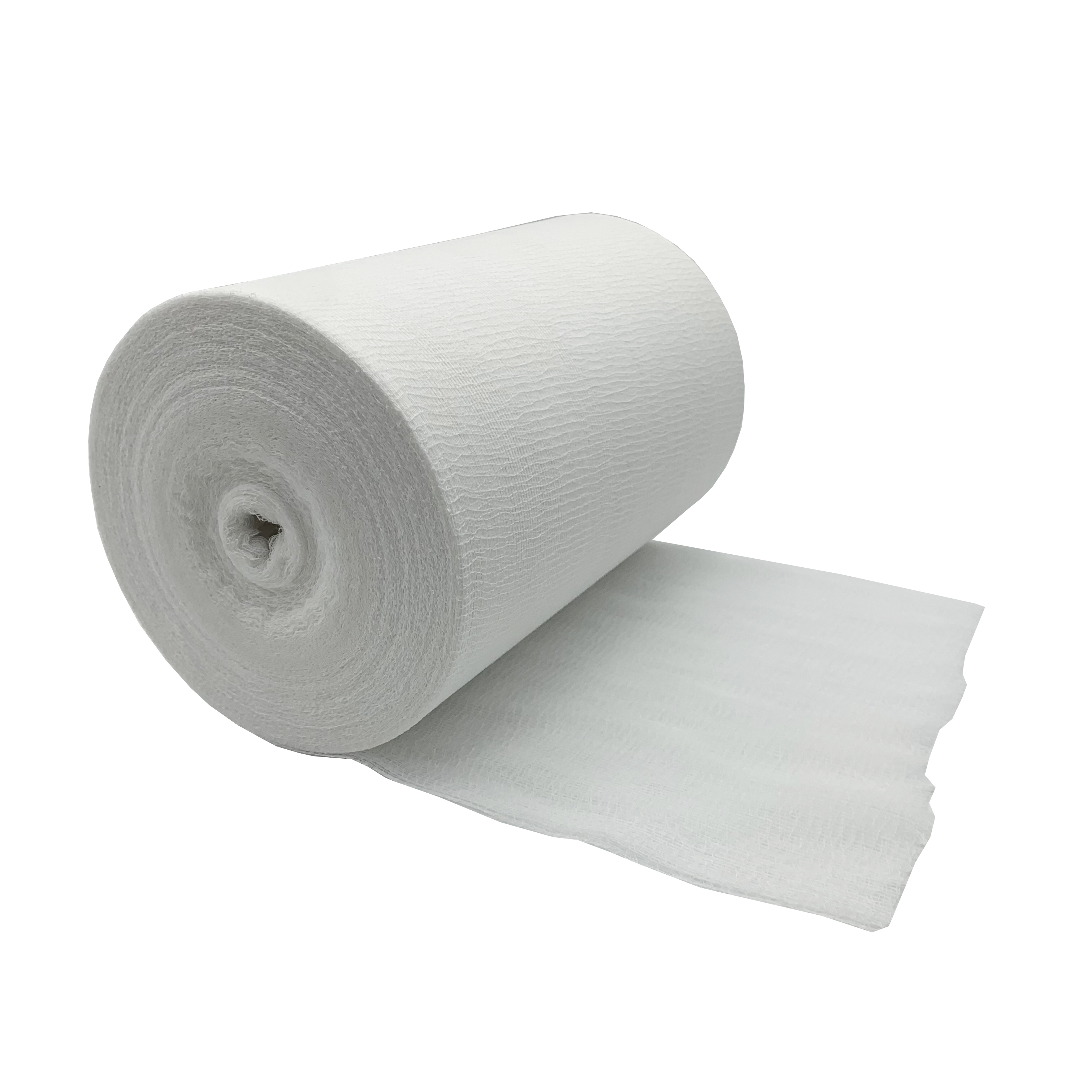
To procurement teams, the difference between hydrophilic and normal cotton is not just a quality preference but a necessity. It is a regulator of weight. In regulated markets, the British Pharmacopoeia (BP) and the United States Pharmacopeia (USP) both have absorbency standards for surgical cotton; products failing to meet those standards would not be considered medical-grade surgical cotton.
The Hydrophilic Jumbo Gauze Roll format is only important when supplying on an industrial scale. The upstream format is jumbo rolls: large-diameter rolls which are then cut and re-rolled into retail or clinical-use size rolls in hospital, distributors or hospital converters. The most flexible size and packaging options for final dimensions are available through the jumbo roll source, and the price is usually the lowest for high volumes.
Multiple trends are stimulating the demand for the proper hydrophilic gauze. There’s a growing number of surgical procedures worldwide. Chronic wound management, especially in the cases of diabetic foot ulcers and pressure wounds, is increasing as a proportion of hospital spend.
The EU, US, and GCC regulatory bodies have been stepping up their enforcement of imported medical consumables. A buyer who can prove his source of supply from the cotton field to the finished roll is in a much better position than if he cannot.
As for the market, the range of BKAMED’s 100% cotton medical absorbent surgical hydrophilic jumbo gauze roll products reflects this: The product is direct from the factory, of pharmacopoeial quality, available in bulk, and OEM customizable for importers who require a private label or product customized to their specific dimensions.
What Makes a Bandage Roll ‘Hydrophilic’?
Hydrophilic is the term used for water-loving. That property is obtained in cotton gauze by removing all the constituents of raw fiber which would hinder the absorption of water. It is not as simple as most people think, and a buyer’s understanding of the process will enable them to ask better questions when qualifying suppliers.
Non-cellulosic compounds present in raw cotton fibers include waxes, pectins, proteins and natural oils. These compounds form a hydrophobic barrier around each fiber. Water repels in grey fabric (also known as unprocessed woven cotton). Apparel is acceptable. It is a functional failure to wound care gauze.
The purification stages are:
- Scouring: The grey cloth is boiled in an alkaline solution (typically sodium hydroxide) to saponify and dissolve wax and oil.
- Bleaching: The most used bleaching agent for medical-grade cotton is hydrogen peroxide (H2O2). It completely removes non-cellulosic substances and oxidizes the remaining substances that may form color, but do not leave toxic residues. Sometimes chlorine based bleaching is used in non-medical products but is not acceptable for products that will be in contact with wounds.
- Rinsing and Neutralization: Fabric after bleaching is completely rinsed to eliminate any chemicals and neutralized to a pH level suitable for human skin.
- Drying and Inspection: Fabric is dried, and a final moisture content test is conducted before it is wound into jumbo rolls for absorbency testing.
The standard absorbency test is simple, where a small piece of cotton is laid on water. If the cotton meets the BP and USP standards for hydrophilic, the sample is required to sink within 10 seconds. It’s a requirement in some quality programs in only 4 seconds. Product that takes a longer time or floats is not sufficiently purified.
The whiteness and cleanliness of the finished product also depends on how deep and uniform the bleaching process is. Medical grade Hydrophilic Jumbo Gauze Roll material should be bright, uniform white and not have grey or yellow undertones. If there is discoloration in the finished roll it is likely that the scouring or bleaching step was inadequate.
A related specification to watch is the status as a fluorescent whitening agent (FWA). Optical brighteners are used by some manufacturers to “brighten” cotton which is of inferior quality. Both BP and USP ban the use of fluorescent agents in surgical cotton. If it is a Hydrophilic Gauze Roll compliant with the standards it shall be clearly marked that the product does not contain fluorescent whitening agents.
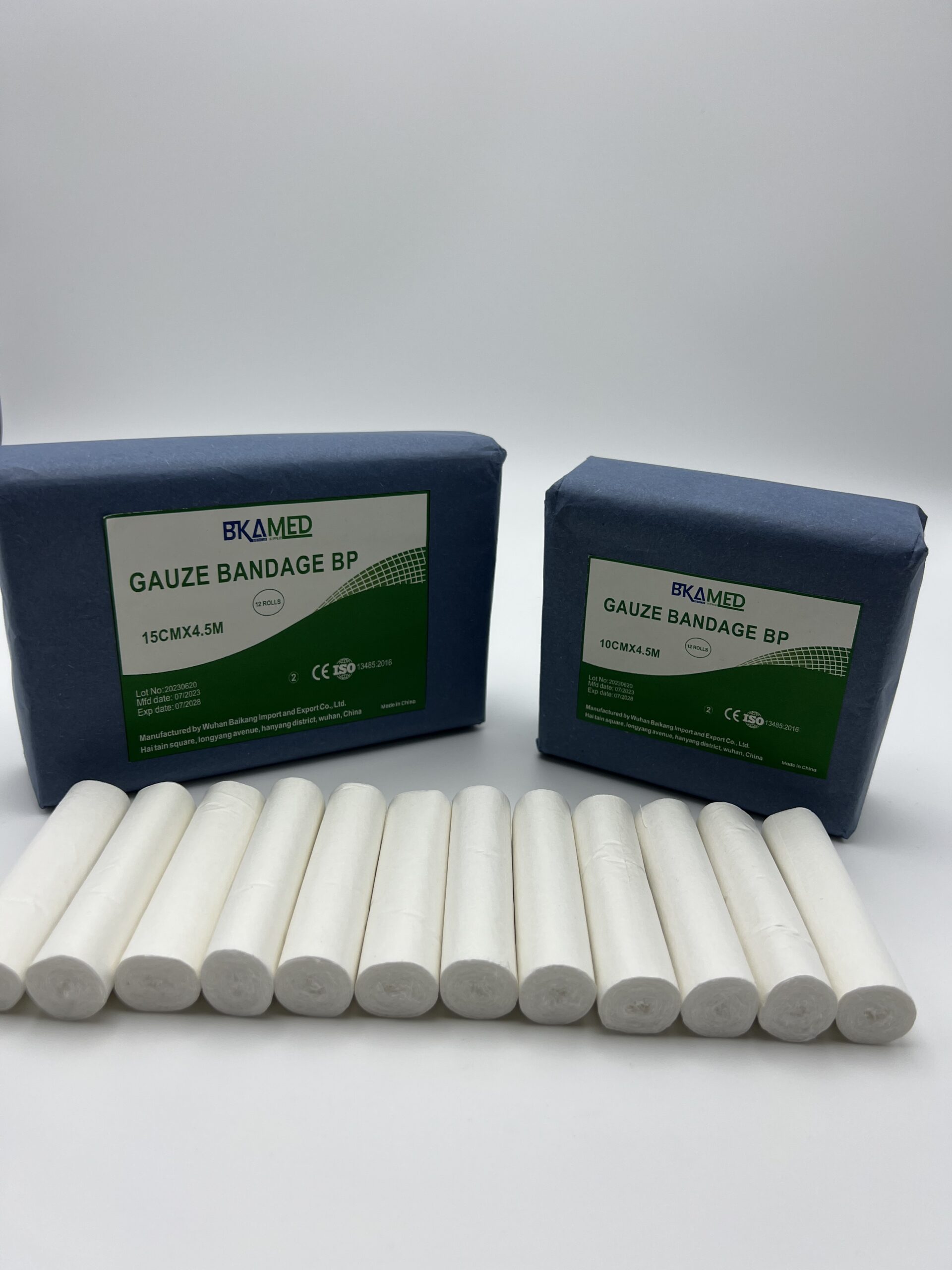
An example of this is the W.O.W. gauze bandage format from BKAMED, which has been proven to be 100% hydrophilic cotton, with documented H2O2 bleaching, and which has been verified as being absorbent as required by pharmacopoeial standards.
Key Specifications for B2B Buyers
A number of technical parameters are directly involved in clinical performance and in downstream processing when purchasing a Hydrophilic Jumbo Gauze Roll. Procurement teams that know about these requirements are extremely difficult to please.
Selvedge (Edge Finish)
One of the most important specifications regarding gauze in surgery or wound care is non-fraying selvedges. A woven fabric’s edges that are finished are called selvedges. When properly produced, each edge of a medical gauze will have the warp threads locked so that the fabric will not unravel when cut or rolled. Patientsafety is a problem if there are loose threads in a wound or surgical area.
With samples, pull on the cut edge of the roll. If threads unravel easily, they are not a good match for the selvedge. If the product is described as ‘selvedged’ or ‘W.O.W.’—woven over-and-over, look for product where the edge threads have been properly locked.
Thread Count and Mesh
Gauze is sold by the number of warp and weft threads it has per square unit. Common specifications are between 20×12 and 28×24 threads per inch. Higher thread count results in a tighter fabric and more stable to control lint. Lower counts result in a lighter, more open, more breathable weave that yields more fibers.
Higher mesh numbers are desired for applications where the wounds are for contact. Standard counts are good for secondary dressing fixation or for general purpose. The specification must always be included with the product documentation as well as with the fabric weight (grams per square meter).
Width and Length Options:
The width of jumbo rolls are generally supplied from 90cm to 100cm and the length range from 1,000m to 10,000m per roll based upon the buyers downstream processing need.
The bandage rolls for clinical use come in a range of between 5cm and 20cm in width. Owners of slitting presses set their parent roll size based on the amount of yield they expect from the business.
Ply and Roll Tension
Most wound care applications are carried out with a single ply of gauze. Downstream, multi-ply configurations (folded gauze swabs) are manufactured.
When winding, the roll tension has an impact on the density and dimensional stability of the final product. When the tension is inconsistent, the rolls have different diameters, leading to issues in automated dispensing devices.
Absorbency and Skin Ventilation:
In addition to the simple sink test, buyers should ask for absorbency in grams of water absorbed per gram of cotton.
The hydrophylicity of a well produced Hydrophilic Jumbo Gauze Roll is usually 24-27 times its original weight. Ventilation (air permeability) data is also applicable for wound care applications, because the air permeability of a gauze is important to the healing environment.
| Parameter | Typical Range | Clinical Relevance |
|---|---|---|
| Thread count | 20×12 to 28×24 per inch | The higher the count , the less lint and the better the integrity. |
| Absorbency | 24-27x weight in water | Primary wound exudate management |
| Absorbency speed | Sinks within 10 seconds (BP/USP) | Confirms complete hydrophilicity |
| Jumbo roll width | 90cm – 100cm | Determines downstream slit yields |
| Roll length | 1,000m – 10,000m per roll | Scales to converter/hospital volume |
| FWA status | Zero fluorescent agents | BP/USP compliance requirement |
| pH (finished product) | 6.0 – 8.0 | Skin compatibility |
Clinical Applications and End-User Demand
Different clinical applications create differing needs among buyers, and buyers who realize that nuance source product that fits their end-market and not generic stock.
Primary Wound Dressing
In primary dressing applications, gauze is in direct contact with the wound bed. This is the hardest of uses. Absorbency, lint control and non-adherence is important (or controlled adherence for some wounds).
For this application, the hydrophilic cotton bandage material should have a pharmacopoeial absorbency and be lint minimized. Non-fraying selvedges are a must.
Secondary Dressing Layer
Secondary dressings are used to hold the primary dressing in place and absorb any fluid that may be in excess. The absorbency speed test is not quite as rigorous here, but the other factors such as roll tension, dimension and general fabric quality are important.
This is typically where buyers think about cost optimised grades, however the certification criteria (ISO, CE) should be the identical.
Post-Surgical Bandaging
Hydrophilic gauze rolls are consumed in huge numbers in surgical wards for wound management after surgery. The pattern of demand here is usually for large quantities, standard sized products and frequently sterile-packaged products in single rolls.
The procurement cycles are predictable and this segment is well suited to long-term supply contracts with a factory such as BKAMED.
Burn Care:
The gauze specifications for burns are very strict. The material should be highly absorbent, very little irritation and can be changed without traumatizing new tissue.
In this context, plain hydrophilic gauze is used for secondary layering and circumferential wrapping, while the gauze impregnated with paraffin is used for the contact layer in wounds.
When purchasing for burn care, the buyer needs to be provided with documented biocompatibility beyond CE marking.
Veterinary Applications
Medical grade gauze is an export product from China that is expanding in the veterinary field. Requirements are similar to human-use requirements for the most part, but may vary depending on market sterility requirements.
The supplier of hydrophilic gauze roll China is also demanded by the distributors to the veterinary hospitals, because the quality of the cotton is the same.

The W.O. gauze bandage from BKAMED provides all the clinical applications listed above and features selvedged edges, 100% hydrophilic cotton and traditional roll size for primary or secondary dressing applications.
Which Standards Apply to Hydrophilic Cotton Bandage Rolls?
Many procurement teams find themselves in trouble at the compliance stage. To begin, the medical gauze standard is not complicated, but multi-layered and each target market has its own specific documentation needs. This is an expensive and time consuming mistake at customs.
British Pharmacopoeia (BP)
The BP monograph for absorbent cotton gauze details the bleaching process, absorbency properties, range of thread counts and the absence of fluorescent agents.
In the UK, procurement is based on BP compliance, and the BP is a widely recognised quality benchmark in many importing countries around the Commonwealth, many in Africa and the Middle East.
United States Pharmacopeia (USP)
The requirements for USP standards for absorbent cotton (USP monograph) and gauze are very similar to BP standards, but there are a few differences in the test method.
Usually, USP compliance documentation is attached to the product for FDA-regulated imports into the US. US importers also must ensure that the manufacturer is FDA establishment registered for that product classification.
European Pharmacopoeia (EUP / Ph. Eur.)
The European Pharmacopoeia is valid for the EEA countries and EU member states. With regard to gauze and cotton bandages, the practice is in good agreement with the relevant monographs of BP.
CE marking pursuant to the relevant Medical Device Regulation (MDR) is the market entry condition of the EU and this does not replace, but rather accompany, pharmacopoeial compliance.
ISO 13485:
The ISO 13485 is the quality management system guide for medical device manufacturers. It is not a product standard, but is a process standard that ensures that the factory has the necessary design control, production control, traceability and corrective action systems.
The ISO 13485 certificate should be requested by every buyer, it should be explicit about the scope of the certificate (which should cover the type of product being purchased), and buyers should make sure it is current.
CE Marking
Medical devices that are sold in the EU must be CE marked. Absorbent cotton gauze is subject to the EU MDR (Regulation 2017/745) and CE marking demonstrates compliance with essential safety and performance requirements.
A declaration of conformity that accompanies the marking, and a technical file kept by the manufacturer for Class I devices, should be submitted.
FDA Registration
If it is being imported from the United States, the manufacturing establishment needs to be registered with the FDA (21 CFR Part 807). The registration number can be checked on the FDA database of public records.
Each person buying medical grade cotton bandage roll product for distribution in the USA should ask for the FDA establishment registration number and check it for themselves before placing an order.
BKAMED is ISO 13485 certified, CE marked and FDA registered throughout their product range of gauze, cottons. Buyers can request documentation packages of all products and the certifications are posted on each product page on the BKAMED website.
Finding a Reliable Wholesale Supplier in China
China continues to be the world’s largest supplier of medical cotton gauze. The country’s raw cotton supply chains, well-developed textile manufacturing & infrastructure, and lower labour costs make it the most competitive sourcing geography for high volume buyers from all over the world.
The market is segmented, however, and one of the most common errors that international buyers make is picking the wrong type of supplier.
Factory vs. Trading Company
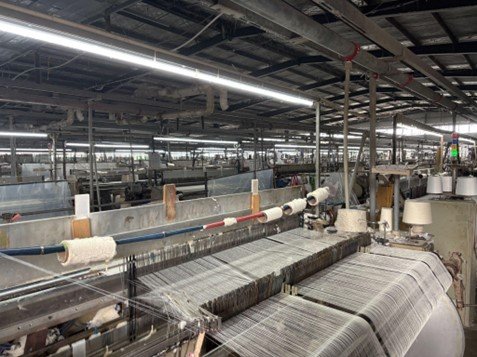
The product is produced in a factory. It is sold by a trade firm, which usually purchases from several factories with a margin. Both are readily available on sites such as Alibaba or Global Sources.
From the quality assurance point of view, the difference is significant in practice. A factory can trace a product back to the production batch, machine and operator when a buyer places a quality hold or requests a nonconformance investigation.
A trading company normally will not be able to. When traceability is a regulatory requirement for pharmacopoeial grade product, purchasing from a factory is not just a preference, it’s a compliance issue.
Vertical Integration
The most capable China factories are vertically integrated. They produce their own grey fabric, own bleaching and purification lines and conduct the finished product test in their own laboratory. This is important because each passing between suppliers is a quality risk. A factory purchasing grey cloth from an outside weaver which then bleached in-house has less control than a factory that bleaches the cloth itself.
When assessing a potential hydrophilic gauze roll supplier China, ask these following questions:
- Do they weave their own fabric or purchase grey goods?
- Do they have their own H2O2 bleaching line?
- Do they have their own tests for absorbency, pH and fluorescent agents?
The responses provide an insight into the true extent of their quality control capacity.
Supplier Vetting Process
The following should be the components of a structured vetting process for an order for a factory price hydrophilic cotton bandage:
- Request ISO 13485, CE and FDA certification documentation. Review the date of the issue, the scope of the certificate and the certificate authority.
- Prior to any bulk commitment, order samples for evaluation. Test absorbency, check selvedges, dimensions against spec.
- Factory audit or third-party inspection: If the order is of a certain size (usually USD 50k+), it can be valuable to get an audit or SGSM/Bureau Veritas inspection done on the factory.
- Check references: Talk to current importers in the country you are looking to import from. A factory that can provide a successful supply for three years to the EU distributors is better than any certificate of any kind.
- Production capacity confirmation: Ensure factory can meet your MOQ and lead time without subcontract. Inquire about their monthly production capacity in rolls or tons.
For over 10 years BKAMED has been exporting medical consumables to more than 60 countries. The range of wound care products is produced in-house and make use of the full vertical integration of the weaving, bleaching and packaging capacities.
OEM Customization Options
The key benefits of purchasing direct from a China factory are getting access to the OEM (original equipment manufacturer) services.
The key to the value of factory direct sourcing for importers, distributors, and hospital supply chains looking to market product under their own brand is actually its customization capabilities, not its price.
Custom Dimensions
Jumbo roll width, finished bandage roll width and length and slit dimensions are all customizable in a full OEM relationship. This is important for distributors that have set up SKU ranges which must match precisely.
When the width of the jumbo roll is not the same as the specification of the slitter used by the distributor, waste and yield losses soon give the factory-direct buyer the cost disadvantage.
Private Labeling
Most factories in China with OEM capability can customize the printing of labels and artwork on each roll packaging, box and shipping carton. Most established distributors find it very easy to do private labeling, as the per unit price difference for the volumes makes it easy. Minimum order quantity is generally higher for custom packaging than it is for stock product.
Packaging Configuration
Packaging specifications for a hospital bandage roll bulk order differ more from those for a retail product that is sold to pharmacists.
In institutional bulk packaging, each product is not retail wrapped, provided in large quantities in hospital cases, with a useful, rather than decorative, carton design. Unit carton, retail barcodes and language labelling for target market is required for pharmacy product needs.
Both configurations are available in the capable factory. Therefore, the first inquiry with the buyers must be clear to the factory of the end channel so that the factory can quote the right packing route. Delivering this wrong at sample stage results in lost artwork and possible lost product packaging, which is time and cost expensive.
Sterile vs. Non-Sterile
Standard production of Hydrophilic Jumbo Gauze Roll material is non-sterile. Sterilization (usually EO gas or gamma) can be offered as a post production facility for those customers who need sterile product for wound contact applications. Sterilization is an additional cost and lead time.
Non-sterile product is the typical level at which a buyer can access product if he or she has his or her own sterilization.
BKAMED provides full OEM services on all surgical cotton wool zig-zag and gauze product lines, custom widths, roll lengths, packaging and private labeling for both retail and institutional sales channels.
Pricing Structure: What Drives Cost Up or Down
The price of Hydrophilic Jumbo Gauze Roll product is less predictable than buyers may think if it is purchased from a factory.
The difference in price between a basic quote and a product that’s fully compliant and certified can be vast and knowing what the difference is will help you avoid making the wrong choice based on the price alone.
Cotton Quality Grade

Medical-grade cotton is more expensive than commodity grade or textile grade cotton. Efficiency of bleaching and quality of the finished product depends on the length of fibers, micronaire reading and the contamination of raw cotton.
The fluorescent product made by combed long-staple cotton is more uniform than the product made by short-staple cotton or blended cotton.
Bleaching Process Depth
Compared with the normal textile bleaching, the cotton bandage processing for H2O2 bleached cotton involves much more process control and higher chemical consumption in the bleaching process along the longer processing time.
In order to lower costs, factories may produce a less absorbent version of the product, which looks similar. The factory gate price reflects the cost difference between properly bleached and inadequately bleached gauze.
Certifications and Compliance
Achieving ISO 13485 certification, CE marking and FDA registration do not come free. These costs are hidden in the cost of alternative factories, which in turn are found in the factory’s cost.
If the buyer has been given a quote that is well below market value from an uncertified supplier, then there is a very good chance that the buyer is dealing with product that is not legal to sell in regulated markets.
Packaging Complexity
The most economical packaging is in plain bulk packing. Individual packaging, custom printed cartons and multi-language labeling all increase costs.
Any purchased configuration should be based on an actual end market needs versus default assumptions.
MOQ and Volume
The minimum order quantity of absorbent cotton bandage roll factory price sourcing is usually from 1 ton to 5 tons. When the volume is higher, the volume pricing kicks in and as the amount of kilograms increases, the price per kg will drop significantly.
Buyers who combine orders from a variety of product categories from one factory, they are in a much stronger negotiating position.
Sterilization:
The cost of finished gauze product incorporates an additional 15-30% for the EO process, depending on pack size and batch volume. The gamma irradiation process is similar.
For buyers who require sterile product, this must be considered as part of their unit economics and not as an optional add-on.
Incoterms
Most international orders of gauze shipments are made on the basis of FOB (Free On Board) from a Chinese port. CIF (Cost, Insurance, Freight) and DDP (Delivered Duty Paid) options are available from factories that have freight connections, but with an extra charge.
Large buyers will often buy FOB as they will have their own freight contracts.
Shipping and Import Considerations by Market
Logistical and regulatory requirements differ widely from country to country. Without the proper documentation package, shipments may be delayed, demurrage may be charged, and in some cases, products will be destroyed at the port of entry.
European Union
The main market access criteria is CE marking. Importers are responsible for having a Declaration of Conformity in place and applicable to the product being imported.
The involvement of Notified Bodies has been updated for certain classes of device for the transition to EU MDR (Regulation 2017/745). The general HS code for cotton gauze bandages is 3005.90 Non-sterile or sterile cloth bandages of cotton, wound dressings.
The lead time for shipping from China to main ports of the EU (Rotterdam, Hamburg, Piraeus) is usually 25 to 35 days by sea freight. Air freight is an option to replenish urgent supplies but is not usually cost-effective for bulk orders of gauze, as is normally the case with medical distributors.
United States
The manufacturer must be registered with FDA and the FDA Unique Device Identification (UDI) system is becoming more applicable to gauze products.
To avoid customs duties falling into the wrong classification, the importer should ensure a customs broker clarifies the classification (usually 3005.10 adhesive dressings or 3005.90 other wound dressings).
It takes 14 to 18 days to transit from Chinese ports to US West Coast (Los Angeles, Long Beach). East Coast delivery (New York, Savannah) will see an additional 7-10 days.
The typical buyer should incorporate at least 60 days of safety stock into his/her inventory model to take into consideration the variability involved in the processing of customs.
Middle East
Medical devices include wound care gauze, which needs to be registered with the local health authority in Saudi Arabia (SFDA) and the UAE (MOHAP).
Usually, CE marking and ISO 13485 are accepted as bases for registration but require some local agent involvement. The lead time Jebel Ali to Chinese ports is around 20-28 days.
| Market | Key Requirement | HS Code | Sea Transit (approx.) |
|---|---|---|---|
| EU | CE marking (MDR) | 3005.90 | 25-35 days |
| USA | FDA registration + UDI | 3005.10 / 3005.90 | 14-28 days |
| Middle East | SFDA / MOHAP registration | 3005.90 | 20-28 days |
| Africa (East) | BP docs / PPB | 3005.90 | 25-35 days |
BKAMED’s Hydrophilic Cotton Bandage Roll Offer
BKAMED is a Chinese company specializing in the production of medical consumables, such as gauzes, cotton, bandages, wound care products, surgical tapes and disposables.

The factory has exported to more than 60 countries and has already established a supply relationship with Europe, the Middle East, Africa and Southeast Asia.
Product Range
BKAMED’s Hydrophilic Jumbo Gauze Roll comes in a wide range of clinical and converter needs.
The usual standard widths for jumbo rolls are 90cm to 100cm and the lengths are available from 1,000m to 10,000m per roll. It comes in a variety of thread counts, ranging from 20×12 to 28×24 threads per inch, depending on the intended use.
The production is carried out by 100% hydrophilic cotton, no fluorescent agents are used in the manufacturing process.
Certifications
BKAMED is certified to ISO 13485, CE marked under EU MDR and FDA establishment registered. Each order comes with certificate documentation.
BKAMED can prepare an additional document as per market requirement such as Free Sale Certificate/Certificate of Origin or BP conformity letter.
OEM Services
Full OEM capabilities are offered throughout the gauze and cotton product line. Custom widths, retail and institutional packaging configurations and both roll lengths and printed packaging are all supported.
BKAMED’s OEM team collaborates with buyers to create artwork for packaging that complies with the labelling requirements for the destination market.
Samples
Samples of Hydrophilic Jumbo Gauze Roll are available to request. Placing a sample order takes 2-3 working days. We suggest that when bulk orders are requested, BKAMED recommends that the customer use BP or USP absorbency testing procedures on received samples before confirming any bulk purchases.
Export Track Record:
BKAMED provides solutions to hospital systems, medical distributors and medical chains throughout Europe, the GCC region, East Africa and Southeast Asia.
Documentation packages are created right from the initial order as a result of the factory’s expertise in exporting products, resulting in quicker clearance at customs and registration.
The full range from the hydrophilic jumbo gauze roll to W.O. gauze bandage, to W.O.W. gauze bandage to surgical cotton wool zig-zag can be seen on the BKAMED product pages. Other wound care products can be found in the wound care product category.
Place Your Wholesale Inquiry Today
Now your procurement team has all the tools they need to accurately assess a supplier and ask the correct questions. The next step is simple: send a request along with the description of the parameters required.
A request for Hydrophilic Jumbo Gauze Roll product should contain the following:
- Roll width and length (Jumbo or Finished Bandage)
- Thread count specification or application description (wound contact, secondary fixation, converter input).
- The amount of product produced in a given year (in kilograms or rolls)
- Required certifications (ISO 13485, CE, FDA or BP/USP conformity)
- Packaging requirements (bulk institutional, retail unit, private label)
- Documents/local regulation requirements (e.g. target market)
- Information provided of requested Incoterms (FOB, CIF or others).
- Are there any samples required? Yes or No and how many?
BKAMED’s export team answers the qualified enquiries within 24 hours. For standard products: quotations within 2 working days since receiving the complete RFQ. Samples will be dispatched within 3-5 working days after placing your order.
For submitting an inquiry, please use the BKAMED inquiry form. Please put all of the above information in so that they can respond as quickly as possible. In the event that buyers are not sure about the technical parameters of the product the best fit is given by the BKAMED team.
Final Thoughts: Getting Hydrophilic Gauze Procurement Right
Getting a Hydrophilic Jumbo Gauze Roll from a China factory is easy, as long as buyers are aware of what they want. Verified H2O2 bleaching, pharmacopoeial absorbency testing and absence of fluorescent agents are all essential for proper hydrophilicity. The right factory can show you traceability from raw cotton to finished roll, is vertically integrated, and is ISO 13485, CE and FDA certified.
The prices are based on quality of the cotton, extent of bleaching, certification overhead, packaging arrangement and order size. Each market has specific shipping and import regulations which can be handled, provided that the proper shipping documentation package is prepared. Private labeling, custom dimensions and more are provided by reputable factories, and open the door to the true value of a factory-direct supply relationship.
BKAMED brings together all these elements: certified manufacturing, vertically integrated production, a complete hydrophilic cotton bandage product portfolio, OEM services and export expertise.
The starting point is a well-structured RFQ and a sample request. For buyers that do due diligence, the result is a dependable supply chain for one of the most basic consumables in clinical medicine.
