
In 2026, low-cost sourcing is no longer the sole driving force in hospital procurement. Scrutiny by the regulatory body, supply chain variability, and infection-control requirements have altered the manner in which institutions review bordered gauze and all adhesive wound dressings within their portfolios. The World Health Organization cites surgical site infection as a significant burden in the whole world, a fact that supports the necessity of clinically dependable surgical island dressing solutions.
To B2B buyers, border gauze is no longer a commodity, but a risk-managed asset. Modern medical dressing gauze should balance assurance of sterility, adhesive performance, and absorbency in accordance with FDA and MDR compliance criteria. The emergence of sophisticated gauze surgical forms has proclaimed that bordered gauze is the standard protocol in post-operative and chronic wound care in all hospitals, GPO networks, and nationally dispersed distributors.
This guide provides a fact-based comparison of serious institutional sourcing decisions.
Key Takeaways
- Bordered gauze is no longer a purchasable commodity. Regulatory security, adhesive reliability, and long-term continuity of supply are some of the issues that hospitals and GPOs consider when gauging bordered gauze, rather than considering price per unit.
- Vertical integration minimizes risk. Manufacturers with control over the production of nonwoven, formulation of adhesives, and sterilization of adhesive wound dressing lines provide increased batch consistency and reduced exposure to recall.
- The number of surgical volumes is rising all over the world. An increasing rate of procedures is still boosting the institutional demand for standardized surgical island dressing and gauze surgical formats.
- Capacity acts as a determinant of the viability of the contract. Not all border gauze suppliers are able to sustain 10M+ unit commitment per year without long lead time or allocation risks.
- A procurement filter is for compliance. When procuring medical dressing gauze in large quantities, ISO 13485, FDA 510(k), CE (MDR), and certified sterilization are also necessary.
Top 10 Bordered Gauze Manufacturers & Brands
This part examines the top bordered gauze, adhesive wound dressing, and surgical island dressing supplier concerning production, certifications, B2B, and pricing strategy.
1. BKAMED – The OEM/ODM Powerhouse
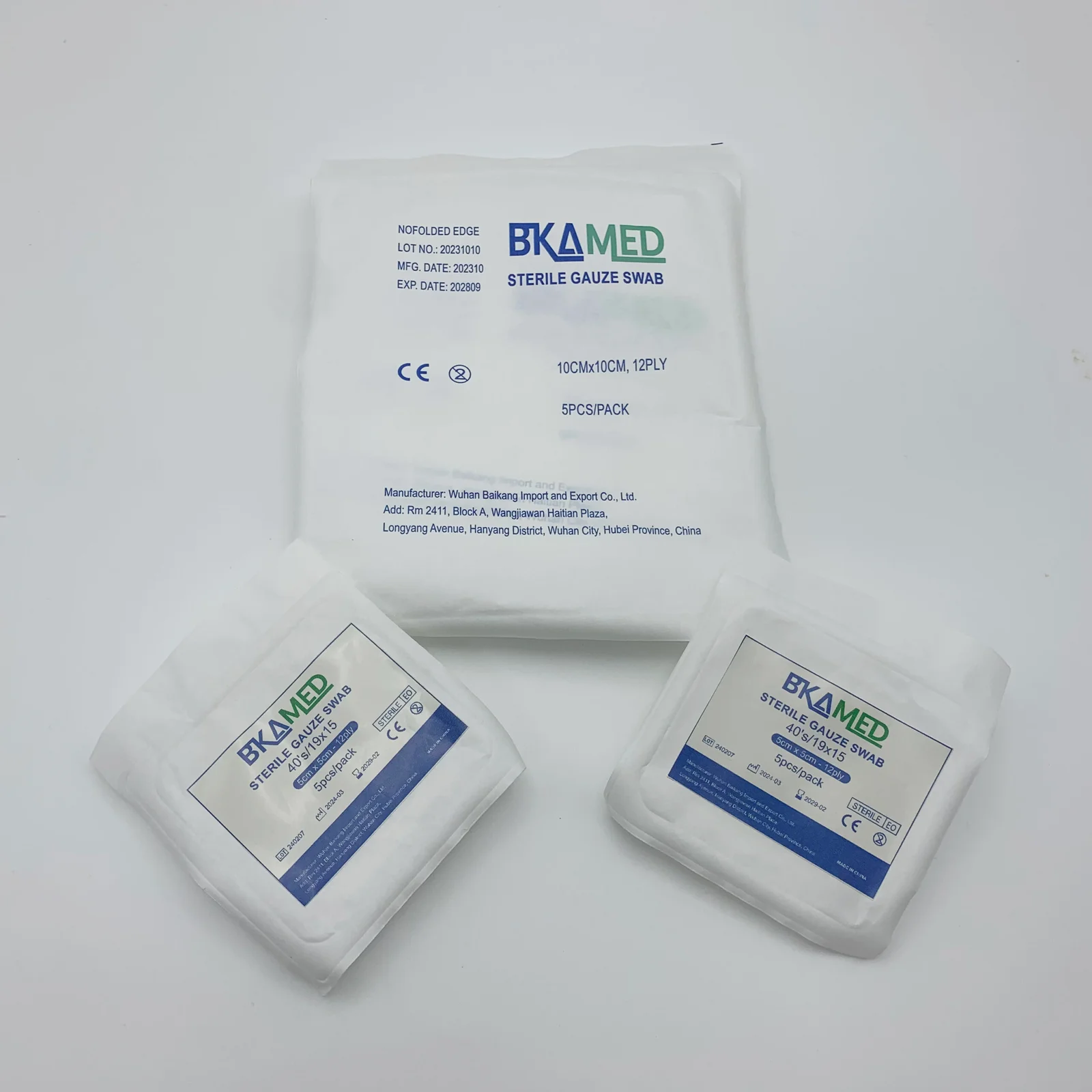
BKAMED is a world-renowned company that deals with the production of bordered gauze, adhesive wound dressing, and surgical island dressing. In the B2B market, it has earned the reputation of vertical integration, enabling it to control the sourcing of raw materials, manufacture of nonwoven textiles, adhesive formulation, sterilization, and packaging. This contributes to BKAMED being desirable as a collaborator by distributors, GPOs, and hospitals when high-volume, compliant, and customizable medical dressing gauze solutions are required.
Product Portfolio
- Post-op and chronic standard 4×4 bordered gauze.
- Surgical island dressing, pediatric and orthopedic sizes (2×4, 6×8, 4×10 cm).
- Super-absorbent polymer (SAP), cellulose, and cotton.
- Silicone adhesive forms for delicate skin.
- Bordered gauze for patient shower tolerance, PU-backed and waterproof.
- OEM/privately-labeled alternatives to distributors who need branded solutions.
Production Capacity
BKAMED has several high-volume production lines:
- 1,000,000+ units per day.
- Pad conversion and automated application of adhesives.
- Fast-paced sterile packaging to maximize container-level shipments.
- Unnecessary sterilization lines (gamma and ETO) that guarantee SAL 10⁻⁶.
Regulatory Compliance
BKAMED is certified to operate in the international market:
- FDA 510(k) cleared for the U.S.
- CE (MDR) for EU distribution.
- Quality management system ISO 13485.
- Adhesive biocompatibility ISO 10993.
- UKCA marking of UK procurement.
Pricing & B2B Advantage
- Tiered bulk and container-level prices that are factory-direct.
- Multi-year and private-label partnerships offer a discount.
- Extensive OEM customization of dimensions, type of adhesive, and packaging.
- Quick response to new product requests during the R&D process, shortening time-to-market.
Procurement Insight
BKAMED is best suited to hospitals or distributors who are interested in:
- Bordered gauze of high volume with ensured regulatory conformity.
- Private-label programs include customizable medical dressing gauze and surgical island dressing.
- Eliminable unit costs and minimal reject rates as a result of automated quality assurance.
2. Medline Industries – Market-Dominant Hospital Supplier
Medline Industries is a major distributor of bordered gauze, adhesive wound dressing, and surgical island dressing, especially in the North American hospitals and institutional market. It is strong with reliability, regulatory compliance, and large distribution networks that have made it a favorite among GPOs and hospital procurement teams.
Product Portfolio
- Normal 4×4 and 2×4 bordered gauze to use in a post op.
- Sensitive skin hypoallergenic acrylic adhesives.
- Pediatric and adult surgical island dressing variations.
- Ready-packaged sterile medical dressing gauze that can be used in the OR and in wards.
- Hospital-ready, multi-pack gauze surgical solutions.
Production & Capacity
- Several large-scale plants in North America and Asia.
- Millions of units per month, fully automated pad conversion, and sterile packaging lines.
- Gamma and ETO sterilization guaranteeing SAL 10⁻⁶.
Certifications
- FDA 510(k) approved to sell in the U.S.
- Quality management system ISO 13485.
- CE (MDR) marking for EU markets.
- Adhesive biocompatibility testing in ISO 10993.
Pricing & B2B Advantage
- Compromise prices through GPO contracts.
- Large standardized SKUs make the supply chain less complex.
- Minimal OEM customization, yet unparalleled reliability to hospitals that need a steady supply.
Medline is best suited to distributors and hospitals that want reliable, compliant, and standardized bordered gauze and medical dressing gauze and are willing to focus more on operational consistency rather than customization.
3. Cardinal Health – Clinical-Grade Supply Network
The Cardinal Health company specializes in supplying bordered gauze, adhesive wound dressing, and surgical island dressing in the United States, with a focus on clinical-grade performance and consistent delivery to hospitals and distributors. Their products are popular in surgery centers, long-term care facilities, and high volume hospitals networks.
Product Portfolio
- Normal 4×4 and 2×4 bordered gauze that has uniform absorption.
- Surgical island dressing with a simple backing that is easy to apply.
- Hypoallergenic acrylic adhesive for sensitive-skinned patients.
- Medical dressing gauze for moderate to high exudate wounds.
- Orthopedic sterile bedside and OR sterile pouches.
Production & Capacity
- Automated production lines in the U.S. with a capacity of 500k-750k units/day.
- Fast adhesive application and consistent boundaries.
- Hospital logistics and GPO distribution optimized sterile packaging.
Certifications
- FDA 510(k) cleared.
- Quality management system ISO 13485.
- CE mark and UKCA compliance.
- Adhesives that were tested under ISO 10993 biocompatibility.
Pricing & B2B Advantage
- High-end middle-range pricing; bulk contracts are typically on an annual basis.
- Coupled with supply reliability and uniform quality as opposed to broad OEM customization.
- The suitable choice for hospitals and distributors who want to use standardized gauze surgical and adhesive wound dressing solutions.
Cardinal Health is a safe option with B2B customers who are more focused on the consistent clinical-grade bordered gauze supply with a stable supply and regulatory guarantee.
4. Smith & Nephew – Advanced Wound Management
Smith and Nephew is a multinational manufacturer of bordered gauze, adhesive wound dressing, and surgical island dressing that is characterized by high standards of providing solutions to the post-operative and chronic wound care. Hospitals and surgical centers that deal with sensitive-skinned patients and high-acuity cases especially seem to appreciate their products.
Product Portfolio
- Adhesive gauze made of silicone for delicate skin.
- Cellulose or SAP core high-absorbency medical dressing gauze.
- Pediatric and adult surgical island dressing sizes.
- Waterproof and semi-permeable post-operative versions.
- Chronic wound and high exudate dressings.
Production & Capacity
- International manufacturing capacity of 400-600k units/day.
- Automated packaging and adhesive application.
- Regional distribution facilities in North America, Europe, and Asia.
Certifications
- FDA 510(k) cleared devices.
- CE marking and the ISO 13485 quality management system.
- Biocompatibility of adhesives ISO 10993.
Pricing & B2B Advantage
- Higher prices indicate superior features and clinical evidence.
- Fewer OEM or private-label solutions, with specialty hospital procurement in focus.
- It is suitable for hospitals that need high-performance bordered gauze and medical dressing gauze that have special adhesives.
Summary: Smith and Nephew would suit B2B customers more who are more keen on high wound care, sensitive-skin compatibility, and longevity in clinical performance, rather than customization or price.
5. Mölnlycke Health Care – European Quality & Safetac® Technology
Molnlycke Health Care is a major European provider of bordered gauze, adhesive wound dressing, and surgical island dressing, and is known because of its Safetac(r) silicone technology, which reduces skin trauma. Their products are sold to high-end surgical centers, hospitals, and distributors that seek high-end, regulatory-compliant medical dressing gauze.
Product Portfolio
- Silicone-bordered gauze of minimal traumatic adhesion.
- Surgical and post-op surgical island dressing standard and large sizes.
- Absorbent cores: cellulose and cotton blends to the extent of moderate to heavy exudate.
- water-resistant types of the patient friendly after-operative care.
- OEM/ private-label alternatives for large-volume purchasers.
Production & Capacity
- 300k-500k units/day in automated facilities in Europe.
- Sterile high-volume packaging lines are designed to maximize the logistics of the hospital.
- The minimum order quantities (MOQs) are more in international shipping.
Certifications
- European distribution marking CE (MDR).
- Quality management system of ISO 13485.
- Biocompatibility testing in ISO 10993.
Pricing & B2B Advantage
- Premium pricing indicates Safetac(r) technology and European standards of compliance.
- Most applicable to distributors and hospitals that require high-quality bordered gauze and adjustment controls.
- Less flexibility for small buyers because of increased MOQs.
Summary: Molnlycke is best suited to B2B buyers who need sophisticated medical dressing gauze, specialty adhesives, and meet the European standards of surgery.
6. Hartmann Group – Reliable European Supplier
Hartmann Group is a highly developed producer of bordered gauze, adhesive wound dressing, and surgical island dressing with a powerful presence in DACH (Germany, Austria, Switzerland). Their products are extensively utilized in hospitals, long-term care facilities, and regional distributors who want the quality and reliability to be constant.
Product Portfolio
- 4×4 and 5×5 bordered gauze for post-operative and chronic wounds.
- Moderate-exudate absorbent pads of high density.
- Pediatric and adult variants of the surgical island dressing.
- Ready-made hospital packages and multi-unit sterile medical dressing gauze.
- Minimal OEM, which deals mainly with branded hospital supplies.
Production & Capacity
- 200k-400k units/day through automated European plants.
- Sterile packaging lines of hospital logistics and regional distribution.
- Regular production guarantees low lead times to the DACH-based buyers.
Certifications
- CE marking for EU markets.
- Quality management system of ISO 13485.
- Biomocompatibility certification of adhesives ISO 10993.
Pricing & B2B Advantage
- Competitive mid-tier pricing, which regional hospitals and distributors can afford.
- Good regional logistics network that delivers goods on time.
- Concentrate on reliability and quality instead of being highly customized.
Summary: Hartmann Group would best suit B2B customers in Europe who would be interested in reliable bordered gauze and medical dressing gauze, more so in the DACH region, where quality and supply should be uniform and stable.
7. Winner Medical – Large-Scale Asian Manufacturer
Winner Medical is a large Asian manufacturer of bordered gauge, adhesive wound dressing, and surgical island dressing with high volume production and sustainability. Their products are aimed at global distributors, hospitals, and OEM business associates who are in need of cost-effective, reliable, compliant medical dressing gauze.
Product Portfolio
- Post-op and chronic wound 4×4 and 5×5 bordered gauze.
- Pediatric and adult variants of the surgical island dressing.
- Cores made of high absorbency cotton, cellulose, or SAP.
- Waterproof and semi-permeable choices for patient convenience.
- Distributor/global partner OEM/ private label services.
Production & Capacity
- More than 1,000,000 units/day through various automated Asian plants.
- Container-level packaging is designed for international shipping.
- Sterilization with gamma and ETO techniques for SAL 10⁻⁶.
Certifications.
- Quality management system of ISO 13485.
- CE marking for EU export.
- Select SKUs are cleared by the FDA 510 (k).
- ISO 10993 biocompatibility-tested adhesives.
Pricing & B2B Advantage
- Competitive bulk pricing, which suits large-volume distributors.
- Well-developed OEM/ private-label strengths, which make it possible to have branded dressing solutions with gauze.
- A consistent supply chain all over the world lowers the chances of delays on foreign based purchasers.
Summary: Winner Medical would be best applied among distributors and hospitals that require bulk bordered gauze that is cost-effective and has compliance documentation, along with scalable OEM services.
8. Dynarex Corporation – Value-Oriented Supplier
Dynarex Corporation offers bordered gauze, adhesive wound dressing, and surgical island dressing solutions at affordable prices to EMS providers, long-term care facilities, and hospitals interested in budget-based procurement. Their products are optimally positioned to fulfill high-quality clinical standards and are cost-effective for large-scale B2B customers.
Product Portfolio
- Normal 4×4 and 2×4 bordered gauze.
- Surgical island dressing to use on general wounds.
- Institutional use of retail-ready and pre-packaged medical dressing gauze.
- EMS and long-term care distribution units of multi-pack sterile gauze surgical units.
Production & Capacity
- A daily production capacity of 150k-300k units.
- Automated sterile packaging of small to medium orders.
- Few OEM choices yet enough to buy in volume, standardized SKUs.
Certifications
- U.S. distribution registered by the FDA.
- Quality management system ISO 13485.
- Adhesive biocompatibility conforms to ISO 10993.
Pricing & B2B Advantage
- Prices in the low-to-mid-tier will suit EMS providers and long-term care facilities.
- An inexpensive substitute for expensive, bordered gauze brands.
- Dependable supply chain of standardized medical dressing gauze with no meaningful customization.
Summary: Dynarex is best suited to hospitals, EMS, and long-term care distributors who want cheap, bordered gauze and adhesive wound dressing that offer dependable supply and quality without having to focus on customization, but instead focus on affordability.
9. Dukal Corporation – Specialty & Kit Solutions
Dukal Corporation is an American distributor of bordered gauze, adhesive wound dressing, and surgical island dressing and has a great orientation in preparing customized kit-packing solution to hospitals, surgical centers, and distributors. Their products are supposed to sustain procedure-specific inventory and optimize OR efficiency.
Product Portfolio
- Bordered gauze in standard and specialty sizes.
- Custom versions of surgical island dressing.
- Ready-prepared kits of medical dressing gauze and complementary products.
- Hospital logistics optimized, sterile, and separately packaged units.
Production & Capacity
- Production capacity of 100k-250k units/day.
- Plants geared towards kit assembly and packaging of multiple components.
- Automated sterile packaging guarantees consistency of quality and batches.
Certifications
- U.S. Distribution cleared by FDA 510(k).
- Quality management system based on ISO 13485.
- CE marking for EU export.
- Adhesive biocompatibility determined to ISO 10993 standards.
Pricing & B2B Advantage
- Mid-pricing of standard bordered gauze and kit solutions.
- High prices on customized procedure kits.
- Ideal for distributors and hospitals who want ready-made medical dressing gauze kits and save time in inventory management.
Summary: Dukal Corporation is well-suited to B2B customers who require bordered gauze to be a part of specialty kits, and the quality is consistent over time, regulatory compliance is observed, and easy hospital-ready packaging is observed.
10. Lohmann & Rauscher (L&R) – Waterproof & Specialized Dressings
Lohmann and Rauscher (L&R) is a European producer of bordered gauze, adhesive wound dressing, and surgical island dressing, which has the Curapor(r) line and exclusive waterproof items. L&R is oriented to supplying hospitals, surgery centers, and distributors with high-quality, regulatory-compliant medical dressing gauze that is more comfortable and caring to patients.
Product Portfolio
- 4×4 and 5×5 bordered gauze used in post-operative and chronic wound care.
- Post-shower adhesive wound dressing of waterproof and semi-permeable type.
- Silicone adhesive products for delicate skin.
- Pediatric and adult surgical island dressing sizes.
- Ready-made sterile medical dressing gauze is part of hospital logistics.
Production & Capacity
- Production capacity in Europe of 200k-400k units/day.
- Sterile packaging lines and automated adhesive application.
- A distribution network that is regional and EU-oriented in providing delivery on time.
Certifications
- The European markets are marked with CE.
- Quality management system based on ISO 13485.
- Adhesive biocompatibility ISO 10993.
Pricing & B2B Advantage
- High pricing due to the use of waterproof and silicone features.
- Best applied to hospitals and distributors with patient convenience and bordered gauze of high quality as priorities.
- Minimal OEM or own-label; emphasis on clinical performance and regulatory compliance.
Summary: L&R is best suited to B2B customers who require waterproof, silicone-based, and regulatory-compliant bordered gauze that can be used in high-end hospitals and surgical centers.
Strategic Summary of Manufacturer Landscape
The international bordered gauze market is divisible into four strategic groups:
- OEM Powerhouses (e.g., BKAMED) – Custom-based, high capacity, vertically integrated.
- Hospital Supply Giants (Medline, Cardinal) – SKUs that are distribution dominant and standardized.
- Premium Wound Specialists (Smith & Nephew, Molnlycke) – Advanced technology, expensive.
- Value Suppliers/ Kit-Oriented Suppliers (Dynarex, Dukal, Winner) – Cost-based and flexible packaging.
The most significant differentiators to B2B purchasers considering bordered gauze include:
- Manufacturing control of layers of adhesive wound dressing.
- Regulatory documentation (FDA, CE, ISO)
- Scalability of production annually.
- Lead-time reliability
- Pricing tier flexibility
- The table format showed the estimated pricing levels by 10k, 100k, and 1M of bordered gauze.
The Comparative Matrix: Certifications, Capacity, Lead Times & Pricing of Bordered Gauze

For institutional buyers, brand recognition is not enough to compare suppliers of bordered gauze. The procurement groups should consider the level of certification, scalability of production, the ability to endure its logistics, and the cost per unit estimates. This section provides a data-based model to screen manufacturers of adhesive wound dressing when it comes to high-volume deals.
1. Certification Audit: Regulatory Strength in Bordered Gauze
In 2026, eligibility is determined by regulatory compliance. A border gauze supplier cannot legally gain entry into the major healthcare markets without proper documentation.
Core Certifications for Medical Dressing Gauze
- FDA 510(k) – Needed to clear surgical island dressing products in the American market.
- CE (MDR) – Requirement of EU distribution of gauze surgical devices.
- The ISO 13485 is a quality management system standard pertaining to the manufacturing of medical devices.
- UKCA – It is a necessary post-Brexit device placement in the UK.
The U.S. FDA database states that Class I and II wound dressings have to prove sterility validation and biocompatibility testing. Procurement officers must always check the listing numbers of bordered gauze products.
Certification Comparison Table
| Manufacturer | FDA 510(k) | CE (MDR) | ISO 13485 | UKCA | Observations of Bordered Gauze |
|---|---|---|---|---|---|
| BKAMED | Yes | Yes | Yes | Yes | Complete export paperwork of OEM bordered gauze. |
| Medline | Yes | Yes | Yes | Yes | Strong U.S. compliance |
| Cardinal Health | Yes | Yes | Yes | Yes | Regulatory strength focused on the U.S. |
| Smith & Nephew | Yes | Yes | Yes | Yes | Premium compliance portfolio |
| Mölnlycke | Yes | Yes | Yes | Yes | Strong MDR positioning |
| Hartmann | Yes | Yes | Yes | Yes | EU-heavy compliance |
| Winner Medical | Yes | Yes | Yes | Limited | Export-ready medical dressing gauze |
| Dynarex | Yes | Yes | Yes | Limited | Focused on the U.S. market |
| Dukal | Yes | Yes | Yes | Limited | Kit compliance strength |
| L&R | Yes | Yes | Yes | Yes | European leadership |
Procurement Insight
Base requirements are satisfied by all players. The distinction is, however, in:
- MDR transition readiness
- Revised technical documentation on adhesive wound dressing.
- Post-market surveillance systems.
Manufacturers whose production of bordered gauze is vertically integrated generally furnish quicker documentation updates in the course of a regulatory audit.
2. Capacity Comparison: Who Can Handle 10M+ Units of Bordered Gauze?
Big GPO contracts are often more than 10 million units per year. That volume cannot be maintained by all surgical island dressing suppliers without the risk of allocation.
Estimated Daily Production Capacity
| Manufacturer | Approximate Daily Bordered Gauze Production. | Annual Contract Suitability |
|---|---|---|
| BKAMED | 1,000,000+ units | 50M+ feasible |
| Medline | High (multi-facility) | 20M–50M |
| Cardinal Health | High | 20M–40M |
| Smith & Nephew | Moderate | 5M–15M |
| Mölnlycke | Moderate | 5M–15M |
| Hartmann | Moderate | 5M–15M |
| Winner Medical | High | 30M+ |
| Dynarex | Moderate | 5M–10M |
| Dukal | Moderate | 5M–10M |
| L&R | Moderate | 5M–15M |
Capacity Risk Considerations
When purchasing bordered gauze, consider:
- Automated sterile lines of packaging.
- ETO vs Gamma, vendors of backup sterilization.
- Raw material buffer inventory.
- In-house nonwoven conversion capacity.
Medical dressing gauze substrate suppliers who use third-party converters are subject to bottlenecks in global demand peaks.
3. Lead Time Analysis: Ocean vs Air vs On-Shoring
Post-pandemic logistics led to a reorganization of procurement schedules of adhesive wound dressing and gauze surgical supplies.
Typical Lead Times (Bulk Orders)
| Region | Ocean Freight | Air Freight | Domestic Supply |
| Asia to the U.S. | 25–40 days | 5–10 days | N/A |
| Europe to the U.S. | 20–30 days | 3–7 days | N/A |
| Domestic U.S. | N/A | 2–5 days | 2–7 days |
Strategic Implications for Bordered Gauze
- Ocean transport has the lowest landed price of bordered gauze on the container level.
- Air delivery can be used to deliver the replenishment of surgical island dressing in the case of the emergency.
- On-shoring minimizes logistics risk at the expense of cost-per-unit.
Large-volume OEM manufacturers of border gauze normally provide 30-45 day production cycles, as well as transit time.
4. Pricing Tiers: Estimated Cost Per Unit of Bordered Gauze
Prices differ greatly depending on adhesive technology, absorbent core compound, and packaging.
Estimated Pricing Matrix (Standard 4×4 Bordered Gauze)
| Volume | OEM (Asia-Based) | Mid-Tier Brand | Premium Silicone |
| 10,000 units | $0.18–$0.28 | $0.35–$0.50 | $0.80–$1.20 |
| 100,000 units | $0.14–$0.22 | $0.30–$0.45 | $0.70–$1.00 |
| 1,000,000 units | $0.10–$0.18 | $0.25–$0.40 | $0.60–$0.90 |
What Drives the Cost of Bordered Gauze?
- Adhesive Type
- Acrylic = cheaper standard adhesive wound dressing.
- Silicone = high-quality pricing in surgical island dressing.
- Absorbent Core
- Medical dressing gauze made of cotton.
- Cellulose blend
- SAP-enhanced cores
- Sterilization
- Gamma irradiation
- ETO sterilization (needs an aeration cycle).
- Packaging
- Individual sterile pouch
- Retail-ready cartons
- Bulk hospital case packs
The factory-direct manufacturers of bordered gauze usually offer the most aggressive prices at 1M+ because brand-layer markups are removed.
5. Quality & Rejection Risk in Bordered Gauze Contracts
A 1 percent failure on gauze surgical products can lead to:
- OR disruption
- Increased infection risk
- Inventory recalls
- Contract penalties
As the CDC data on the effects of the surgical site infection indicates, post-operative infection represents another huge expense to the healthcare systems. Although one of the factors is dressings, regular quality in bordered gauze minimizes the risk of contamination and dressing failure.
Audit should be done by the procurement teams on:
- Consistency of adhesive peel.
- MVTR validation data
- The level of sterility Assurance (SAL 10⁻⁶ standard)
- Biocompatibility under ISO 10993
Strategic Procurement Summary
In the decision between bordered gauze makers on a large scale, the decision matrix must consider:
- Regulatory coverage (FDA, MDR, ISO)
- Multi-unit (million unit) contract capability.
- Lead-time resilience
- Adhesive technology type
- Cost-per-unit at volume
- The ability to customize adhesive wound dressing formats.
In cases where GPOs and distributors need to achieve the best margin, vertically integrated OEM manufacturers of bordered gauze tend to provide the highest pricing leverage. In the case of specialty care institutions, the premium silicone surgical island dressing may warrant a higher price based on the patient profile demands.
Anatomy of a High-Performance Bordered Gauze
To institutional buyers, bordered gauze needs to be considered in terms of its layered engineering. Although it might seem straightforward, a good adhesive wound dressing is a multi-layered medical device that is created to address exudate, prevent contamination, and reduce the trauma caused to the skin.
Loosely engineered border gauze can cause a higher chance of maceration, adhesive failure, or secondary trauma during removal. In hospitals and distributors that purchase medical dressing gauze, technical performance measures are essential in making procurement decisions.
A typical surgical island dressing has three innermost layers:
- Non-adherent contact layer
- Absorbent core
- Adhesive border
The reliability of gauze surgical applications in the real world depends on each of the layers.
Layer 1: The Non-Adherent Contact Layer
Preventing Secondary Trauma in Bordered Gauze.
Bordered gauze has a wound-contact layer that prevents the dressing from adhering to granulating tissue. The secondary trauma may be the result of improper design of the contact layer during dressing changes.
Common Materials Used in Adhesive Wound Dressing
- Perforated polyethylene PE film.
- Silicone-coated mesh
- Low-adherence polyester net
The most common in typical border gauze is perforated PE film that is cost-effective and efficient in transferring fluids. The size of tore can be used to regulate the flow of exudate into the absorbent pad and inhibit tissue ingrowth.
Procurement Metrics to Evaluate
- Density of perforation (drainage rate)
- Peel force at 72 hours of testing.
- Biocompatibility (cytotoxicity testing of ISO 10993)
High-quality bordered gauze can be dressed with silicone-impregnated wound contact layers, particularly in the fragile-skin programs. This, however, drives up the price-per-unit.
In high-volume hospital contracts, acrylic-based contact layers in medical dressing gauze are usually the most cost-effective and high-performing choice.
Layer 2: The Absorption Core
The Fluid Management of Medical Dressing Gauze.
The working core of bordered gauze is the absorption pad. It is there to take care of exudate without maceration or leakage.
Core Material Options in Bordered Gauze
-
Cotton-Based Core
- Traditional material
- High comfort
- Lower cost
- Appropriate to moderate exudate.
-
Cellulose Blend Core
- More uniform density
- Better absorbency uniformity.
- Widely used in contemporary adhesive wound dressing.
-
Super-Absorbent Polymer (SAP) Enhanced Core
- Retaining increased fluid volumes.
- Reduces strike-through
- Commonly applied in high-level surgical island dressings.
Absorption Performance Benchmarks
The procurement teams considering gauze surgical products should require:
- g/m² absorption capacity
- Pressure testing of retention.
- Strike-through resistance
Most bordered gauze has to deal with low-to-moderate exudate when used after the operation. In chronic wound environments, an increase in the absorption cores may be needed.
Pad Thickness Considerations
Thicker pads become more absorbent but less flexible. In orthopedic or spinal incision sites, a thin-profile border gauze is used to ensure that patients move about freely.
Layer 3: The Adhesive Border
The Characteristic Feature of Bordered Gauze
The adhesive border distinguishes the difference between bordered gauze and ordinary medical dressing gauze pads.
This coating assures a non-secondary fixation (e.g., tape). The type of adhesive has a direct impact on wear time, comfort to the patient, and procurement risk.
Acrylic Adhesive: The Industry Standard
The majority of adhesive wound dressing product lines incorporate medical-grade acrylic adhesive.
Advantages:
- Cost-effective
- Reliable 3–7 day wear time
- Strong adhesion to dry skin
- Bordered gauze can be produced in large quantities.
Risks:
- The possible skin irritation of the sensitive population.
- Increased peel force compared to silicone.
In the case of high-volume procurement, acrylic-based border gauze is the best profile of margin and constant supply chain economics.
Silicone Adhesive: The 2026 Premium Trend
Silicone borders are employed in specialty surgical island dressing with increasing frequency.
Advantages:
- Low trauma removal
- Perfect to use on aged skin or weak skin.
- Fewer medical adhesive-related skin injuries (MARSI).
Disadvantages:
- 2-3x higher price than acrylic.
- Few suppliers are able to produce silicone-bordered gauze in large volumes.
Premium prices can be reasonable for silicone adhesive wound dressing lines to serve distributors who offer long-term care or oncology facilities.
Breathability (MVTR): The Most Overlooked Metric in Bordered Gauze
Moisture Vapor Transmission Rate (MVTR) defines the ability of a bordered gauze to deal with moisture evaporation.
Why MVTR Matters
Low MVTR leads to:
- Maceration
- Delayed healing
- Skin breakdown
Excessively high MVTR may:
- Dry the wound bed
- Minimize optimum recovery factors.
The balanced performance of MVTR in border gauze helps maintain a moist wound-healing environment without an excessive amount of fluid build-up.
Typical MVTR Benchmarks
- Normal acrylic bordered gauze: 500-1500 g/m2/24h
- Waterproof surgical island dressing supported by film: 800 2000 g/m2/24h.
MVTR validation reports should be requested when the procurement teams are auditing the medical dressing gauze suppliers.
Sterility Assurance in Gauze Surgical Products
Every sterile bordered gauze should pass to SAL 10⁻⁶.
Common Sterilization Methods
- Gamma Irradiation
- Faster processing
- Stable for bulk production
- Usual in adhesive wound dressing plants of high capacity.
- Ethylene Oxide (ETO)
- Lower material degradation
- Requires an aeration phase
- Frequently applied to delicate border gauze materials.
Institutional purchasers need to confirm residual testing reports on ETO- sterilized bordered gauze.
Engineering Summary for B2B Procurement
A high-performance bordered gauze is defined by:
- Non-adherent trauma-preventive contact layer.
- Absorbent core corresponded with exudat
- stable acrylic or silicone adhesive border.
- Balanced MVTR performance
- Validated sterility
In the case of B2B purchasers, technical due diligence separates trustworthy adhesive wound dressing vendors from commodity converters. The use of a low-cost medical dressing gauze that has not undergone absorption and adhesive testing can cause downstream clinical risk.
Engineering transparency is equally vital in the 2026 procurement strategy as much as the pricing when bidding on bordered gauze in large quantities.
Why Sourcing “Standard” Gauze Is a Risk: The 2026 Regulatory Landscape for Bordered Gauze
Getting bordered gauze without complete regulatory approval is not a minor compliance issue anymore in 2026; it is a material risk. There is growing attention to the issue of supplier qualification, documentation traceability, and post-market surveillance of every adhesive wound dressing that hospitals, GPOs, and national distributors put into circulation.
What was previously considered a commodity border gauze purchase is now subject to more stringent international device oversight models. The alignment of regulations has been considered a competitive advantage amongst the manufacturers of medical dressing gauze.
MDR Compliance: How the European Regulation Reshaped Bordered Gauze
The European Medical Device Regulation (EU MDR 2017/745) has completely transformed the process of certifying and maintaining wound dressings, such as the surgical island dressing and gauze surgical products, in the EU market.
The most significant MDR effects on the suppliers of bordered gauze include:
- Increased technical documentation.
- Compulsory clinical assessment updates.
- Increased post-market surveillance (PMS) requirements.
- Implementation of Unique Device Identification (UDI).
- Greater Supervision of the Notified Body.
Even the apparently basic bordered gauze products must keep the updated risk management files and the biological safety documentation, even under MDR.
Several small adhesive wound dressing product converters found it difficult to move over MDD to MDR because of documentation gaps. In the case of B2B buyers, this has reduced the number of suppliers of compliant border gauze.
Procurement Implication:
When a supplier fails to supply MDR Annex II technical documentation when requested, the bordered gauze is to be indicated as high-risk and distributed in the EU.
FDA 510(k) and U.S. Compliance for Adhesive Wound Dressing
Since sterile bordered gauze is the type of gauze with sterile borders and no antimicrobial additives, it is usually classified in Class I or II medical devices in the U.S.
To commercially sell surgical island dressing products in the U.S., producers need to:
- Filing registration with the FDA.
- List the device
- Ensure design controls (where applicable)
- Authenticate the sterility procedures.
- Provide biocompatibility test documents.
In the case of antimicrobial-enhanced gauze surgical variants, a 510 (k) premarket notification might be necessary.
Procurement Risk:
Distributors who import bordered gauze without being listed as devices under the U.S. may face shipment detention and liabilities to recall.
Biocompatibility (ISO 10993): The Adhesive Safety Factor in Bordered Gauze
The most biologically sensitive part of bordered gauze is the adhesive border. All adhesives that contain acrylic or silicone should go through ISO 10993 biological examination.
Medical dressing gauze minimum testing includes:
- Cytotoxicity
- Sensitization
- Irritation
Additional testing may be needed, e.g., sub-chronic toxicity, in the case of long-wear adhesive wound dressing.
The consequences ofa lack of checking adhesive safety may be:
- Skin injury claims
- Product liability exposure
- Institutional procurement prohibitions.
Before approving any new supplier of border gauze, high-volume buyers should request complete ISO 10993 test overviews.
Sterility Assurance Levels (SAL): Gamma vs ETO in Gauze Surgical
The international standard of a sterile bordered gauze is sterility Assurance Level (SAL) 10⁻⁶
Gamma Irradiation
Advantages:
- Effective in large-scale sterilization.
- Usable with the majority of adhesive wound dressing materials.
- Faster cycle times
Considerations:
- Possible degradation of the polymer in case of uncontrolled conditions.
Ethylene Oxide (ETO)
Advantages:
- Lower material stress
- Good at intricate surgical island dressing constructions.
Considerations:
- Indicates that it requires residual testing (EO, ECH levels)
- Aeration results in a longer production cycle.
Procurement Insight:
In case of sourcing bordered gauze sterilized through ETO, make sure that the reports are in line with ISO 10993-7 limits.
UDI & Traceability: Accountability in Border Gauze Supply
According to MDR and FDA regulations, bordered gauze packaging should now be provided with:
- UDI labeling
- Batch/lot traceability
- Expiration dating
Traceability secures the institutions when there is a recall and enhances inventory management.
Medical dressing gauze purchasers are exposed to a greater liability downstream when the manufacturers do not have digital traceability channels.
Post-Market Surveillance (PMS) & Vigilance Systems
To comply with modern times, the suppliers of adhesive wound dressing must uphold:
- Complaint handling systems
- Corrective action field procedures.
- Reporting to authorities on vigilance.
Large OEM manufacturers of bordered gauze usually have regulatory teams within themselves. Smaller converters can depend on third-party consultants, which might slow the speed of response in compliance audits.
In the case of GPO-level procurement, PMS maturity must be included as part of supplier evaluation.
Import Compliance & Documentation Gaps
In the importation of bordered gauze by foreign producers, the purchaser should ensure:
- Certificate of Free Sale
- Sterility validation reports.
- Testing of packaging integrity.
- Shelf-life verification (usually 3-5 years)
One of the common problems in the international gauze surgical trade is the lack of full documentation during customs inspection.
Hidden Cost Risk:
Re-testing or late clearance through customs can result in increased landed cost of border gauze.
The Hidden Risk of “Commodity” Medical Dressing Gauze
The greatest procurement mistake in 2026 will be the assumption that bordered gauze can be used interchangeably regardless of the supplier.
Examples of regulatory differences may be:
- Outdated CE certificates
- Incomplete biocompatibility renewal.
- Unequal sterilization validation.
- Lack of UDI compliance
A 5-year adhesive wound dressing supply contract should have provisions that deal with regulatory changes and recertification dates.
Strategic Regulatory Takeaway for B2B Buyers
In procuring bordered gauze, institutions must:
- Verify FDA, CE (MDR), ISO 13485 status
- Order biocompatibility ISO 10993 reports.
- Check SAL 10⁻⁶ sterility test.
- Audit traceability systems
- Conduct post-market surveillance reviews.
Regulatory stability in 2026 is a more powerful differentiator in terms of comparing border gauze suppliers than branding. A conforming, properly documented manufacturer of surgical island dressing minimizes liability, defends the reputation of the institutions, and secures long-term contracts.
When it comes to high-volume medical dressing gauze purchasing, compliance maturity is not an option–it is a pillar.
Customization & OEM: The BKAMED Blueprint for High-Volume Bordered Gauze
To distributors, GPO-backed importers, and evolving brands of private-label healthcare, resale is no longer the future of bordered gauze acquisitions, but ownership. OEM and the use of private label manufacturing enable B2B buyers to dictate a margin, brand equity, and stability of a contract in the market that is highly competitive in adhesive wound dressing.
BKAMED is one of the manufacturers in the world that has positioned itself as a vertically integrated OEM provider of bordered gauze, surgical island dressing, and advanced medical dressing gauze formats.
This section explains that high-volume buyers may take advantage of OEM manufacturing to achieve greater profitability and less reliance on multinational brands.
White-Label vs Private Label in Bordered Gauze
White-label sourcing is confused by many distributors with actual and actual production of bordered gauze on a private label.
White-Label Bordered Gauze
- Standard product
- Distributor logo applied
- Limited customization
- Faster time-to-market
White-label adhesive wound dressing programs are effective with smaller distributors that are in SKU test mode.
Private Label Border Gauze
- Customized pad thickness
- Adjusted adhesive compound.
- Custom dimensions
- Unique packaging design
- Exclusive SKU ownership
Medical dressing gauze with a private label offers higher margin control and distinction.
BKAMED is compatible with either of the two models; its manufacturing control also allows more customization than most of the suppliers of surgical gauze.
Custom Dimensions: Beyond Standard 4×4 Bordered Gauze
The 4×4 bordered gauze is used predominantly in hospitals, although specialized surgery is also increasingly requiring specialized dimensions.
Types of Custom Surgical Island Dressing Formats:
- 10×15 cm for spinal incisions
- 6×8 cm in minimal invasive orthopedic surgeries.
- Long 4×10 abdominal closures.
- Pediatric-sized adhesive wound dressing variants.
BKAMED has the opportunity to regulate nonwoven conversion; therefore, it has the ability to regulate absorbent pad size and adhesive border width without delays by third parties.
Procurement Advantage:
The distributors have the benefit of enjoying exclusive sizing in border gauze, avoiding the direct competition of prices.
Adhesive Customization in Bordered Gauze
Various markets need varying performance characteristics of adhesives.
Customization Options:
- General hospital uses require acrylic adhesive.
- Sensitive skin needs acrylic of low tack.
- Fragile-skin reqiures Silicone adhesive.
- A 7-day surgical island dressing requires an extended-wear adhesive.
Formulation of the adhesive has a direct influence on the peel strength, wearing time, and level of complaints.
In cases of high medical dressing gauze volumes, a custom-designed adhesive will minimize returns and enhance client retention.
Absorbent Core Engineering for OEM Medical Dressing Gauze
The absorption profile is not identical in all institutions.
BKAMED’s OEM program allows:
- Cotton-based absorbent pads
- Cellulose-enhanced cores
- Higher exudate control requires a SAP-integrated core.
- Variable pad thickness
This flexibility allows distributors to develop tiered product lines:
- Value bordered gauze
- Normal hospital-grade adhesive wound dressing.
- High-quality silicone gauze surgical.
This type of segmentation expands the margin opportunities within various healthcare segments.
Packaging Engineering: Designed for Global Logistics
The landed cost of bordered gauze is greatly influenced by inefficiencies in packaging.
BKAMED offers:
- Peel pouches that are individually sterile.
- Custom inner carton counts
- Container-efficient master carton design.
- Pallet designs in ocean freight.
In the case of large importers of border gauze, container optimization may save 8-15 percent of the unit of freight cost.
Moreover, custom packaging provides adherence to:
- UDI labeling
- MDR packaging requirements
- FDA device labeling regulations.
Sterilization Strategy in OEM Adhesive Wound Dressing
OEM partners must ensure:
- Validated SAL 10⁻⁶
- More than 5 years of shelf life sterility.
- ETO sterilized bordered gauze residual testing.
BKAMED has incorporated sterilization planning in the initial stages of product development to avoid failures of compliance at late stages.
This minimizes the time-to-market of new private-label surgical island dressing launches.
Case Study: Margin Expansion Through OEM Bordered Gauze
One of the European distributors was a mid-sized company that sold branded bordered gauze at a 12-15% gross margin in the past.
Following the shift to a BKAMED medical dressing gauze program under a private label:
- Unit cost reduced by 28%
- Redesigned packaging made the container efficient.
- Introduction of custom sizes in orthopedic accounts.
- Unique SKU ownership acquired.
Result:
- Gross margin increased to 34-37%
- The revenue grew annually without raising sales volume.
- The rate of contract renewal was enhanced by the stability of prices.
Key Insight:
The possession of the adhesive wound dressing SKU eradicates brand-layer markup and safeguards distributor pricing independence.
Lead Time & Scalability in OEM Border Gauze
Bordered gauze high-volume contracts demand:
- Constant sourcing of raw materials.
- Redundant production lines
- Scheduling of production is predictable.
The 1,000,000+ units per day capacity of BKAMED can serve:
- 10M+ distributor contracts per year.
- Multi-country rollouts
- Airfreight replenishment in case of an emergency.
This is scalability that separates OEM-based gauze surgical manufacturers and smaller converters.
Risk Mitigation in OEM Bordered Gauze Contracts
OEM contracts must contain:
- Regulatory compliance assures.
- Quality rejection rates.
- Commitments of sterility validation.
- Price stabilization clauses of raw materials.
- Lead-time performance standards.
BKAMED has an upstream control over the production of medical dressing gauze, and there is less exposure to risks posed by third-party vendors.
Strategic Conclusion: Why OEM Bordered Gauze Is a Margin Lever
In the case of B2B buyers, the transition of brand resale to OEM bordered gauze convert cost center to profit center.
The advantages include:
- Higher gross margins
- Exclusive SKUs
- Personalized product differentiation.
- Scalable capacity
- Regulatory alignment
- Freight optimization
Vertical integration and flexibility of customization are the key factors of long-term supplier value in a competitive market of adhesive wound dressing.
To distributors that want to compete with multinational brands, OEM surgical island dressing programs offer the direct route to pricing and portfolio growth.
Sustainability in Medical Textiles: The “Green Gauze” Initiative in Bordered Gauze Manufacturing
Sustainability has ceased to be a marketing story and is now a procurement need. Hospital systems, government tenders, and multinational distributors are more likely to consider environmental impact in sourcing bordered gauze, adhesive wound dressing, and more extensive medical dressing gauze portfolios in 2026.
To large volume B2B purchasers, sustainability is now a factor in tender scoring, ESG reporting, and long-term supplier selection. The ecological footprint of the border gauze manufacturing, including the sourcing of raw materials, sterilization, freight, etc., has turned into a quantifiable purchase variable.
Biodegradable Backings: Rethinking the Structure of Bordered Gauze
The use of traditional bordered gauze is usually dependent on the synthetic backing and plastic films. Although useful, such materials enhance waste buildup in the long run.
- New sustainability innovations are:
- Biodegradable nonwoven fabrics.
- Fewer plastic composite layers.
- Adhesive wound dressing backings made using plant-based polymer blends.
With distributors providing environmentally regulated marketplaces, the incorporation of low-impact surgical island dressing forms can enhance the competitive advantages in open tenders.
Nevertheless, biodegradable materials should continue to possess:
- MVTR performance
- Adhesive stability
- Sterility integrity
The functional safety of gauze surgical products must not be compromised by environmental innovation.
Eco-Friendly Adhesives in Adhesive Wound Dressing
The adhesive chemistry makes a major contribution to the environmental profile of the bordered gauze.
Solvent-Based Adhesives (Traditional)
- Increased VOC emissions in the course of production.
- Longer curing processes
- Increased regulatory pressure in some areas.
Water-Based Acrylic Adhesives (Emerging Standard)
- Reduced emissions
- Reduced environmental processing effect.
- Similar performance to standard border gauze.
Water-based adhesive systems are increasing in scalable medical dressing gauze production, especially in vertically integrated factories in 2026.
For B2B customers, documentation of the adhesive formulation can be requested to facilitate ESG compliance reporting.
Sustainable Cotton & Cellulose Sourcing for Medical Dressing Gauze

The absorbent part of bordered gauze is usually made of cotton or cellulose.
Sustainable sourcing efforts have now incorporated:
- Responsibly farmed cotton
- Cellulose pulp, FSC-certified.
- Reduced-bleaching processes
- High water-efficient textile conversion.
Big distributors serving European markets are demanding more and more traceable sourcing of adhesive wound dressing products.
Suppliers who can demonstrate responsibility in sourcing cotton have strategic leverage in government and non-government procurement programs.
Carbon Footprint in Bordered Gauze Supply Chains
The carbon emission in the production of bordered gauze is a result of:
- Production of nonwoven textiles.
- Adhesive coating processes
- Sterilization (Gamma or ETO)
- Ocean and air freight
Freight by sea is the least emitting ship mode on a unit basis when it comes to the distribution of container-size border gauzes. Nevertheless, inefficient carton optimization elevates shipping rates and total carbon emissions.
The manufacturers that optimize the size of the master cartons to fit inside containers lower the freight price and carbon intensity.
With high-volume importers of surgical gauze, logistics optimization can minimize the CO2 emissions per million units.
Sterilization & Environmental Impact in Surgical Island Dressing
Sterilization adds value to the environmental impact of bordered gauze.
Gamma Sterilization
- Energy-consuming yet efficient.
- No chemical residue
ETO Sterilization
- Requires chemical handling
- Needs aeration facilities.
- Strict emission monitoring
The procurement teams that test big contracts based on adhesive wound dressing must consider the sterilization method in ESG scoring systems.
Packaging Reduction Strategies in Border Gauze
One of the biggest contributors to landfill in disposable medical supplies is packaging waste.
The following improvements are based on sustainability:
- Finer sterile pouch materials.
- Optimized carton density
- Minimized secondary packaging.
- Pallet redesign to maximize the loading of containers.
Even the slightest optimization in packaging can lead to a great decrease in the environmental footprint of distributors who handle millions of units of bordered gauze.
Regulatory & Tender Implications for Sustainable Bordered Gauze
Sustainability scoring has become an important aspect of procurement within many public healthcare systems.
The environmental requirements could be:
- Carbon footprint reporting
- Percentage of recyclable packaging.
- Sustainable sourcing statements.
- Waste minimization programs.
Suppliers that provide ESG documentation of medical dressing gauze have a competitive tender advantage.
Balancing Sustainability & Performance in Adhesive Wound Dressing
Sustainability is a value, but it cannot compromise:
- Adhesive reliability
- Absorption performance
- MVTR stability
- Sterility assurance
Cheap environmental claims that are not clinically proven cause a threat to hospitals utilizing bordered gauze in the operating theatres.
Incremental sustainability is the best approach, as it maximizes materials and logistics without affecting clinical-grade performance of surgical island dressing products.
Strategic Sustainability Takeaway for B2B Buyers
Bordered gauze procurement sustainability is no longer a choice, but a strategy.
The institutions need to assess:
- Adhesive chemistry (water-based vs solvent-based)
- Sustainable sourcing of raw materials.
- Packaging efficiency
- Freight optimization
- Environmental impact of sterilization.
In high-volume contracts with adhesive wound dressing, collaborating with manufacturers who consider sustainability in their production, rather than marketing, helps to achieve sustainability as well as procurement stability in the long term.
Environmentally optimized border gauze will have a growing effect on tender awards and institutional partnerships in 2026 and further onwards.
Procurement Strategy: The “Total Cost of Ownership” (TCO) Model for Bordered Gauze
B2B purchasers of bordered gauze, adhesive wound dressings, and surgical island dressings products are out of unit price comparison in 2026. The emphasis is on Total Cost of Ownership (TCO)- a holistic methodology that includes the hidden costs, supply risk, and operational effects throughout the lifecycle of the medical dressing gauze.
A properly developed TCO model allows GPOs, hospital supply chain managers, and procurement teams to maximize the use of suppliers, contract terms, and margin management.
1. Hidden Costs in Bordered Gauze Procurement
The unit price of bordered gauze is not the limit. Hidden costs include:
Import Duties & Tariffs
- Import duties on international medical dressing gauze shipments might be 3-10% based on HS codes.
- Clearance needs country-of-origin documentation.
Sterilization Re-Testing
- Regulatory or Insurance requirements may also impose in-house sterility tests on imported adhesive wound dressing.
- ETO sterilization batches could also undergo residual testing, which is an additional cost of $0.02 to 0.05 per unit.
Shelf-Life & Dead Stock
- Normal shelf-life of bordered gauze: 3-5 years.
- Overstocking exposes one to the risk of expiry.
- Expired gauze surgical products are expensive to dispose of.
Logistic Delays
- Delays at ocean freight (25-40 days) may cause urgent air deliveries at a high price.
- Container inefficiency adds to unit landed cost.
2. Quality Rejection Rates
The highest concealed cost is quality failures on a bordered gauze:
- A 100k unit order with a defect rate of only 1% corresponds to 1,000 defective units.
- Clinical consequences: disruptions of the OR, risk of infections, exposed to litigation.
- The replacement and expedited shipping add expenses.
In the case of B2B buyers, it is important to source suppliers whose rejection rates are documented to be low. BKAMED has vertically integrated OEM manufacturers reporting less than 0.5% of rejection rates on surgical island dressing SKUs.
3. Operational & Handling Costs
- Staff time to check every batch of medical dressing gauze.
- Storage and movement of more than one SKU.
- Multi-location hospitals Inventory management software requirements.
Warehouse handling and stock rotation should be part of the TCO model for high-volume distributors of adhesive wound dressing.
4. Pricing Tier Analysis in the TCO Model
An order of 1,000,000 units of bordered gauze points to TCO implication:
| Supplier Type | Unit Price | Hidden Costs per Unit | Effective Cost per Unit |
| OEM Factory-Direct | $0.12 | $0.02 | $0.14 |
| Mid-Tier Brand | $0.30 | $0.05 | $0.35 |
| Premium Silicone | $0.80 | $0.08 | $0.88 |
Observation: Despite being sold at a higher price per unit, bordered gauze from quality suppliers can be more reliable in terms of quality, but at a higher TCO. The total landed cost is frequently maximized by a factory-direct OEM.
5. Contractual Flexibility & Risk Mitigation
TCO should consider:
- Minimum Order Quantities (MOQs)
- Lead-time flexibility
- Regulatory compliance is ensured.
- Clauses of penalty in case of missed delivery.
To distributors that source surgical island dressing, integrating contractual KPIs within the TCO model lowers downstream operational risk.
6. Case Example: B2B TCO Optimization
The evaluation of 500k units of bordered gauze in three suppliers was conducted in a mid-sized hospital group:
- OEM, factory-direct – Low unit cost, high levels of customization, uniform sterility documentation.
- Mid-tier brand – Consistent supply, average price, few sizing choices.
- Premium silicone – High unit price, niche uses, limited bulk capacity
TCO calculation revealed:
- OEM factory-direct option saved 22% of the overall procurement cost.
- Less expired inventory as a result of 5-year shelf-life planning.
- Reduced re-testing and shipping contingencies.
Findings: This hospital realized a significant cost reduction without adverse effects on the performance of adhesive wound dressing.
Strategic Recommendations for B2B Buyers
- Assess All Cost Drivers: unit price, sterilization, customs, storage, and quality risk.
- Focus on High-Capacity, Vertically Integrated Suppliers: Decreases hidden costs and lead-time risk.
- Add Lifecycle Considerations: Shelf-life, expiry management, and disposal.
- Negotiate Flexibility: MOQs, delivery frequency, private-label options.
- Benchmark Quality Indicators: Rejection rate, sterility validation, adhesive performance.
In large-volume medical dressing gauze purchases, an effective TCO model provides sufficient procurement choices on top of surface price.
Addressing Niche Industry Questions (FAQ) for Bordered Gauze
When sourcing bordered gauze, adhesive wound dressing, or surgical island dressing to hospitals, GPOs, and distributors, B2B buyers are usually asked detailed questions regarding operations. This frequently asked questions section deals with the most frequently asked procurement and clinical questions that can influence contract decisions, product choice, and risk management.
1. Is bordered gauze waterproof or water-resistant?
Answer:
- Normal bordered gauze uses a semi-permeable backing of PU or PE film.
- The majority are water-resistant and not waterproof, and offer splash protection without completely blocking moisture vapor (MVTR).
- Waterproof variations or silicone surgical island dressing products would be advisable for the post-op patients who might have a shower.
Procurement Insight: It would always be necessary to check the compliance of backing material and MVTR when considering the bulk orders of adhesive wound dressing.
2. What is the difference between “Island Dressing” and Bordered Gauze?
| Feature | Island Dressing | Bordered Gauze |
| Design | Adhesive border on central absorbent pad. | Non-adherent pad that has a specified adhesive border. |
| Use Case | Chronic wounds, post-op sites | Intermediate to low exudate surgical sites. |
| Customization | High – silicone, PU, SAP | OEM or standard medical dressing gauze that is customizable. |
| Flexibility | Can contour around limbs | Fixed sizes; OEM solutions are possible. |
Procurement Hint: SKU range and sizing should be considered when purchasing gauze surgical products in large quantities.
3. Can bordered gauze be used on infected wounds?
- Normal adhesive wound covering is not necessarily antimicrobial.
- To avoid bacterial proliferation in infected wounds, use selective silver-impregnated or antimicrobial cores in surgical island dressing.
- Sterility should be checked at the manufacturing point to facilitate safe usage.
Distributor Notice: Make sure that all antimicrobial bordered gauze vendors are registered with the FDA or CE listings of the product type.
4. How long can bordered gauze stay on a wound?
- Normal acrylic bordered gauze: 3-7 days based on the level of exudate.
- Silicone adhesive versions for delicate skin: up to 7 days, low risk of skin trauma.
- Dressings that are oversaturated or dirty need to be changed at all times.
Procurement Implication: Bulk buyers would have to correlate SKU data on wear-time with hospital dressing-change procedures to maximize the rate of turnover of medical dressing gauze.
5. Bordered Gauze vs Foam Dressings: When to Upgrade
| Feature | Bordered Gauze | Foam Dressings |
| Absorption | Moderate exudate | High exudate, chronic wounds |
| Cost | Lower | Higher |
| Skin Trauma | Moderate | Low (if silicone interface) |
| Customization | OEM size options | Few in bulk purchasing |
Decision Factor: Hospitals are advised to use a dual system–bordered gauze (regarding standard surgeries), and foam dressing (regarding high exuding wounds).
6. What certifications should buyers verify for bordered gauze?
- FDA 510(k) for U.S. distribution
- CE (MDR) for EU markets
- ISO 13485 for quality management
- UKCA on post-Brexit UK procurement.
Procurement Hint: Request the suppliers to provide UDI traceability, SAL 10⁻⁶ sterilization validation, and ISO 10993 biocompatibility reports of adhesive wound dressing.
7. How to evaluate adhesive performance in surgical island dressing?
Key metrics for B2B buyers:
- Peel force consistency
- Wear time (3-7 days)
- Fragility Incompatibility with skin.
- MVTR equilibrium in terms of moisture control.
The supplier audit documents should have documentation of adhesive testing in high-volume procurement contracts.
8. Are custom dimensions and packaging feasible in bordered gauze?
Yes. Suppliers specialized in OEM, such as BKAMED, facilitate:
- Customized pad sizes (e.g., spinal, orthopedic, pediatric)
- Master cartons, sterile pouches, and custom inner boxes.
- Branding and custom labeling.
Procurement Advantage Custom sizing will reduce cross-SKU confusion and will enable distributors to distinguish their offerings of medical dressing gauze.
9. What sterilization methods are commonly used for bordered gauze?
| Method | Advantages | Considerations |
| Gamma Irradiation | Fast, scalable | Possible to degrade sensitive polymers when not monitored. |
| Ethylene Oxide (ETO) | Gentle on adhesives | Increased aeration period; chemical residues have to be checked. |
B2B Insight: Check SAL 10⁻⁶ and the residual testing report before buying adhesive wound dressing in bulk.
10. How should bulk buyers manage inventory of gauze surgical products?
- Monitor SKU turnover and wear-time information.
- Move inventory based on expiration date (3-5 years average)
- Have a stock buffer to be replenished in case of emergency.
- Schedule ordering cycles with lead times for sterilization.
Effective inventory control eliminates wastage and maximizes TCO in large volume bordered gauze contracts.
Strategic FAQ Takeaways
- The bordered gauze is mostly waterproof; check the support material.
- The difference between surgical island dressing and bordered gauze has an impact on procurement.
- Sterility, adhesive safety, and MVTR are vital indicators to B2B buyers.
- OEM customization enhances inventory efficiency and brand differentiation.
- Large-scale distribution of adhesive wound dressing is non-negotiable when it comes to regulatory compliance.
This frequently asked question will enable supply chain managers and distributors to make sound decisions whenever sourcing high-volume bordered gauze products.
Future Trends: The 2027 Outlook for Bordered Gauze
The bordered gauze market is fast changing, with the innovations extending beyond the traditional wound coverage. To B2B buyers, hospitals, and distributors, these trends are critical to the future of their procurement strategy for adhesive wound dressing, surgical island dressing, and medical dressing gauze portfolios.
1. Smart Dressings: Integrating Sensors into Bordered Gauze
Next-generation bordered gauze is starting to be designed with inbuilt sensors to monitor the wound conditions without removal:
- pH sensors: Early detection of infection.
- Moisture sensors: Monitor exudate in real-time.
- Temperature sensors: Flag inflammation or poor circulation.
Implication to B2B Buyers: Smart adhesive wound dressing would save on extra dressing changes that would cut down labor and reduce the risk of infection, which is vital in calculating the TCO in the hospital.
Market Insight
ResearchAndMarkets (2026) forecasts that smart wound care (such as sensor-built bordered gauze) has the potential to dominate 8-10% of volume hospital procurement by 2028. This will be a huge growth potential for forward-thinking distributors.
2. Automation and AI in Gauze Surgical Manufacturing
Bordered gauze reliability is being transformed by AI-controlled production lines:
- Adhesive anomalies and inconsistency of pads are identified by visual inspection systems.
- Uniformity of the adhesive borders is guaranteed by robotic placement.
- Predictive maintenance minimizes the downtime of large factories.
BKAMED and other OEMs are implementing AI to deliver almost zero defects in surgical island dressing, which is unmatched in reliability to distributors and hospital supply chains.
Procurement Impact: Reduced rejection rates also lead to lower hidden costs, and this makes TCO models more desirable.
3. Expansion of Silicone Adhesive Usage
- Silicone bordered gauze is the default in delicate skin populations.
- Projected increase in long-term care and geriatric hospital units.
- OEM customization enables the hospitals to standardize silicone adhesive wound dressing in sensitive-skin wards.
In 2027, distributors can expect demand to shift to higher-margin low-trauma gauze surgical SKUs.
4. Sustainable Innovation in Medical Dressing Gauze
The trends in sustainability of 2026 will affect procurement:
- Biodegradable backing and water-based adhesives.
- Efficient container logistics to minimise carbon footprint.
- Suppliers are required to provide full ESG documentation.
Proactive hospitals and GPOs will give preference to bordered gauze suppliers that show a significant improvement in reducing environmental impact.
5. Integration with Digital Procurement Systems
- Inventory management in real time and automatic reorder notifications.
- Supplier dashboards with sterility batch validation and regulatory certificates.
- Followable TCO and ESG compliance reports.
By using digital procurement systems, suppliers of adhesive wound dressing can minimize stock-outs and streamline their operations to cater to high volumes.
6. Personalized Medicine & Custom Bordered Gauze
- Individually customized sizes and absorption rates depending on surgery type.
- AI-based demand forecasting enables distributors to match SKU production with hospital procedure volume.
- OEM through private labeling programs allows institutions to offer differentiation in products and manage margins.
High-volume gauze surgical procurement is increasingly being differentiated through personalization.
Strategic Takeaways for 2027 B2B Procurement
- Smart dressings will decrease labor expenses and enhance patient outcomes.
- Manufacturing based on AI will guarantee high standards of consistency and less concealed expenses.
- High-margin SKU growth will be fueled by silicone adhesive expansion.
- Sustainability remains a procurement requirement.
- Inventory and TCO will be optimized by the digital integration and customization of OEM.
B2B purchasers who comply with these trends will gain a competitive edge, and it will guarantee clinical reliability and financial savings in bordered gauze procurement during 2027.
Conclusion: Making the Right Strategic Choice for Bordered Gauze
The 2026-2027 bordered gauze landscape will be characterized by quality, regulatory compliance, customization, and sustainability. Hospitals, GPOs, and distributors need to consider the capacity, sterility guarantee, TCO, and ESG performance of adhesive wound dressing suppliers in addition to price.

BKAMED is a viable partner to purchase surgical island dressing in large volumes:
- The production is vertically integrated to provide constant quality and minimal rejection rates.
- Exclusive SKUs and custom dimensions are made possible through OEM and private-label.
- Risk is mitigated through regulatory compliance (FDA, CE/MDR, ISO 13485).
- Sustainability programs minimize environmental effects and promote ESG objectives.
Sign long-term contracts that are valid and scalable at BKAMED to maximize margins, minimize concealed expenses, and sustain clinical confidence across hospital networks.
- Download the BKAMED 2026 Product Catalog for detailed specifications
- Order a Sterile Sample Pack to be able to prove the quality of your institution.
This will make certain that your bordered gauze purchases are future-oriented, cost-effective, and regulatory-compliant.
